
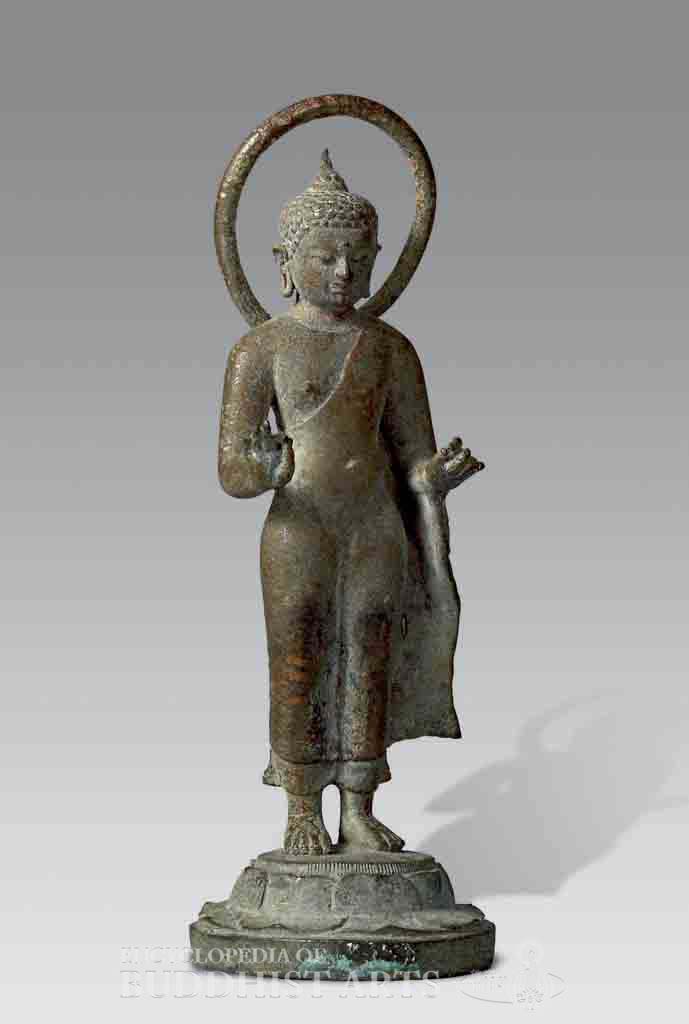
Standing Buddha
Bronze
Standing Buddha
INDONESIA
This statue was cast early during the Central Javanese period (circa 7th–13th century). The hollow ring of the nimbus was created separately and added later. Although the style of the monastic robe shows Indian Gupta influence, the shape of the head and hairline and the small flame ornament over the usnisa are Javanese traits.
The Buddha stands on a reversed lotus pedestal with both arms bent at the elbows and hands held out separately in vitarka (teaching) mudra. The thin monastic robe clings to the body, leaving right shoulder bare. However, the hem on the left side falls away from the body after folding over the left wrist.
For more details, go to the Encyclopedia of Buddhist Arts: Sculpture St-Z, page 1140.
Cite this article:
Hsingyun, et al. "Standing Buddha." Encyclopedia of Buddhist Arts: Sculpture St-Z, vol. 13, 2016, pp. 1140.
Hsingyun, Youheng, Yann Lovelock, Yuan Chou, Susan Huntington, Gary Edson, and Robert Neather. 2016. "Standing Buddha" In Encyclopedia of Buddhist Arts: Sculpture St-Z, 13:1140.
Hsingyun, Youheng, Lovelock, Y., Chou, Y., Huntington, S., Edson, G., & Neather, R.. (2016). Standing Buddha. In Encyclopedia of Buddhist Arts: Sculpture St-Z (Vol. 13, pp. 1140).
@misc{Hsingyun2016,
author = Hsingyun and Youheng and Lovelock, Yann and Chou, Yuan and Huntington, Susan and Edson, Gary and Neather, Robert,
booktitle = {Encyclopedia of Buddhist Arts: Sculpture St-Z},
pages = 1140,
title = {{Standing Buddha}},
volume = 13,
year = {2016}}
author = Hsingyun and Youheng and Lovelock, Yann and Chou, Yuan and Huntington, Susan and Edson, Gary and Neather, Robert,
booktitle = {Encyclopedia of Buddhist Arts: Sculpture St-Z},
pages = 1140,
title = {{Standing Buddha}},
volume = 13,
year = {2016}}