
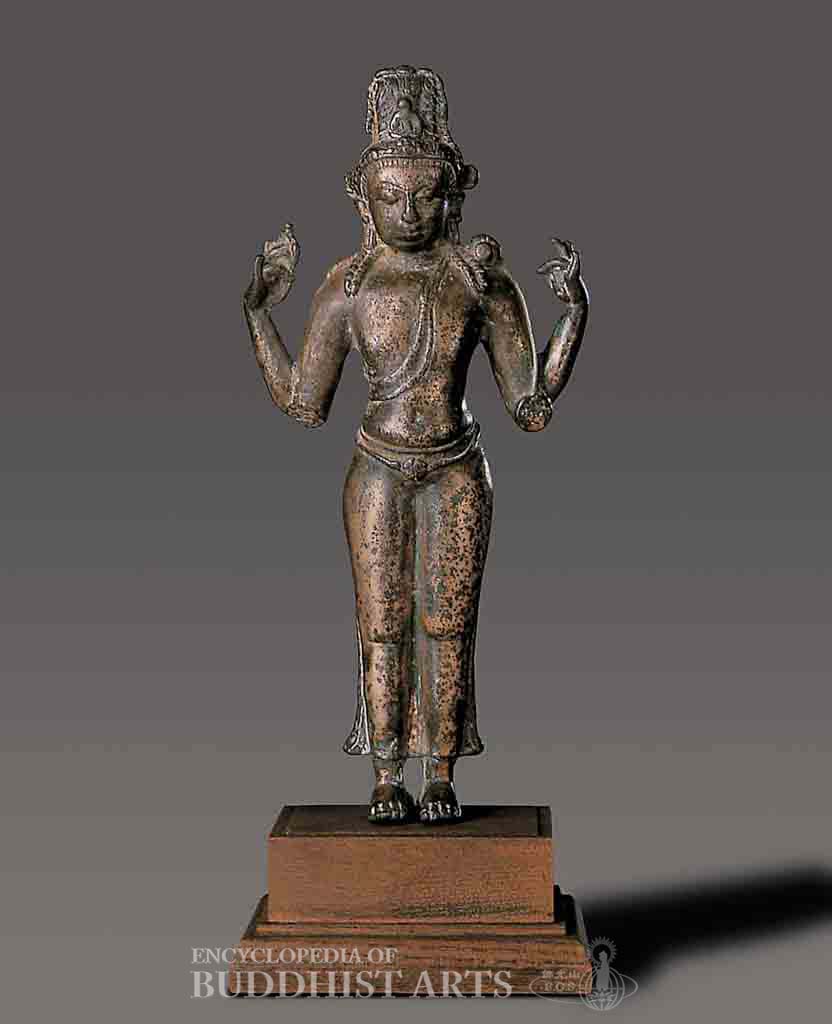
Sumatra: Four-Armed Avalokitesvara
Gilt copper alloy
Sumatra: Four-Armed Avalokitesvara
INDONESIA, Sumatra
The seated Buddha on the figure’s headdress identifies the statue as Avalokitesvara. Thick plaits hang down to the shoulders. The figure once had four arms but the two originally at the front have broken at the elbow. The remaining left hand once held prayer beads, while the right hand holds a conch. A lotus stem and its bud creep along the arm of the missing hand on the right. The only ornament decorating the body is a sacred thread and a simple jeweled belt that secures the translucent skirt through which the shape of the knees can be seen. Though it is possible the statue was influenced by the art of the Pala period (circa 8th–12th century), the broad forehead and wide mouth are Central Javanese traits.
For more details, go to the Encyclopedia of Buddhist Arts: Sculpture St-Z, page 1176.
Cite this article:
author = Hsingyun and Youheng and Lovelock, Yann and Chou, Yuan and Huntington, Susan and Edson, Gary and Neather, Robert,
booktitle = {Encyclopedia of Buddhist Arts: Sculpture St-Z},
pages = 1176,
title = {{Sumatra: Four-Armed Avalokitesvara}},
volume = 13,
year = {2016}}