
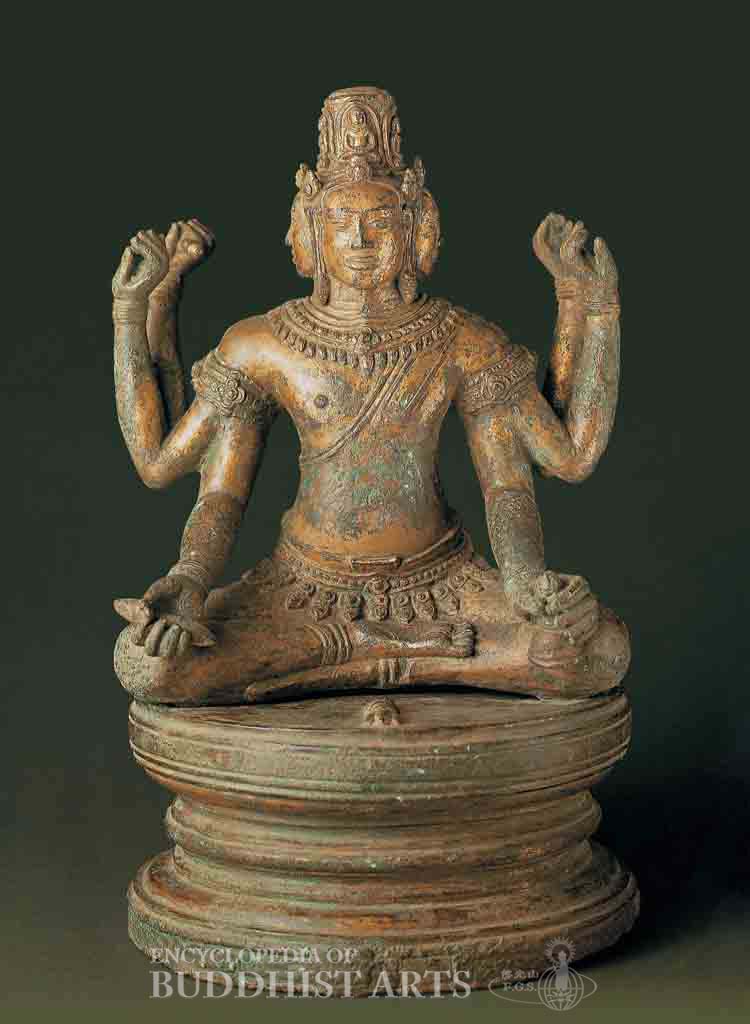
Vajrasattva
Gilt copper alloy
Vajrasattva
CAMBODIA; Angkor period
The statue was created during the 12th to 13th century of the Angkor period (circa 9th–15th century). This manifestation of Vajrasattva has three faces and six arms. The figure is seated in half lotus position on a circular throne. The face displays Khmer features, and the body is heavily ornamented with jewelry. Three seated Buddhas are on the crown, one above each face. The attributes are difficult to identify but the lower pair of hands hold the vajra and bell, while the right upper hands hold a Dharma wheel and a lotus, and the left hands hold prayer beads and a conch shell. Another vajra is in front of the feet on the throne.
For more details, go to the Encyclopedia of Buddhist Arts: Sculpture St-Z, page 1297.
Cite this article:
Hsingyun, et al. "Vajrasattva." Encyclopedia of Buddhist Arts: Sculpture St-Z, vol. 13, 2016, pp. 1297.
Hsingyun, Youheng, Yann Lovelock, Yuan Chou, Susan Huntington, Gary Edson, and Robert Neather. 2016. "Vajrasattva" In Encyclopedia of Buddhist Arts: Sculpture St-Z, 13:1297.
Hsingyun, Youheng, Lovelock, Y., Chou, Y., Huntington, S., Edson, G., & Neather, R.. (2016). Vajrasattva. In Encyclopedia of Buddhist Arts: Sculpture St-Z (Vol. 13, pp. 1297).
@misc{Hsingyun2016,
author = Hsingyun and Youheng and Lovelock, Yann and Chou, Yuan and Huntington, Susan and Edson, Gary and Neather, Robert,
booktitle = {Encyclopedia of Buddhist Arts: Sculpture St-Z},
pages = 1297,
title = {{Vajrasattva}},
volume = 13,
year = {2016}}
author = Hsingyun and Youheng and Lovelock, Yann and Chou, Yuan and Huntington, Susan and Edson, Gary and Neather, Robert,
booktitle = {Encyclopedia of Buddhist Arts: Sculpture St-Z},
pages = 1297,
title = {{Vajrasattva}},
volume = 13,
year = {2016}}