
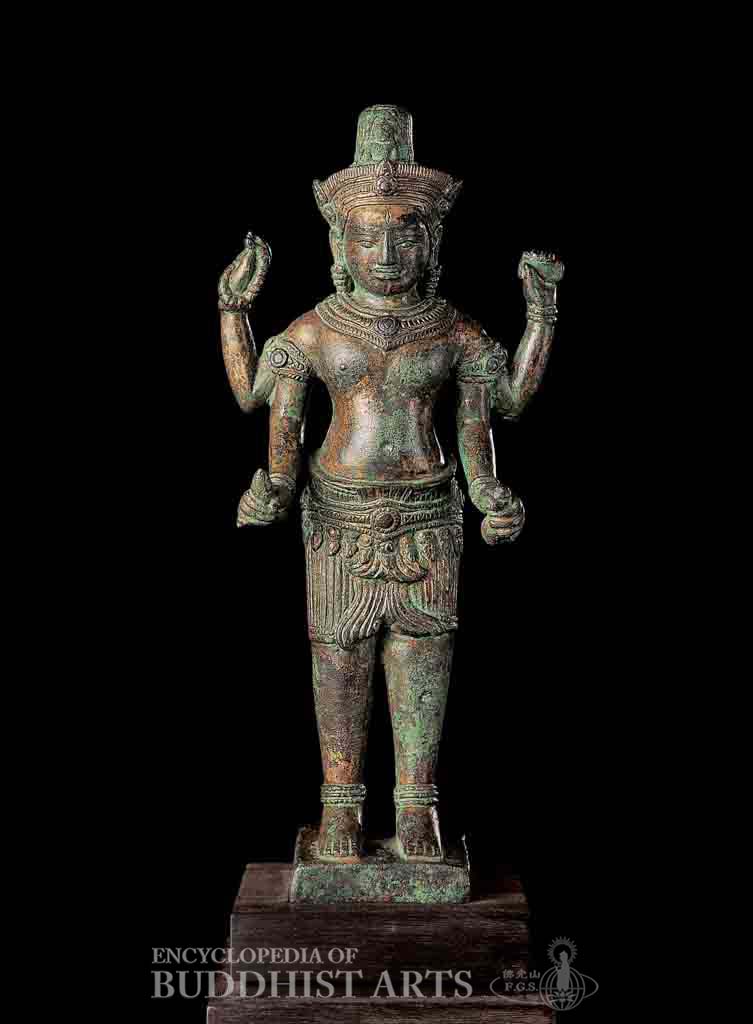
Four-Armed Avalokitesvara
Gilt copper alloy
Four-Armed Avalokitesvara
CAMBODIA
This Four-Armed Avalokitesvara, with most of its gilt gone, stands on a square pedestal. The figure wears a crown and a high topknot fronted with a seated Buddha. A third eye is located in the center of the forehead. The Bodhisattva portrays some characteristics common to the Angkor period (circa 9th–15th century), such as holding a string of prayer beads, a lotus bud, a scripture, and a vase. The Bodhisattva, with Cambodian features consisting of a wide face, thick lips, a large nose, has broad shoulders and a disproportionately short upper body with a slim waist. The arms and legs are thick and sturdy while the body is adorned with thick pieces of jewelry, all characteristic of sculptures created between the 12th and 13th centuries. The skirt has thick folds with a distinct fish-tail ornament hanging down the center. This outfit is consistent with the attire that Kampucheans wore as recorded by Zhou Daguan, a Chinese foreign trade official, during the mid-13th century of the Chinese Yuan dynasty (1271–1368).
For more details, go to the Encyclopedia of Buddhist Arts: Sculpture A-F, page 348.
Cite this article:
author = Hsingyun and Youheng and Lovelock, Yann and Chou, Yuan and Huntington, Susan and Edson, Gary and Neather, Robert,
booktitle = {Encyclopedia of Buddhist Arts: Sculpture A-F},
pages = 348,
title = {{Four-Armed Avalokitesvara}},
volume = 10,
year = {2016}}