
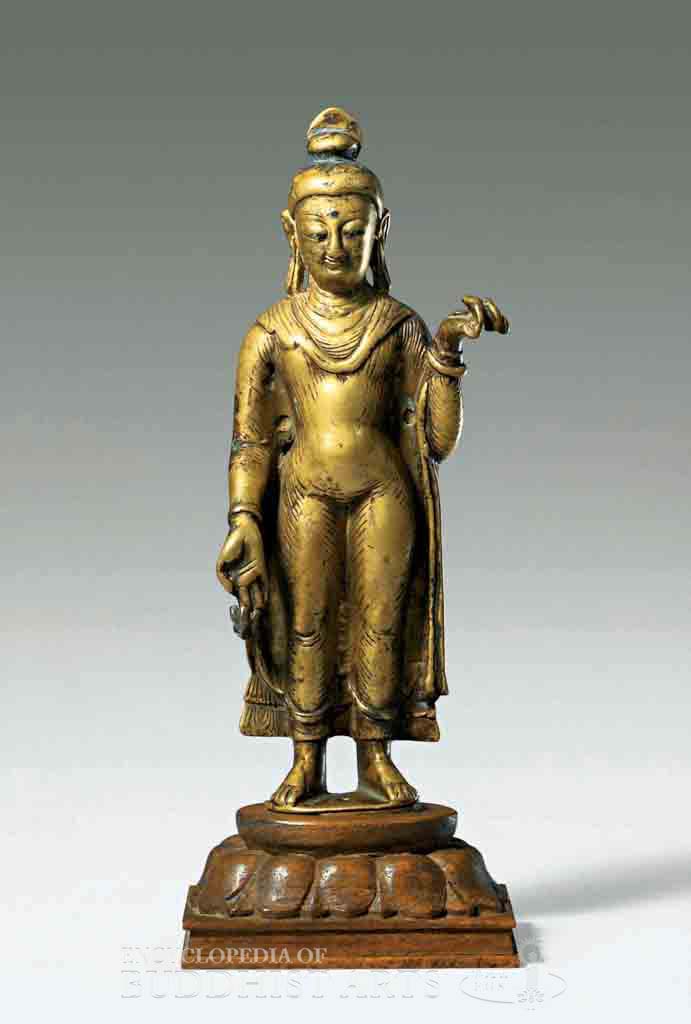
Standing Buddha
Brass
Standing Buddha
INDONESIA
The Buddha has a uniquely shaped usnisa, consisting of hair arranged into a rounded topknot from which a broad flame of knowledge arises. Other signs of the figure’s status include a mid-forehead urna, elongated earlobes that reach to the shoulders, and the three lines on the neck. The modeling of the face and other features is unsophisticated making use of simple incisions. The right hand is in varada (wish-granting) mudra. A monastic robe covers both shoulders and clings to the body, reminiscent of the Gupta style. The treatment of the robe is characteristic of Indian style, from where Buddhism was brought to Indonesia.
The back of the statue is flat and has a hole to suggest that a mandorla may have been attached. Though the statue is of brass, the eyes are inlaid with silver and the lips with copper typical of 8th and 9th century Kashmiri sculptures. A residual blue pigment remains around the eyes and urna.
For more details, go to the Encyclopedia of Buddhist Arts: Sculpture St-Z, page 1140.
Cite this article:
author = Hsingyun and Youheng and Lovelock, Yann and Chou, Yuan and Huntington, Susan and Edson, Gary and Neather, Robert,
booktitle = {Encyclopedia of Buddhist Arts: Sculpture St-Z},
pages = 1140,
title = {{Standing Buddha}},
volume = 13,
year = {2016}}