
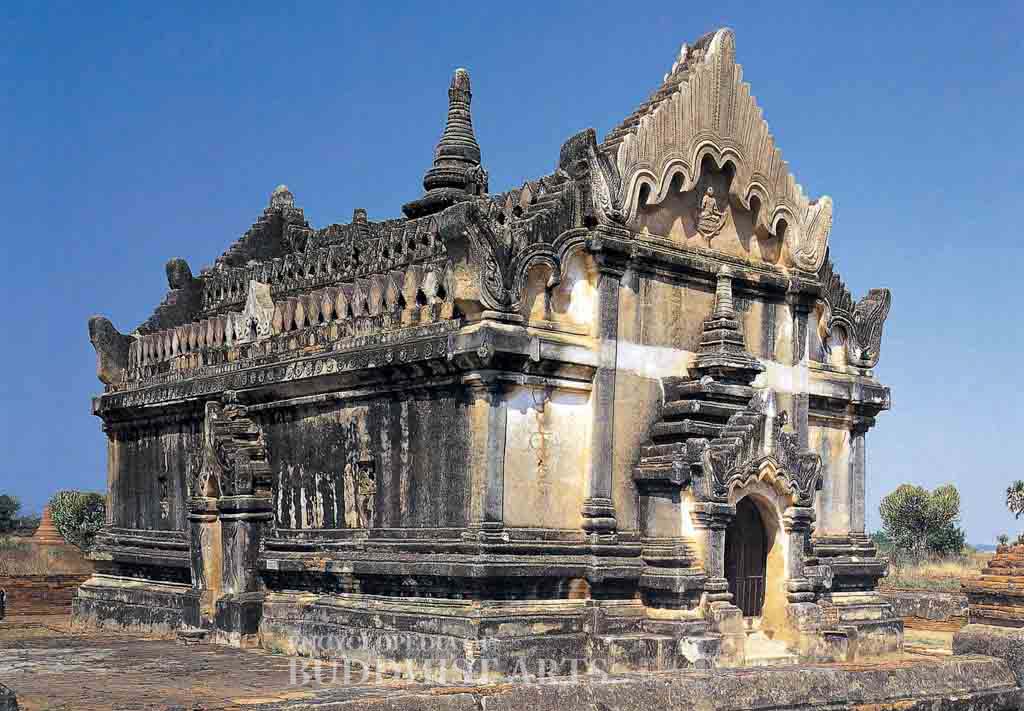
Upali Thein Hall
Upali Thein Hall
MYANMAR, Mandalay, Bagan
Upali is the name of an eminent monk who lived during the rule of King Htilominlo (reigned 1210–1234), and Thein is derived from the Pali word for Ordination Hall. The Upali Thein was built in the 13th century during the Bagan Empire (circa 849–1287), and underwent restoration at the end of the 18th century during the Konbaung dynasty (1752–1885). It is one of the few well-preserved ordination halls from the Bagan period.
The east-facing ordination hall is a brick structure with a gable roof. In the 18th century low embattled parapets were added to the roof. The main shrine lies in the center with a corridor on either side. A statue of the Buddha seated on a Sumeru throne is enshrined at the west end of the main shrine. There are murals from the late 17th and early 18th centuries with large continuous narratives of the renunciation and enlightenment of the Buddhas, as well as the consecration of an ordination hall by King Anawrahta (reigned 1044–1077).
With the rise of Buddhism, many ordination halls were built during the Bagan dynasty. They not only served as halls for the ordination of monastics, but were also regularly used to carry out rituals, such as confession, repentance, and the recitation of the precepts.
For more details, go to the Encyclopedia of Buddhist Arts: Architecture T-Z, page 1163.
Cite this article:
author = Hsingyun and Youheng and Johnson, Peter and Mankuang and Lancaster, Lewis,
booktitle = {Encyclopedia of Buddhist Arts: Architecture T-Z},
pages = 1163,
title = {{Upali Thein Hall}},
volume = 4,
year = {2016}}