
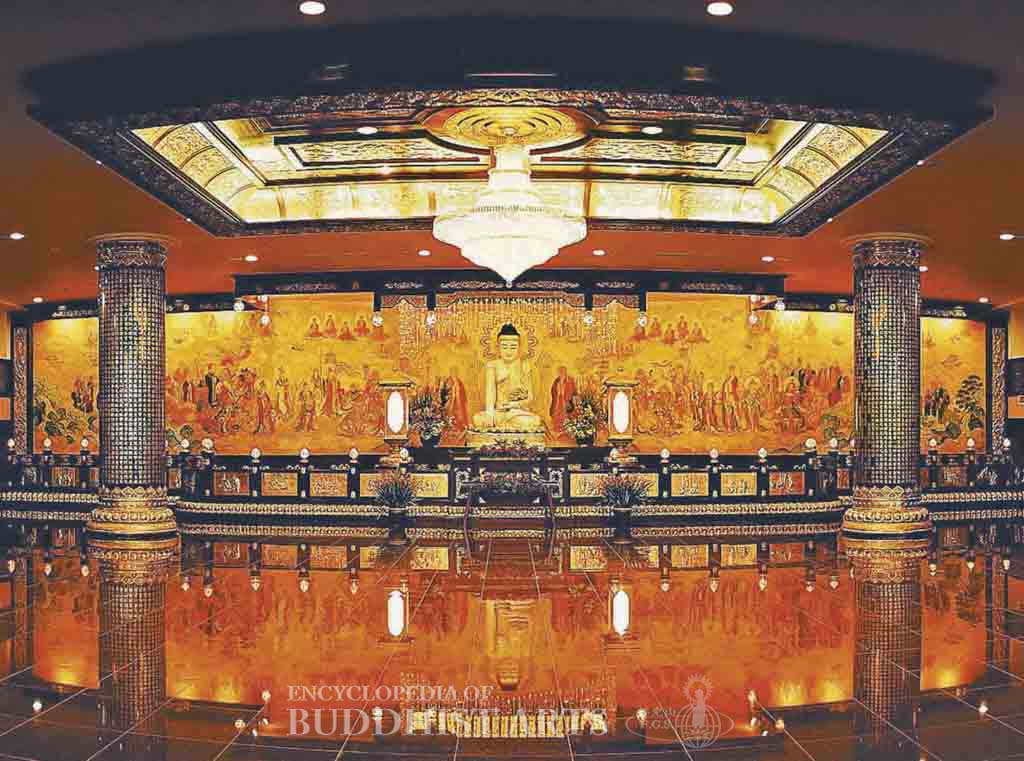
Fo Guang Shan Lan Yang Temple: Great Hero Hall (interior)
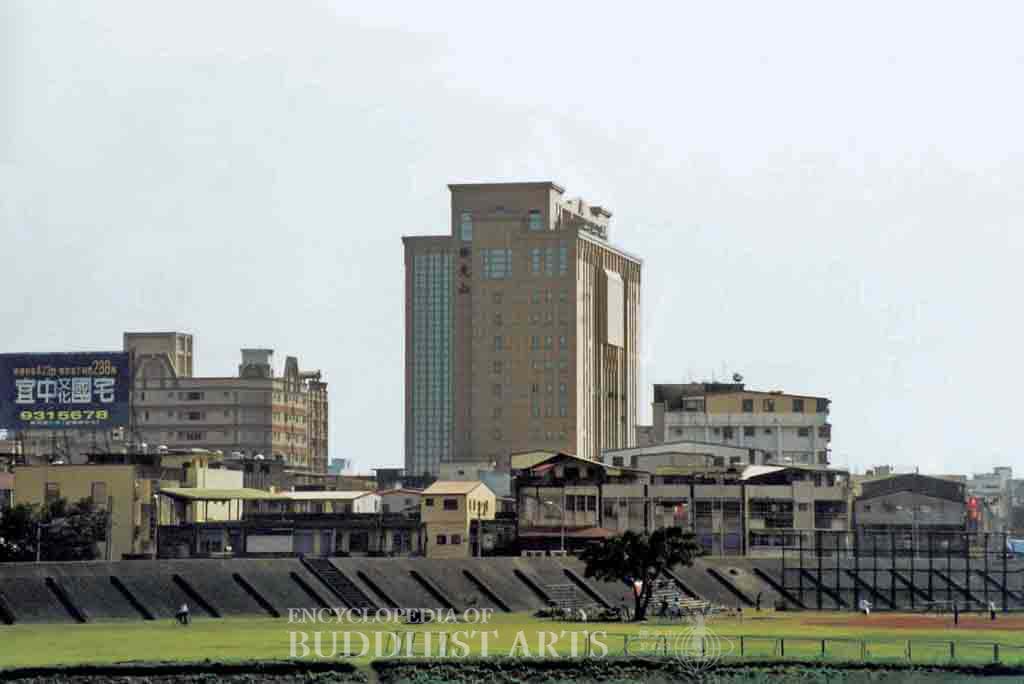
Fo Guang Shan Lan Yang Temple
Fo Guang Shan Lan Yang Temple
TAIWAN, Yilan
The temple was originally established during the rule of Emperor Daoguang (reigned 1821–1850) of the Qing dynasty as Cai Hall, and was later renamed Leiyin (Sound of Thunder) Temple. In 1952, devotees invited Master Hsing Yun to preside over the temple. Services were organized and local people were able to study the Dharma. The number of devotees grew and a lecture hall was built in 1956. The temple was damaged by a typhoon in 1963. It was reconstructed to a height of four stories and became a landmark in Yilan. The temple was rebuilt in 1996 and was given its present name.
The main building consists of 14 stories and three basement levels. It contains the Great Hero Hall, Fo Guang Yuan Art Gallery, Waterdrop Tea House, Lan Yang Cultural Center, Fo Guang University Downtown Campus, community college classrooms, chanting hall, meditation hall, and an auditorium.
A statue of Sakyamuni Buddha is enshrined within the Great Hero Hall. Behind the statue there is an illustration of the Avatamsaka World painted by the artist Mi Xiong. There are four columns within the Great Hero Hall, each engraved with a different sutra: the Amitabha Sutra, the Diamond Sutra, the Medicine Buddha Sutra, and the “Universal Gateway Chapter” of the Lotus Sutra. The Ksitigarbha Sutra is engraved on the two side walls. An interesting feature of the temple is the Amitabha lamp, which is a replica of a Tang dynasty (618–907) artifact found in the underground palace of Famen Temple in Shaanxi.
For more details, go to the Encyclopedia of Buddhist Arts: Architecture A-F, page 320.
Cite this article:
author = Hsingyun and Youheng and Johnson, Peter and Mankuang and Lancaster, Lewis,
booktitle = {Encyclopedia of Buddhist Arts: Architecture A-F},
pages = 320,
title = {{Fo Guang Shan Lan Yang Temple}},
volume = 1,
year = {2016}}