
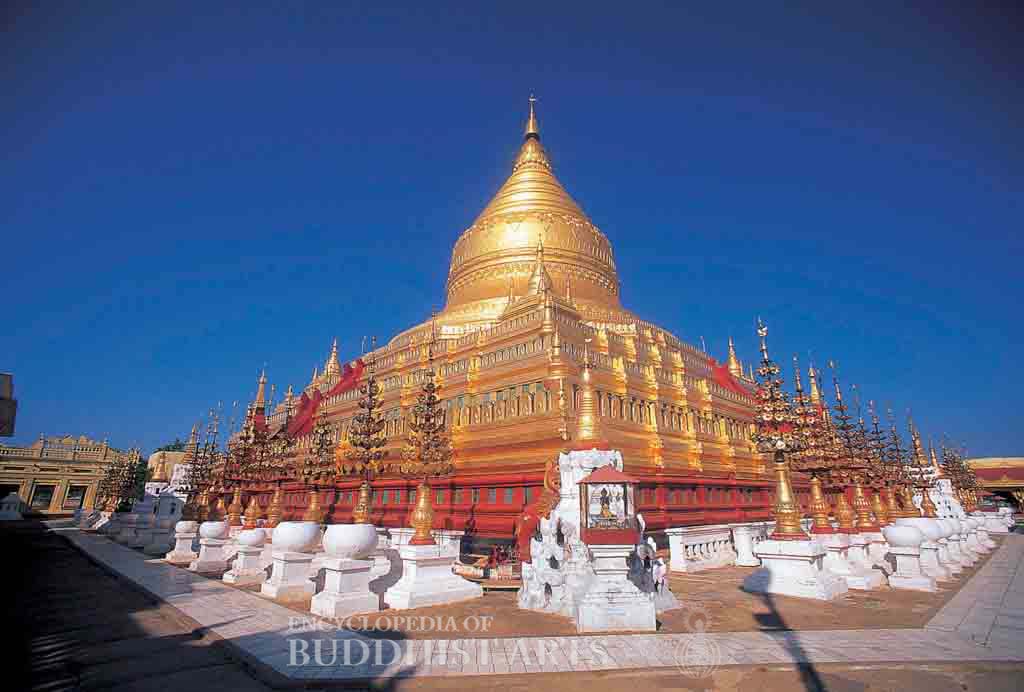
Shwezigon Pagoda
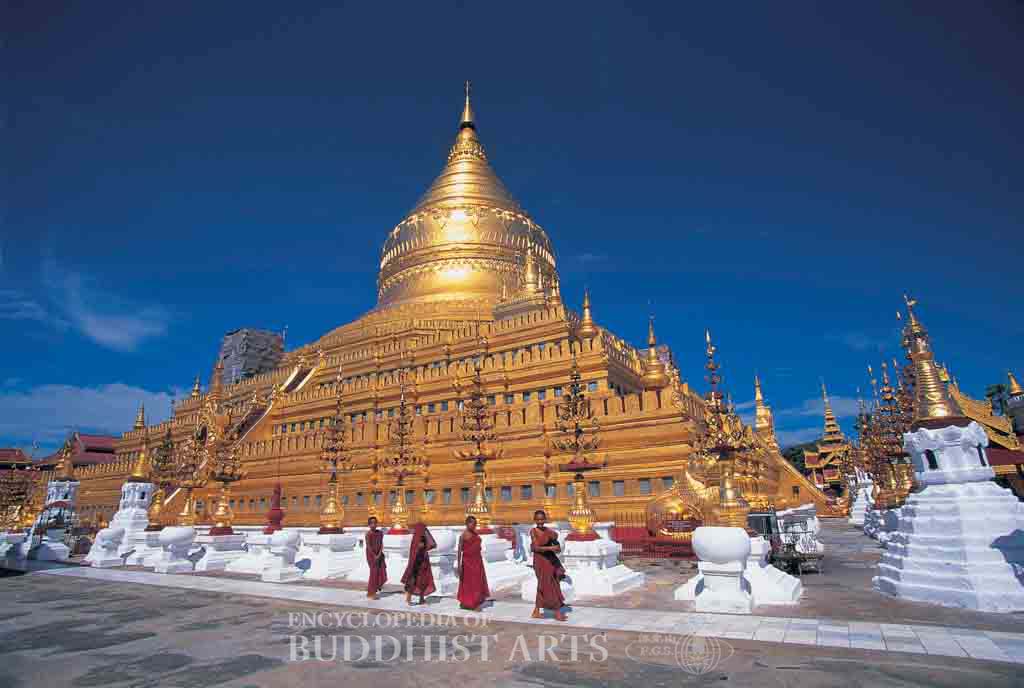
Shwezigon Pagoda
Shwezigon Pagoda
MYANMAR, Mandalay, Bagan
Shwezigon means Land of Victory. The pagoda is located on the east side of the Ayeyarwady River. It is one of the most important pagodas in Myanmar and was built to enshrine a duplicate of the Buddha’s tooth relic. It is also said to house a bone relic of the Buddha. King Anawrahta (reigned 1044–1077) of Bagan started the construction of the pagoda. However, only the base was completed when the king died, leaving completion of the pagoda to King Kyansittha (reigned circa 1084–1113).
The pagoda is built of stone bricks and the entire surface is covered in gold leaf. It is enclosed by a boundary wall which measures approximately 230 m on each side. There is a pair of white lion statues guarding the entrance. The base of the pagoda is square and consists of three Sumeru terraces. At each cardinal point there is a flight of steps and a shrine, which houses a 4 m high bronze standing Buddha. The pagoda base is elaborately decorated. The walls of the terraces are lined with 547 glazed panels depicting scenes from the Jataka tales. On the two lower terraces there is a small pagoda at each corner, while on the upper terrace there is a replica of the main pagoda on every corner. Above the base, there is an octagonal platform, surmounted by the bell-shaped pagoda body which is adorned with delicate reliefs. The body culminates in a band of upright and inverted lotuses, followed by a spire in the form of an amalaka fruit, a canopy, and a finial. This pagoda had a significant influence on the architectural style of subsequent pagodas in Bagan.
For more details, go to the Encyclopedia of Buddhist Arts: Architecture M-S, page 1016.
Cite this article:
author = Hsingyun and Youheng and Johnson, Peter and Mankuang and Lancaster, Lewis,
booktitle = {Encyclopedia of Buddhist Arts: Architecture M-S},
pages = 1016,
title = {{Shwezigon Pagoda}},
volume = 3,
year = {2016}}