
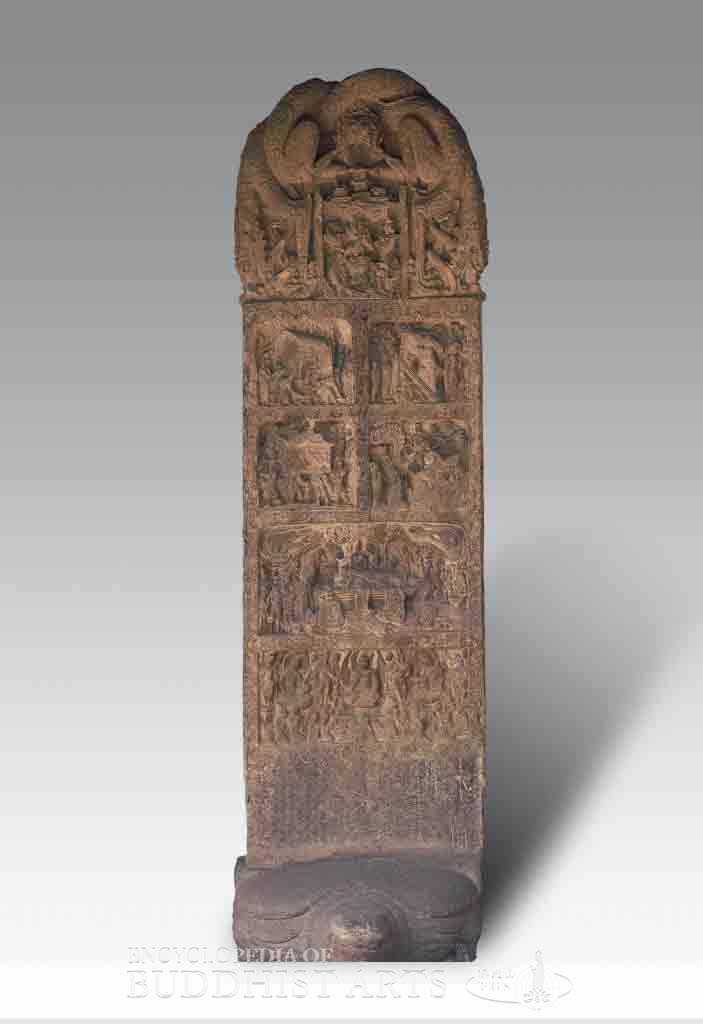
Dayun Temple: Stele on Nirvana
Stone
Dayun Temple: Stele on Nirvana
CHINA, Shanxi, Yuncheng; Wu Zhou period
The temple where this stele was found has an interesting history. In 690, supporters of Empress Wu Zetian (reigned 684–705) began to circulate the Mahamegha Sutra, which is called Dayun Jing in Chinese. They claimed, based on a prophecy in this sutra, that Empress Wu was the incarnation of Maitreya Buddha and thus should rule in her own right. She ordered the wide distribution of the sutra and the construction of temples called Dayun across the country after taking control of the government. An inscription states that this stele from Dayun Temple was constructed for the well being of Empress Wu.
Dragons are located at the top of the stele, while a turtle acts as its base. The top part also includes depictions of stupas and Mount Sumeru. The rest of the stele is divided into six sections that depict scenes from the Buddha’s parinirvana. These images include the last teaching; passing away; laying the Buddha’s body into a casket; the funeral procession; cremation; and the distribution of relics among the eight kings. The sides of the structure are decorated with lotus-borne children, Heavenly Kings, and Dharma-protecting lions.
For more details, go to the Encyclopedia of Buddhist Arts: Sculpture A-F, page 286.
Cite this article:
author = Hsingyun and Youheng and Lovelock, Yann and Chou, Yuan and Huntington, Susan and Edson, Gary and Neather, Robert,
booktitle = {Encyclopedia of Buddhist Arts: Sculpture A-F},
pages = 286,
title = {{Dayun Temple: Stele on Nirvana}},
volume = 10,
year = {2016}}