
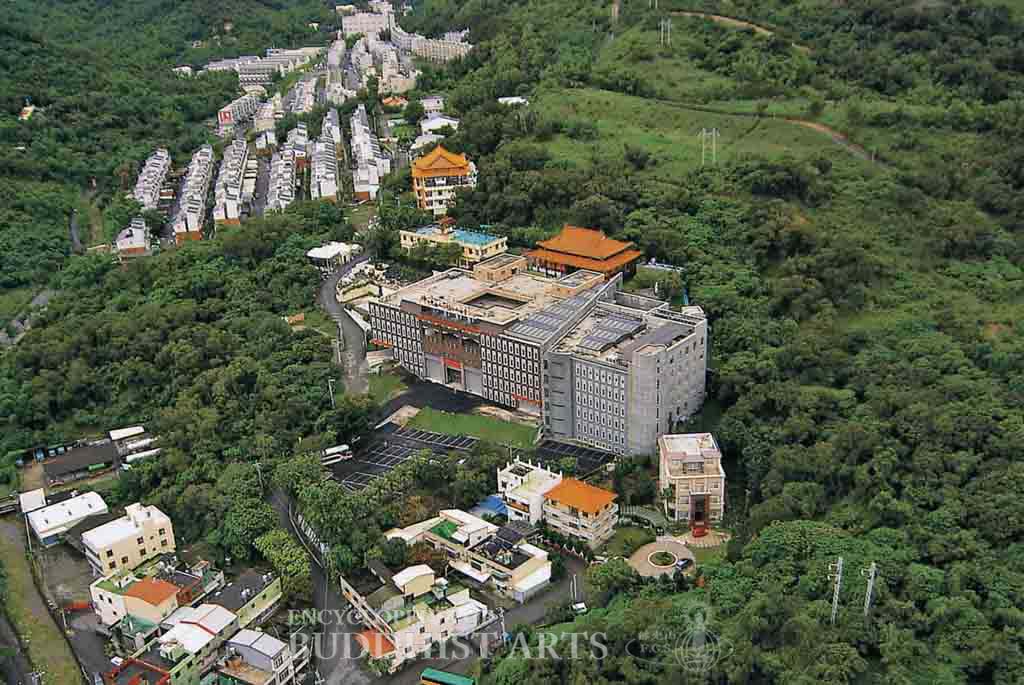
Fo Guang Shan Fu Shan Temple (aerial view)
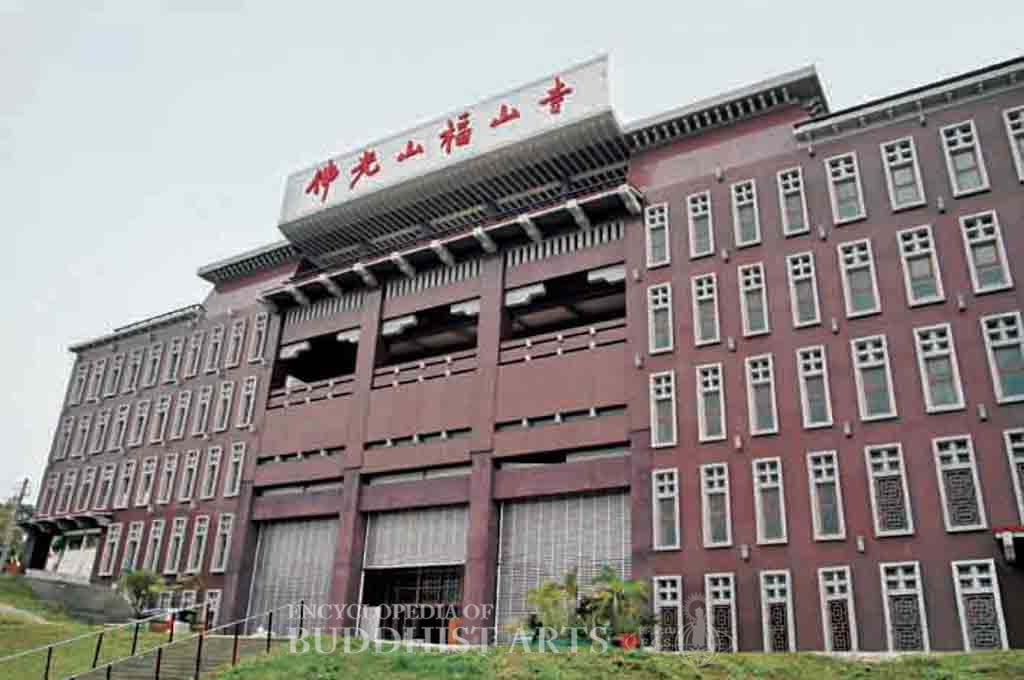
Fo Guang Shan Fu Shan Temple
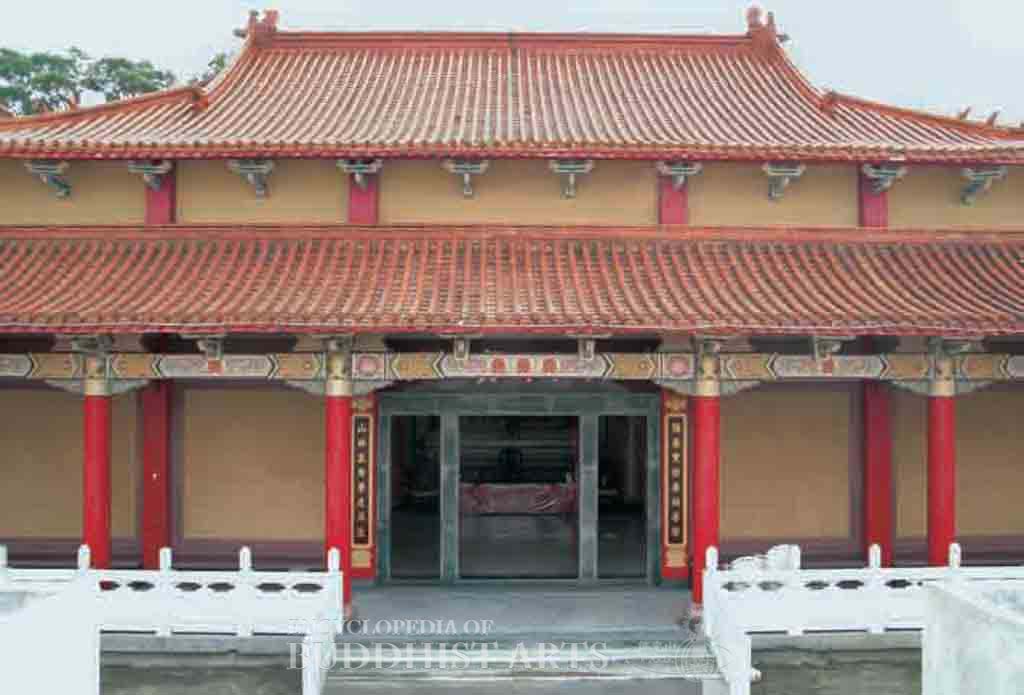
Fo Guang Shan Fu Shan Temple: Great Hero Hall
Fo Guang Shan Fu Shan Temple
TAIWAN, Changhua
Fu Shan means Mountain of Blessings. The temple is situated on a hill in the village of Fushan. It is the first branch temple established by Fo Guang Shan. It was built in 1975 for the purpose of propagating the Dharma using culture and education, as intended by Master Hsing Yun, founder of Fo Guang Shan. In 1981, the Fo Guang Buddhist Canon Committee moved in and started the compilation of the Fo Guang Buddhist Canons and Fo Guang Buddhist Dictionary. The Fu Shan Buddhist College was formed in 1983. Subsidence and earth fissures raised safety concerns and part of the temple was demolished in 1997, while at the same time a new multipurpose building was constructed.
The temple was built according to the contours of the land. It consists of the main temple gate, the Great Hero Hall, and the Buddhism Building. The five-by-three bay Great Hero Hall has a double-eave hip-and-gable roof. The hall houses the Amitabha Buddha Triad and its walls are filled with miniature Buddha niches. The multi-purpose Buddhism Building is located in front of the Great Hero Hall. It is seven stories high and has two levels below ground. The building contains an auditorium, the Fo Guang Yuan Art Gallery, a library, classrooms, meeting rooms, a meditation hall, and offices. The stairway that runs from the first to the fifth story consists of 99 steps and is a special architectural feature. The auditorium on the first story has a high ceiling and houses a statue of Vairocana Buddha. The temple has functioned as a center of culture, education, art, and Dharma propagation over many years.
For more details, go to the Encyclopedia of Buddhist Arts: Architecture A-F, page 312.
Cite this article:
author = Hsingyun and Youheng and Johnson, Peter and Mankuang and Lancaster, Lewis,
booktitle = {Encyclopedia of Buddhist Arts: Architecture A-F},
pages = 312,
title = {{Fo Guang Shan Fu Shan Temple}},
volume = 1,
year = {2016}}