
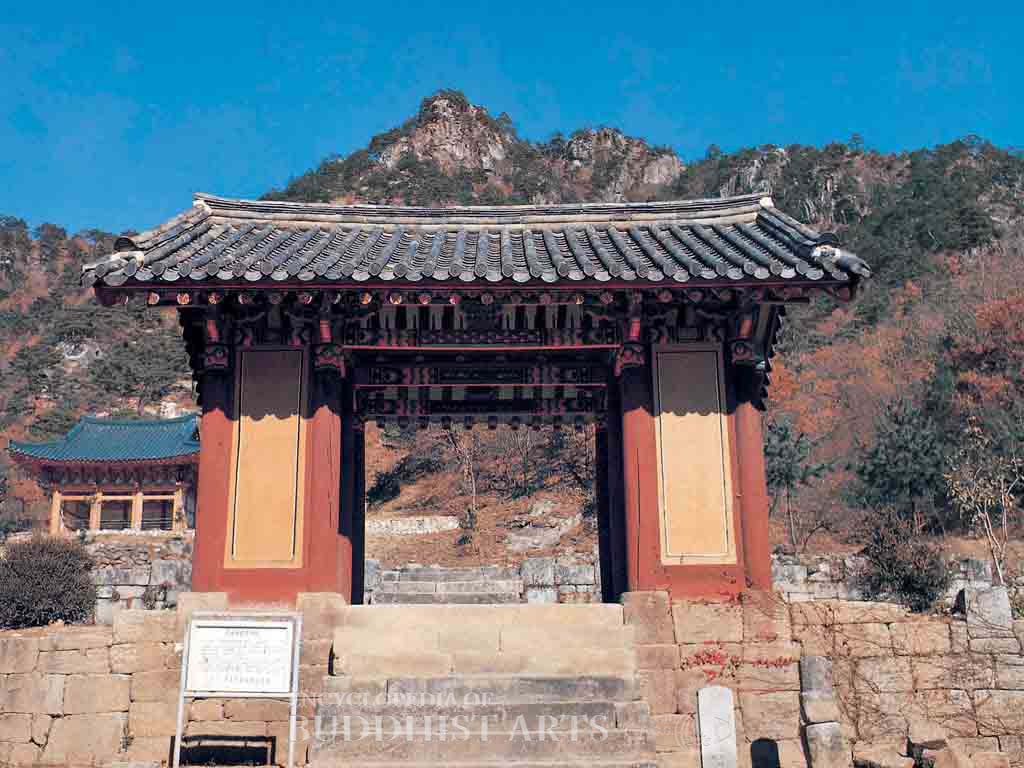
Cheongpyeongsa Temple Revolving Gate
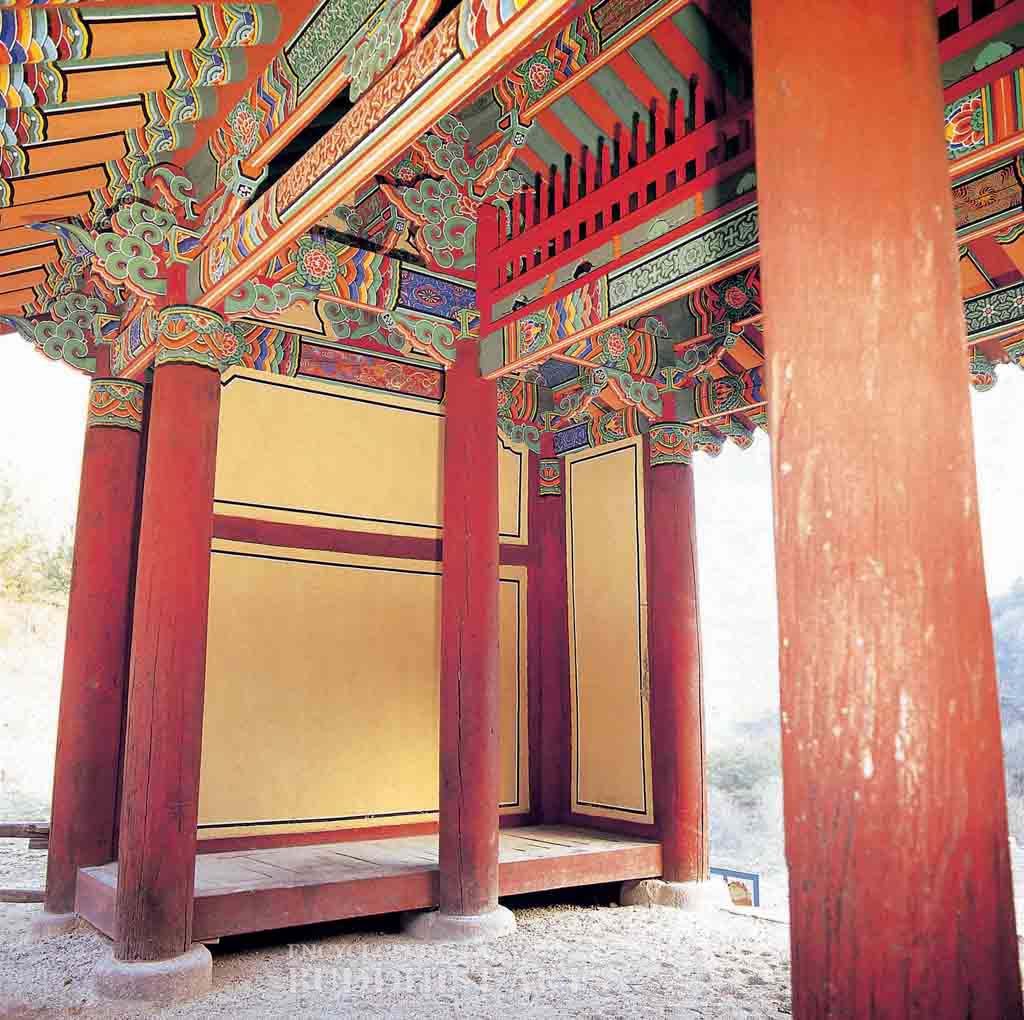
Cheongpyeongsa Temple Revolving Gate
Cheongpyeongsa Temple Revolving Gate
SOUTH KOREA, Gangwon, Chuncheon
The Revolving Gate symbolizes the cycle of birth and death. It is located in Cheongpyeongsa Temple, which was established by Seon Master Seunghyeon in 973 of the Goryeo dynasty. It was occupied and then abandoned a number of times throughout its history. The gate was rebuilt by Seon Master Bou in 1557 during the Joseon dynasty. Many halls within the temple were burned down during the Korean War (1950–1953), with only this gate and the Ultimate Bliss Hall remaining. This gate was listed as Treasure No. 164 in 1963.
The gate has a single-eave overhanging gable roof and stands upon a stone platform. The three-by-one bay structure has a wide central bay; the side bays are covered with wooden boards. The roof is supported by bracket sets with wing-like arms, which is a bracket system unique to Korean architecture. The purlins, tie beams, and rafters are all painted in bright colors. The side bays of the gate once held statues of the Four Heavenly Kings.
For more details, go to the Encyclopedia of Buddhist Arts: Architecture A-F, page 143.
Cite this article:
author = Hsingyun and Youheng and Johnson, Peter and Mankuang and Lancaster, Lewis,
booktitle = {Encyclopedia of Buddhist Arts: Architecture A-F},
pages = 143,
title = {{Cheongpyeongsa Temple Revolving Gate}},
volume = 1,
year = {2016}}