
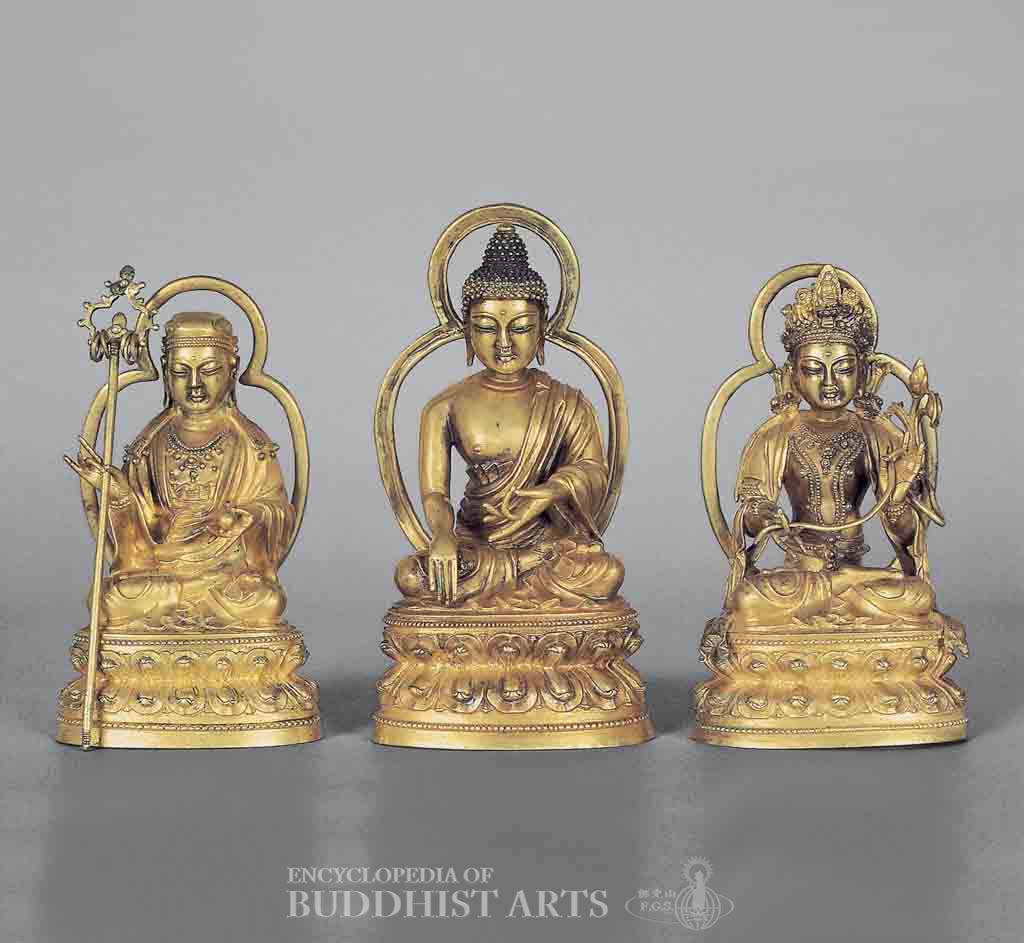
Kumgangsan: Buddha Triad
Gilt copper alloy
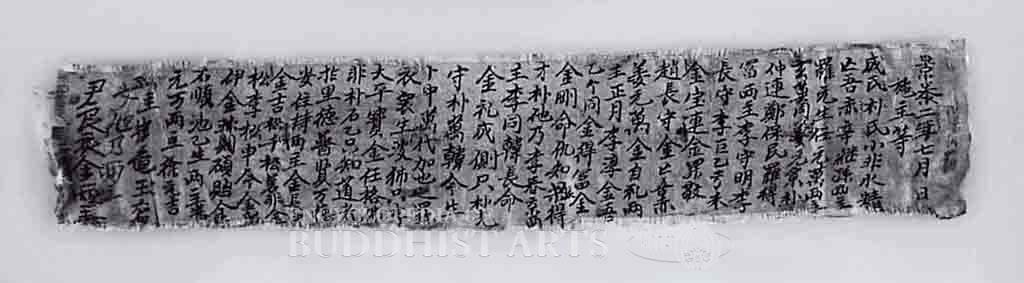
Kumgangsan: Buddha Triad - Inscription
Kumgangsan: Buddha Triad
NORTH KOREA, Kangwon, Kumgang; Joseon dynasty
Discovered on Kumgangsan, the triad was made in 1451 according to an inscription found inside the Buddha figure. All three figures are seated in full lotus position on double lotus thrones and are outlined by a composite openwork aureole and nimbus. The Buddha at the center is dressed in a monastic robe that leaves the right shoulder bare. His right hand is in bhumisparsa (earth-touching) mudra and the left hand in lotus mudra. Avalokitesvara, located on the right, wears an ornate crown with a Buddha image at the apex. The figure’s hands are in lotus mudra and holds the long stem of a lotus. Ksitigarbha, located on the left, has his right hand in karana (warding off evil) mudra and holds a monk’s staff while the left hand holds a jewel.
For more details, go to the Encyclopedia of Buddhist Arts: Sculpture G-M, page 569.
Cite this article:
author = Hsingyun and Youheng and Lovelock, Yann and Chou, Yuan and Huntington, Susan and Edson, Gary and Neather, Robert,
booktitle = {Encyclopedia of Buddhist Arts: Sculpture G-M},
pages = 569,
title = {{Kumgangsan: Buddha Triad}},
volume = 11,
year = {2016}}