
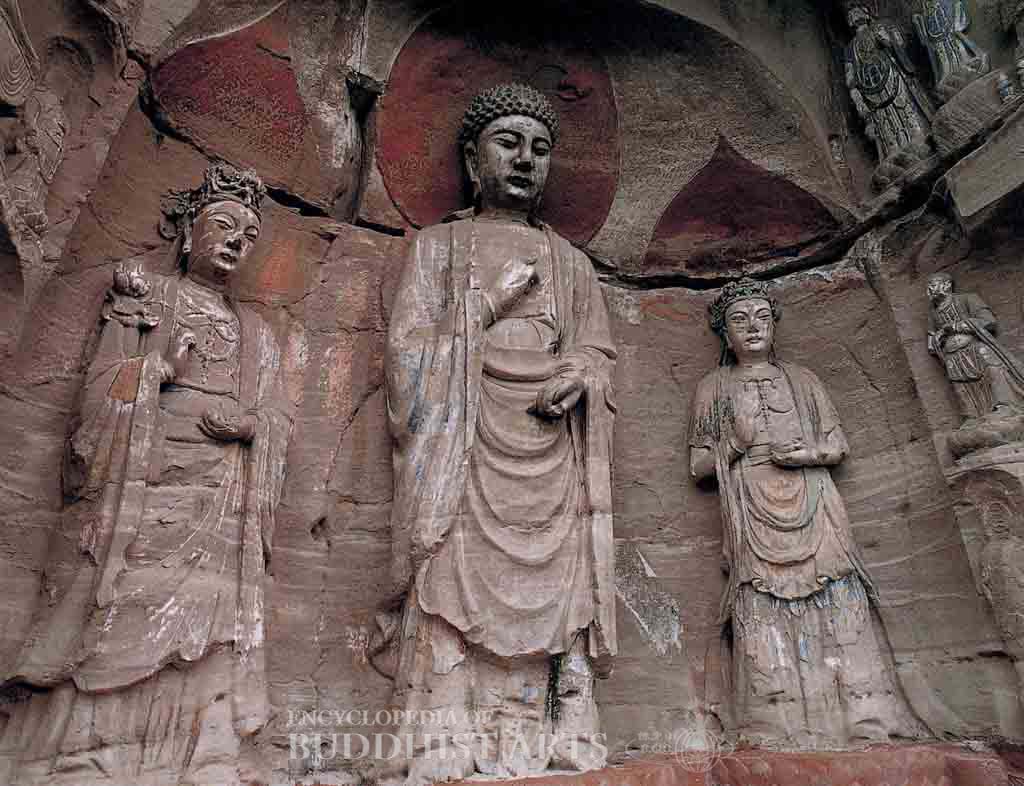
Anyue Qianfo Temple Rock Carvings: Cave 24 - Amitabha Buddha Triad
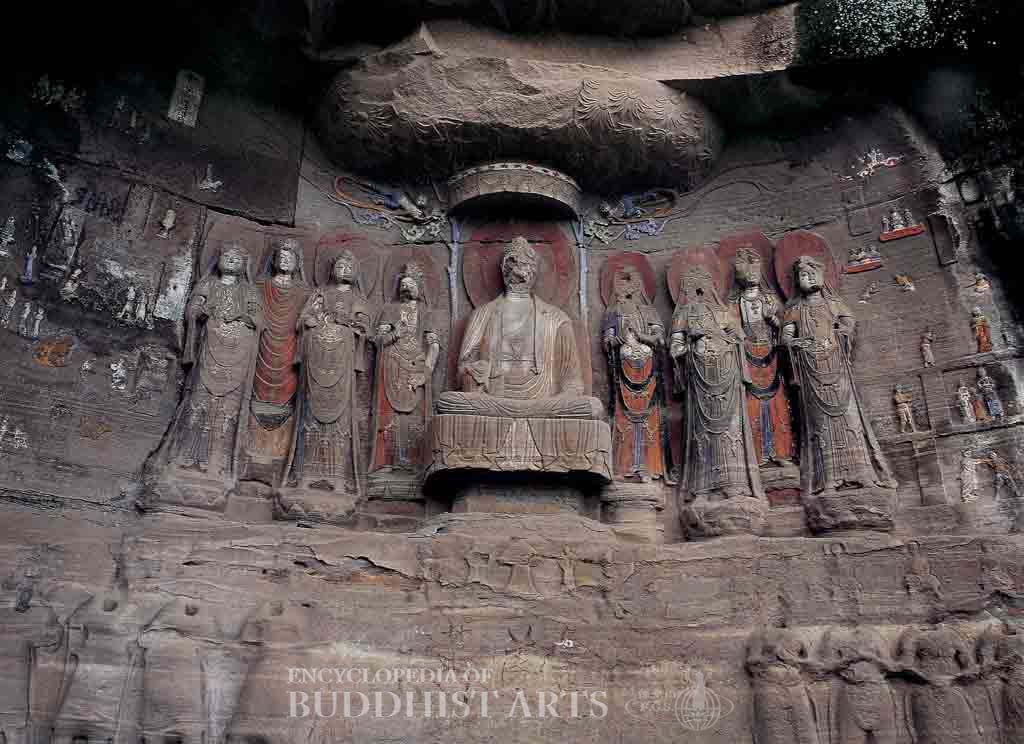
Anyue Qianfo Temple Rock Carvings: Niche 96 - Illustration of the Medicine Buddha Sutra
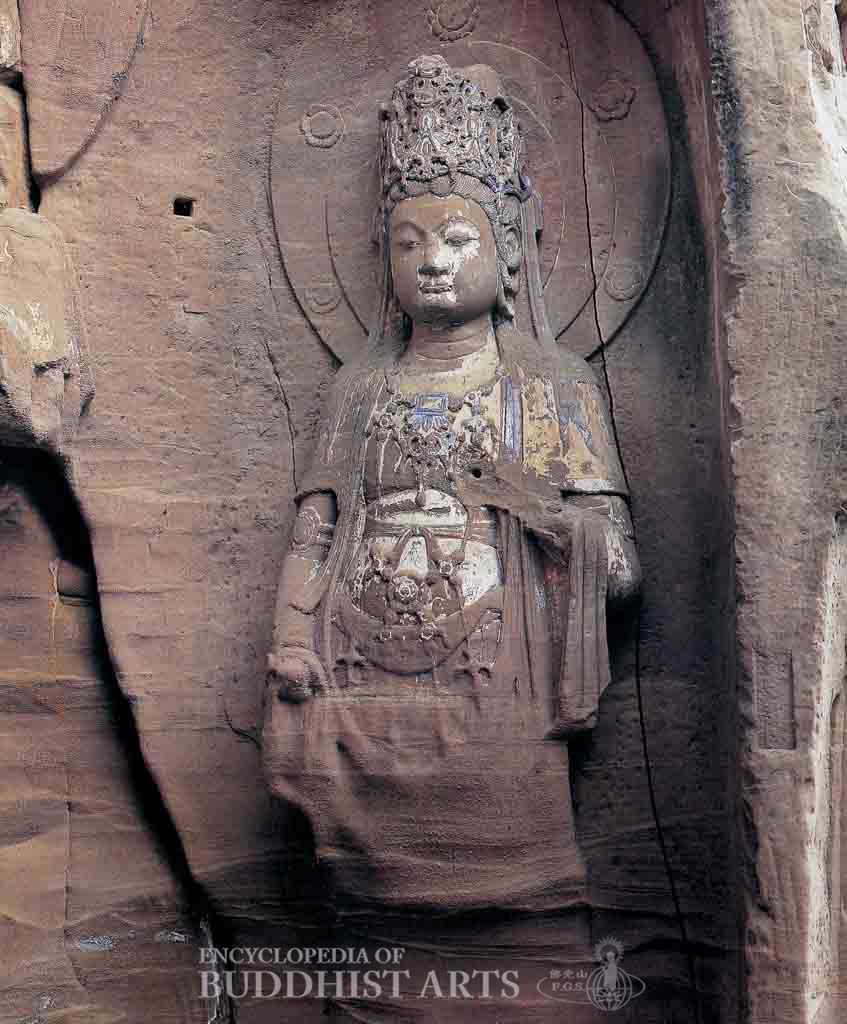
Anyue Qianfo Temple Rock Carvings: Niche 56 - Bodhisattva (right side)
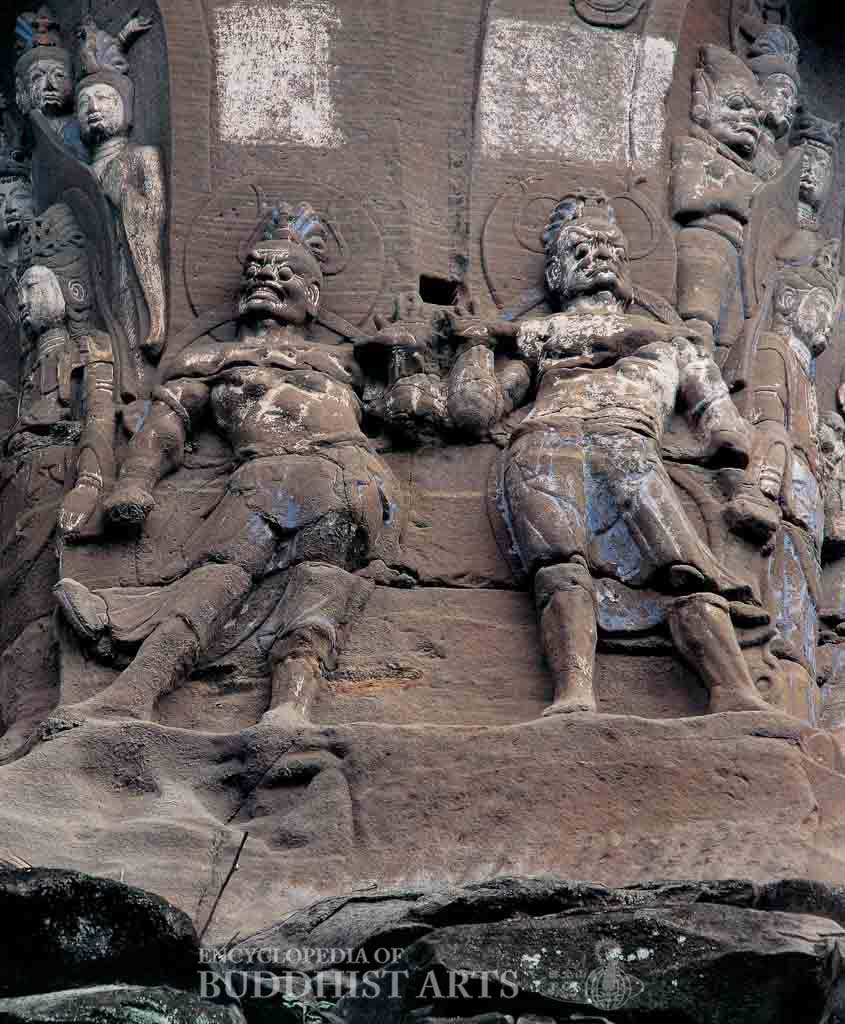
Anyue Qianfo Temple Rock Carvings: Niches 50 and 51 - Warriors
Anyue Qianfo Temple Rock Carvings
CHINA, Sichuan, Ziyang
The Anyue Qianfo (Thousand Buddhas) Temple Rock Carvings are located on the northern and southern slopes of Dayunshan (Great Cloud Mountain), northwest of Anyue county. They were created during the Tang dynasty (618–907) and currently comprise of 105 caves and niches, 3,061 sculptures, 3 Tang dynasty tablets, and 26 inscriptions, the earliest of which is dated to 732. The carvings were listed as a National Cultural Heritage Site in 2006.
The majority of the niches were constructed between the Tang and Northern Song (960–1127) dynasties. Caves 24 and 56, as well as Niches 50 and 51, date from the Tang dynasty. Some of the identifiable figures featured in the niches include Sakyamuni Buddha, Maitreya Buddha, Medicine Buddha, the Amitabha Buddha Triad, Thousand-Armed Avalokitesvara Bodhisattva, and Wisdom Kings. Unfortunately, although some were restored by later generations, the majority of the carvings have suffered severe weathering and some of the niches have collapsed entirely.
Cave 24, first constructed during the High Tang period (712–756), is a square cave with a domed ceiling. It measures 5.3 m in width, 6.6 m in height, and 3.2 m in depth. The cave features the Amitabha Buddha Triad of the Western Pure Land, which consists of Amitabha Buddha flanked by Avalokitesvara and Mahasthamaprapta Bodhisattvas. The triad was restored during the Northern Song dynasty; there is an inscription from this time on one of the walls.
Niche 50 features Maitreya Buddha, two Bodhisattvas, and two disciples. On the walls are carvings of the Eight Classes of Dharma Protectors. The entrance is flanked by warrior sculptures while the main figure, Maitreya Buddha, sits with legs pendent upon a rectangular throne. The majority of the carvings in Niche 51 are similar to those in Niche 50, with the exception that the main figure is Sakyamuni Buddha. Cave 56 contains a Buddha and four Bodhisattvas, all standing over 3 m in height. The features, garments, and ornaments of these figures are characteristic of Tang dynasty carvings.
The niche which best represents the Song style of carving is Niche 96, which illustrates the Medicine Buddha Sutra. A tall, central altar supports a carving of the Medicine Buddha seated cross-legged, with a canopy and two apsaras over the Buddha’s head. Twin Bodhi trees are carved in relief on each side of the Buddha. The niche walls are sculpted with the Eight Great Bodhisattvas mentioned in the sutra, as well as scenes of the nine kinds of untimely deaths and the Twelve Great Vows.
For more details, go to the Encyclopedia of Buddhist Arts: Caves A-E, page 72.
Cite this article:
author = Hsingyun and Youheng and Johnson, Peter and Mankuang and Huntington, Susan and Edson, Gary and Neather, Robert,
booktitle = {Encyclopedia of Buddhist Arts: Caves A-E},
pages = 72,
title = {{Anyue Qianfo Temple Rock Carvings}},
volume = 5,
year = {2016}}