
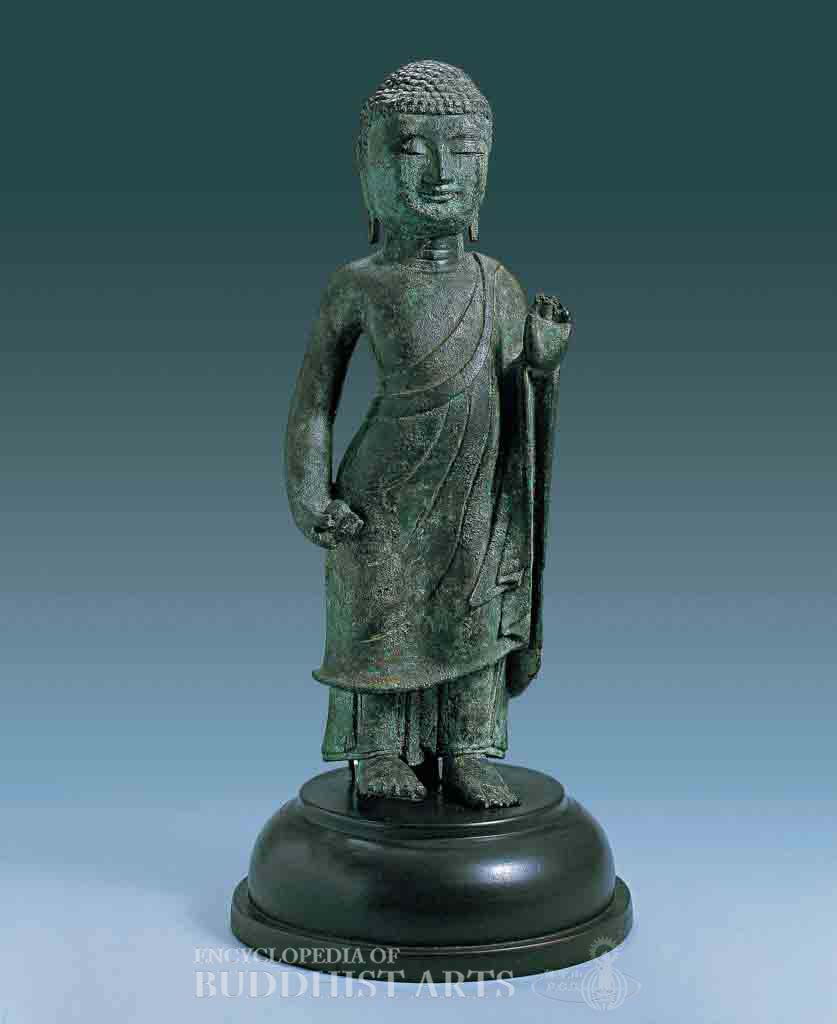
Baengnyulsa Temple: Standing Buddha
Gilt bronze
Baengnyulsa Temple: Standing Buddha
SOUTH KOREA, North Gyeongsang, Gyeongju; Silla dynasty
This statue was originally in Baengnyulsa Temple and is one of 20 similar statues found in the Gyeongju area, that have all been dated to the Silla dynasty (57 BCE–935 CE).
With the waist displaced to the right, the figure’s pose derives from the tribhanga posture of Indian sculpture. The Buddha wears a monastic robe that leaves the right shoulder bare and exposes the skirt beneath. The damaged left hand is raised in abhaya (fearlessness) mudra, while the right hand appears to carry a jewel. Almost closed, the eyes are serene and the three lines on the neck is one of the Thirty-Two Marks of Excellence.
For more details, go to the Encyclopedia of Buddhist Arts: Sculpture A-F, page 107.
Cite this article:
Hsingyun, et al. "Baengnyulsa Temple: Standing Buddha." Encyclopedia of Buddhist Arts: Sculpture A-F, vol. 10, 2016, pp. 107.
Hsingyun, Youheng, Yann Lovelock, Yuan Chou, Susan Huntington, Gary Edson, and Robert Neather. 2016. "Baengnyulsa Temple: Standing Buddha" In Encyclopedia of Buddhist Arts: Sculpture A-F, 10:107.
Hsingyun, Youheng, Lovelock, Y., Chou, Y., Huntington, S., Edson, G., & Neather, R.. (2016). Baengnyulsa Temple: Standing Buddha. In Encyclopedia of Buddhist Arts: Sculpture A-F (Vol. 10, pp. 107).
@misc{Hsingyun2016,
author = Hsingyun and Youheng and Lovelock, Yann and Chou, Yuan and Huntington, Susan and Edson, Gary and Neather, Robert,
booktitle = {Encyclopedia of Buddhist Arts: Sculpture A-F},
pages = 107,
title = {{Baengnyulsa Temple: Standing Buddha}},
volume = 10,
year = {2016}}
author = Hsingyun and Youheng and Lovelock, Yann and Chou, Yuan and Huntington, Susan and Edson, Gary and Neather, Robert,
booktitle = {Encyclopedia of Buddhist Arts: Sculpture A-F},
pages = 107,
title = {{Baengnyulsa Temple: Standing Buddha}},
volume = 10,
year = {2016}}