
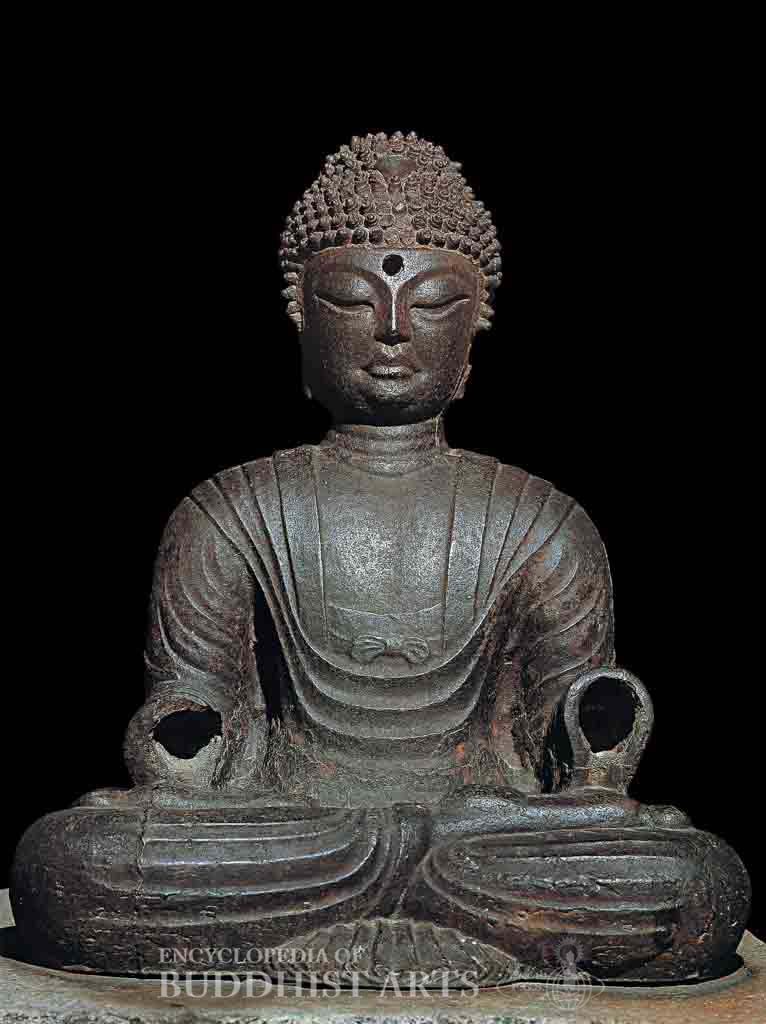
Chungju: Seated Buddha
Iron
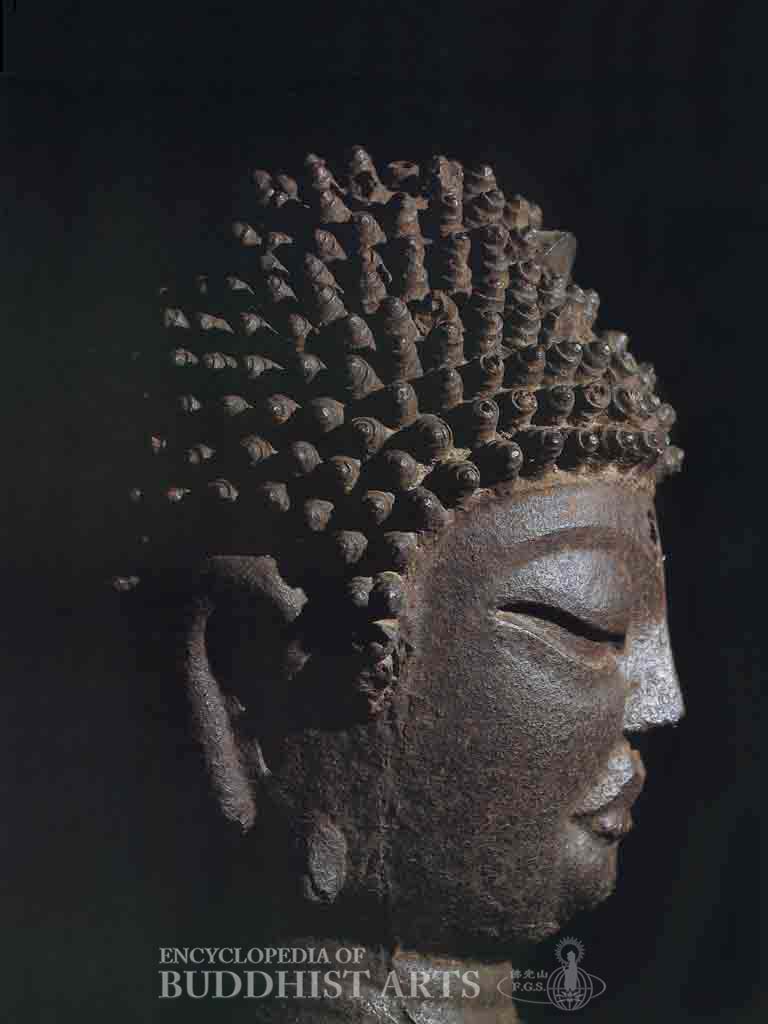
Chungju: Seated Buddha (detail)
Chungju: Seated Buddha
SOUTH KOREA, North Chungcheong, Chungju; Goryeo dynasty
Iron Buddhas started to appear during the Unified Silla dynasty (668–935), but became popular for a while during the Goryeo dynasty (918–1392), from which this Buddha dates. The statues made during the Goryeo dynasty were also larger in size. The statue was listed as Treasure No. 98 in 1963.
The figure is seated in full lotus position wearing a monastic robe that covers both shoulders. The clothing aligns symmetrically downward, the folds fan down the arms and descend in waves over the abdomen and legs. These stylistic folds are often seen in statues from the Pala period (circa 8th–12th century). The head of the statue is disproportionately large.
For more details, go to the Encyclopedia of Buddhist Arts: Sculpture A-F, page 262.
Cite this article:
Hsingyun, et al. "Chungju: Seated Buddha." Encyclopedia of Buddhist Arts: Sculpture A-F, vol. 10, 2016, pp. 262.
Hsingyun, Youheng, Yann Lovelock, Yuan Chou, Susan Huntington, Gary Edson, and Robert Neather. 2016. "Chungju: Seated Buddha" In Encyclopedia of Buddhist Arts: Sculpture A-F, 10:262.
Hsingyun, Youheng, Lovelock, Y., Chou, Y., Huntington, S., Edson, G., & Neather, R.. (2016). Chungju: Seated Buddha. In Encyclopedia of Buddhist Arts: Sculpture A-F (Vol. 10, pp. 262).
@misc{Hsingyun2016,
author = Hsingyun and Youheng and Lovelock, Yann and Chou, Yuan and Huntington, Susan and Edson, Gary and Neather, Robert,
booktitle = {Encyclopedia of Buddhist Arts: Sculpture A-F},
pages = 262,
title = {{Chungju: Seated Buddha}},
volume = 10,
year = {2016}}
author = Hsingyun and Youheng and Lovelock, Yann and Chou, Yuan and Huntington, Susan and Edson, Gary and Neather, Robert,
booktitle = {Encyclopedia of Buddhist Arts: Sculpture A-F},
pages = 262,
title = {{Chungju: Seated Buddha}},
volume = 10,
year = {2016}}