
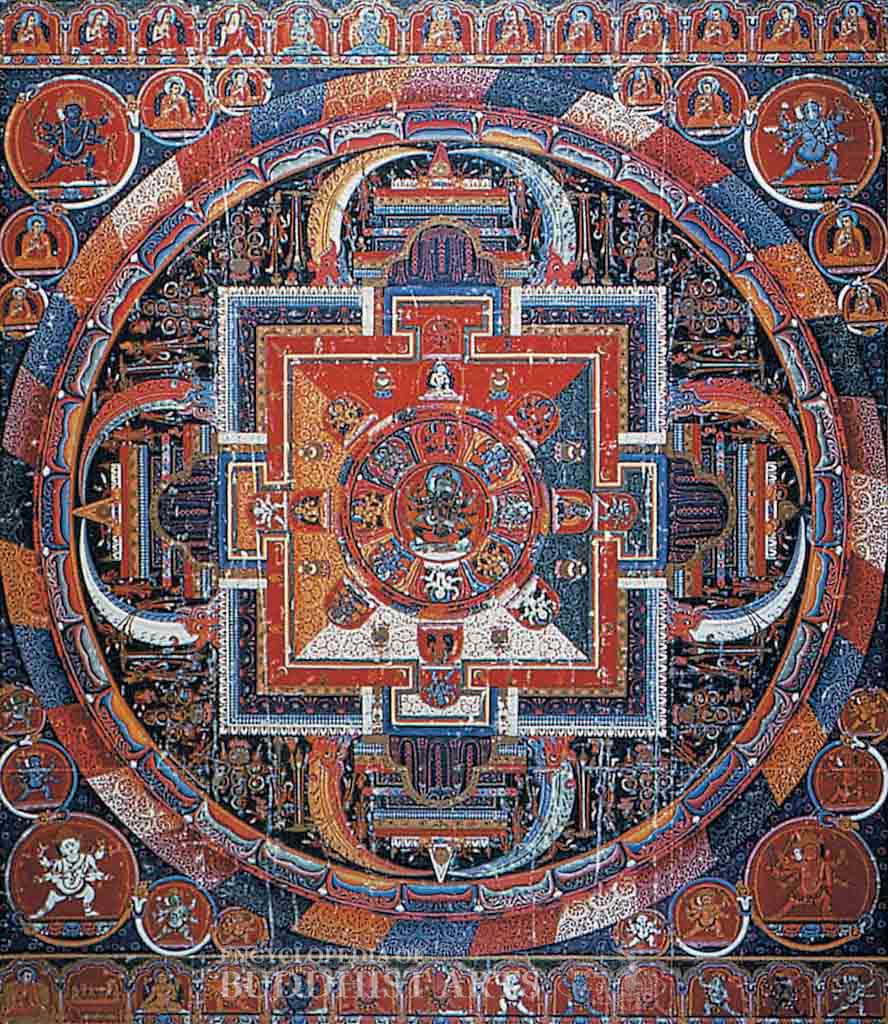
Vajramrita Mandala
Color on canvas
Vajramrita Mandala
CHINA, Tibet, U-Tsang
Vajrayana Buddhism began in India around the 6th century and was subsequently introduced into Nepal, where it was integrated with Shaivism. The recitation of mantras and the visualization of mandalas are essential to Vajrayana practice. This 16th century thangka is part of a set of mandalas belonging to Ngor Monastery. Six-Armed Vajramrita is in the center, in union with his consort Svabhaprajna. Vajramrita holds a vajra, which symbolized compassion, and a bell, representing wisdom. These two figures are surrounded by eight heavenly beings within lotus petals. Eight more deities are arranged on the four cardinal and four semi cardinal points within the inner square. The blue border of the inner square represents a palace wall. The large towers in the center of the sides of the walls are each guarded by a deity with three heads and six arms. Within the outer circle, Dharma instruments are painted against a black background. Colorful patterns decorate the outer rings. Numerous deities with red mandorlas are painted outside the circle. There are rows of seated figures at the top and the bottom of the picture. The mandala is finely detailed and brightly colored. The gates, floral motifs, and patterns are painted in Newar style.
For more details, go to the Encyclopedia of Buddhist Arts: Painting P-Z, page 956.
Cite this article:
author = Hsingyun and Youheng and Youlu and Wilson, Graham and Manho and Mankuang and Huntington, Susan,
booktitle = {Encyclopedia of Buddhist Arts: Painting P-Z},
pages = 956,
title = {{Vajramrita Mandala}},
volume = 16,
year = {2016}}