
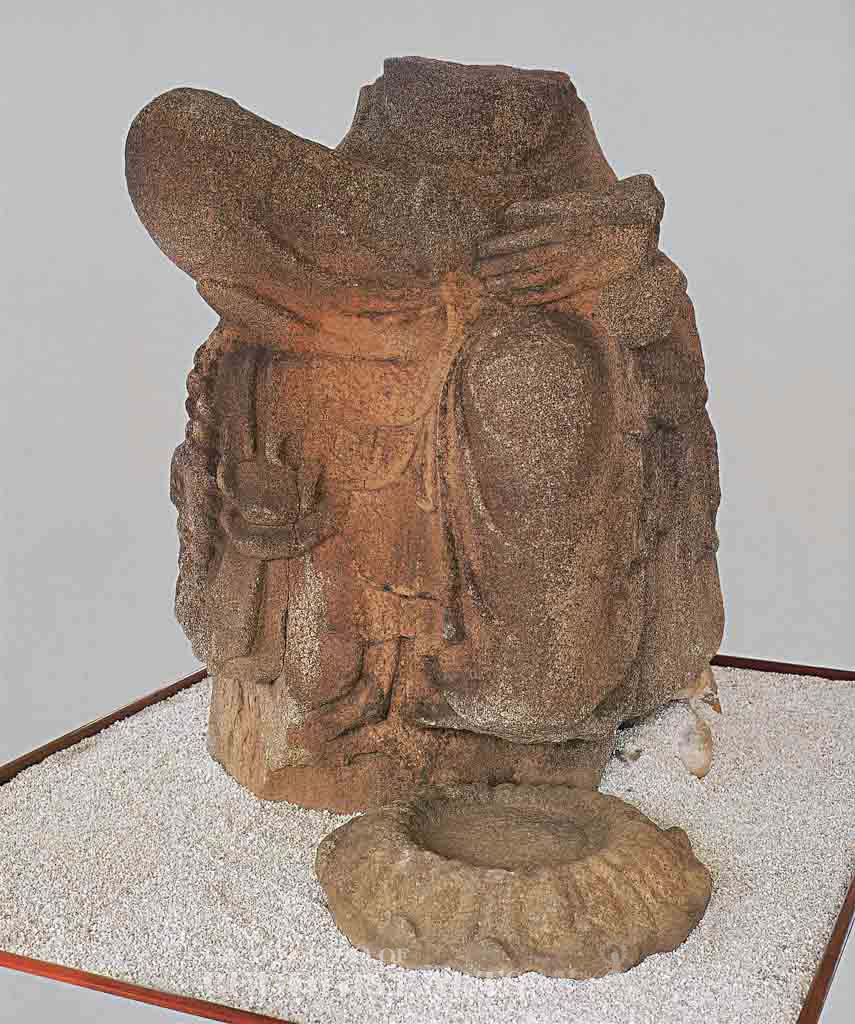
Bukjiri: Bodhisattva in Contemplation
Granite
Bukjiri: Bodhisattva in Contemplation
SOUTH KOREA, North Gyeongsang, Bonghwa; Silla dynasty
Statues in the contemplative posture originated from the Gandharan period of present day India and were passed into Asia. This posture started appearing in Korea during the late 6th and early 7th centuries, and was mostly popular during the late Three Kingdoms period (57 BCE–668 CE) and the Unified Silla dynasty (668–935). Most of the statues from the Three Kingdoms period in this pose were unearthed in the mid-south areas where Baekje and Silla were located. The statue was listed as Treasure No. 997 in 1989.
The original statue was unusually large for its type, and was believed to measure around 2.5 m; all that remains depict the lower part of a figure seated in the relaxation posture. The damaged left leg overhangs the seat and the foot would have been supported on the open lotus below.
For more details, go to the Encyclopedia of Buddhist Arts: Sculpture A-F, page 224.
Cite this article:
author = Hsingyun and Youheng and Lovelock, Yann and Chou, Yuan and Huntington, Susan and Edson, Gary and Neather, Robert,
booktitle = {Encyclopedia of Buddhist Arts: Sculpture A-F},
pages = 224,
title = {{Bukjiri: Bodhisattva in Contemplation}},
volume = 10,
year = {2016}}