
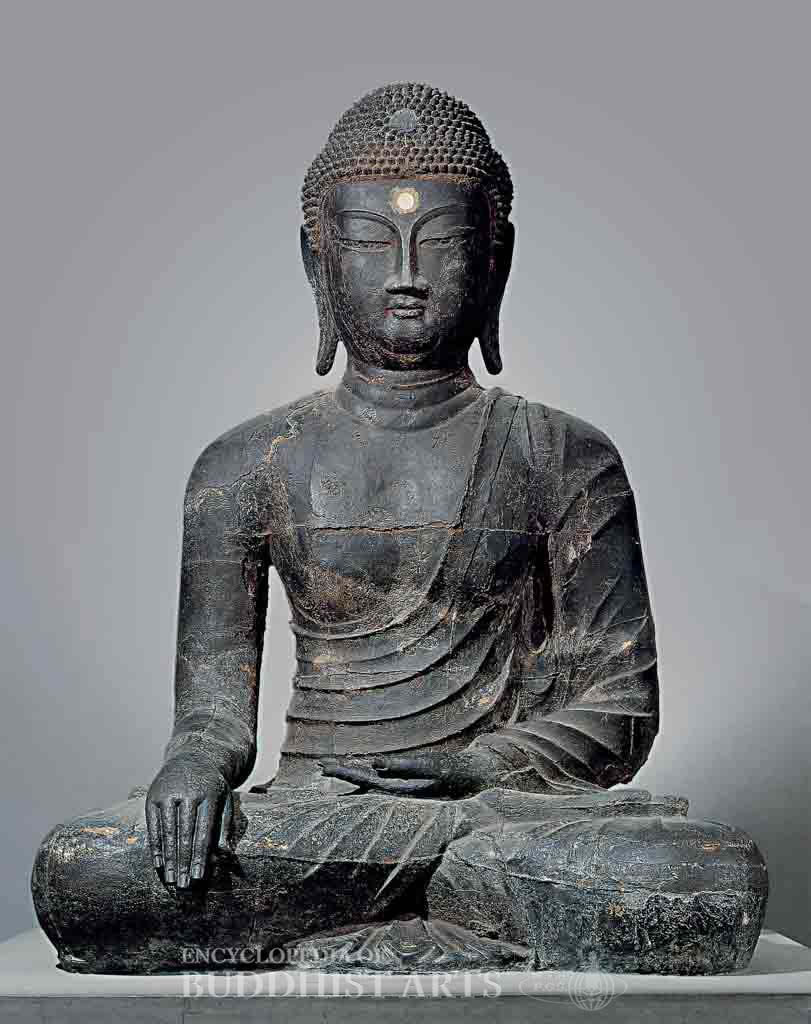
Chungungri: Seated Buddha
Iron
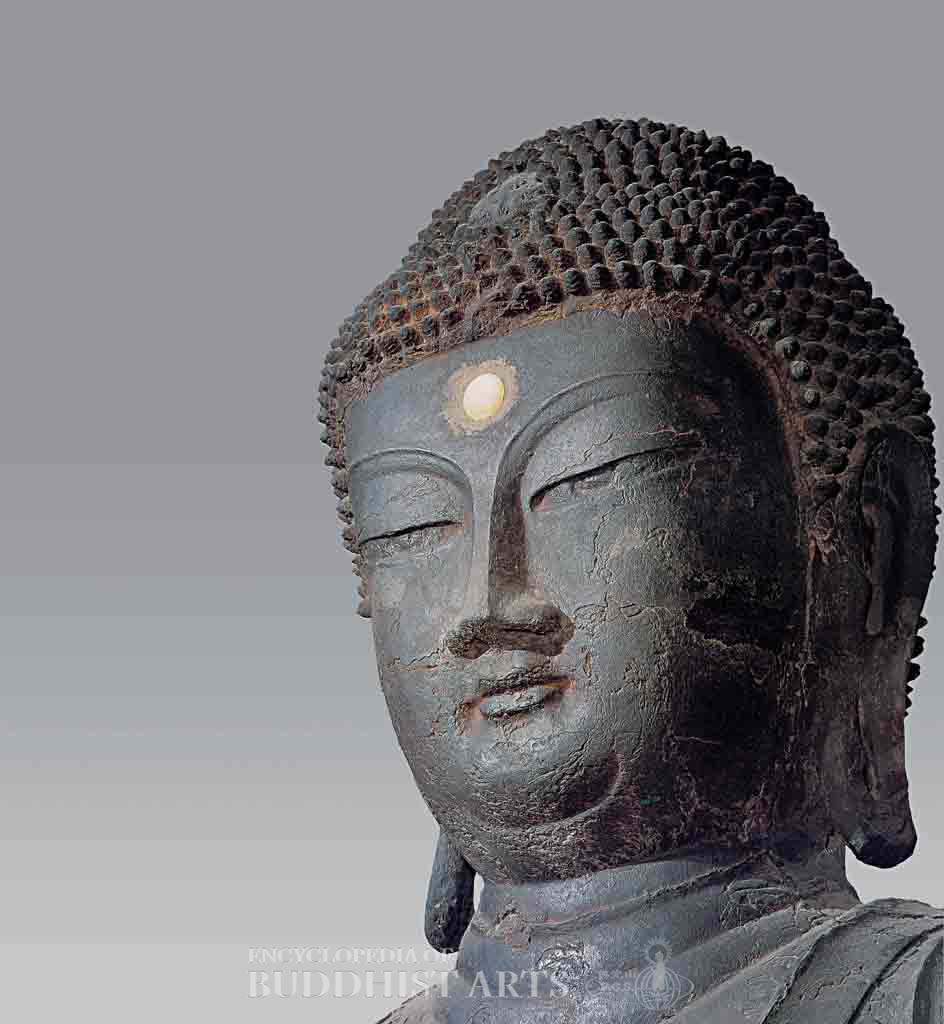
Chungungri: Seated Buddha (detail)
Chungungri: Seated Buddha
SOUTH KOREA, Gyeonggi, Gwangju; Goryeo dynasty
The statue was discovered at a temple site in Chungungri, Gwangju, and is also known as the Gwangju Iron Buddha. It is the largest iron Buddha from the Goryeo dynasty (918–1392), and was listed as Treasure No. 332 in 1963.
It is evident that this iron figure was cast in several parts from the roughness around the joins that were probably plastered over before being varnished and gilded on its installation in the 10th century. Damage to several parts was repaired after its excavation from the temple site, and the arms underwent a second restoration more recently. There is a relatively large urna centered above the lines of the eyebrows that descend on either side to form the long nose. Long slanted eyes contrast with the small mouth. The Buddha is in full lotus position, dressed in monastic robes that leave the right shoulder uncovered, and makes the bhumisparsa (earth-touching) mudra. The statue exhibits the style from the late Unified Silla dynasty (668–935) that was modified into the Goryeo style.
For more details, go to the Encyclopedia of Buddhist Arts: Sculpture A-F, page 262.
Cite this article:
author = Hsingyun and Youheng and Lovelock, Yann and Chou, Yuan and Huntington, Susan and Edson, Gary and Neather, Robert,
booktitle = {Encyclopedia of Buddhist Arts: Sculpture A-F},
pages = 262,
title = {{Chungungri: Seated Buddha}},
volume = 10,
year = {2016}}