

Tanzhe Temple: Great Hero Hall
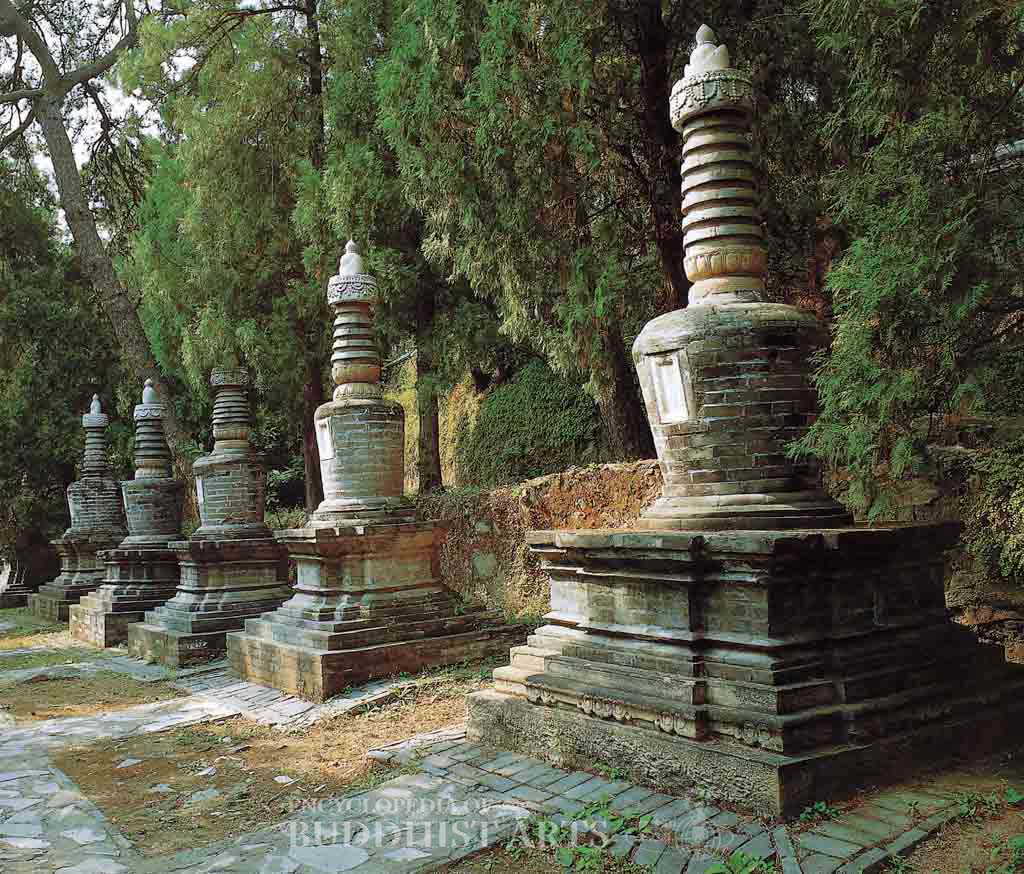
Tanzhe Temple: Forest of Stupas
Tanzhe Temple
CHINA, Beijing
Tan refers to the Dragon Pond, and Zhe means Chinese Mulberry Tree, both of which are found within the temple grounds. It is the oldest temple in Beijing, having been founded in 307 during the Western Jin dynasty. The temple was rebuilt between 696 and 697 during the Wu Zhou dynasty. It was renovated a number of times with the result that most of its existing buildings date back to the Ming (1368–1644) and Qing (1644–1911) dynasties. It was listed as a National Cultural Heritage Site in 2001.
The temple faces south and is built in harmony with its surroundings. The principal temple buildings are along the central path and include the gateway, main temple gate, Heavenly King Hall, Great Hero Hall, and the Vairocana Pavilion. The east path leads to the abbot’s quarters, an imperial lodge from the Qing dynasty, and the Flowing Cup Pavilion. The ordination hall and Avalokitesvara Hall can be found on the west path.
The five-bay wide Great Hero Hall stands on a 2 m high base. It has a double-eave hip roof covered in yellow glazed tiles with green borders. The two ridge decorations in the form of a dragon’s head with a fishtail are 2.9 m high. They are very prominent and are the largest such architectural feature found in Beijing. A statue of Sakyamuni Buddha is enshrined within the hall. Seventy-five brick funerary stupas can be found within the forest of stupas. They date from the Jin (936–946), Yuan (1271–1368), Ming, and Qing dynasties, and are the funerary stupas of the patriarchs of the temple. The majority of them are well-preserved.
For more details, go to the Encyclopedia of Buddhist Arts: Architecture T-Z, page 1090.
Cite this article:
author = Hsingyun and Youheng and Johnson, Peter and Mankuang and Lancaster, Lewis,
booktitle = {Encyclopedia of Buddhist Arts: Architecture T-Z},
pages = 1090,
title = {{Tanzhe Temple}},
volume = 4,
year = {2016}}