

Horyuji Temple Golden Hall Murals: Mural 1 - Sakyamuni Pure Land
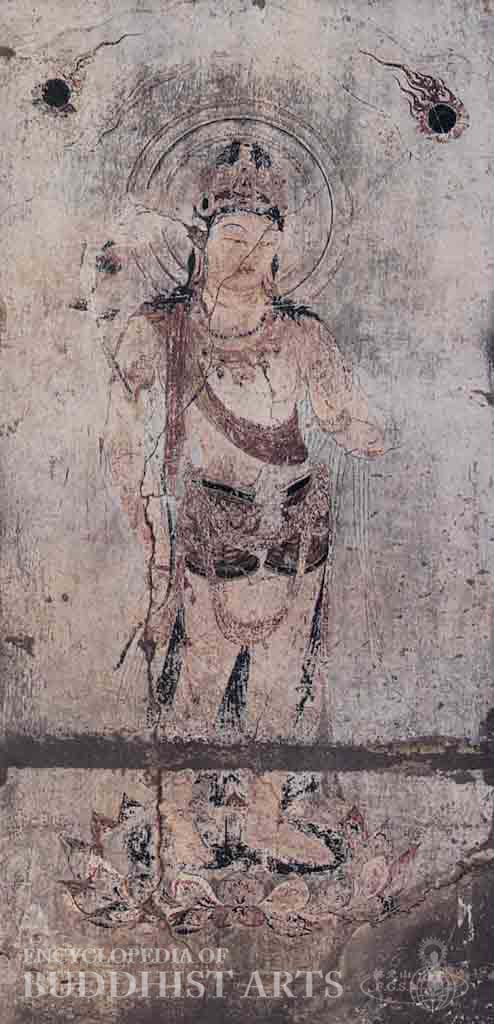
Horyuji Temple Golden Hall Murals: Mural 3 - Avalokitesvara Bodhisattva

Horyuji Temple Golden Hall Murals: Mural 2 - Seated Bodhisattva
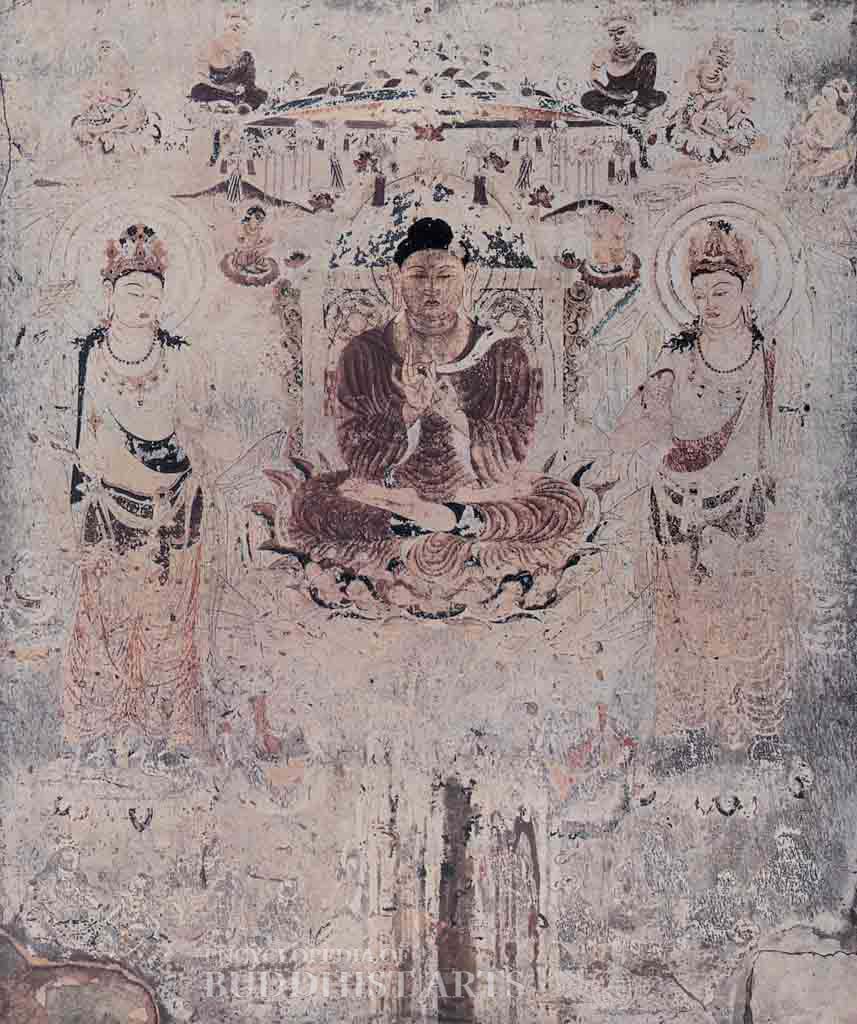
Horyuji Temple Golden Hall Murals: Mural 6 - Amitabha Pure Land
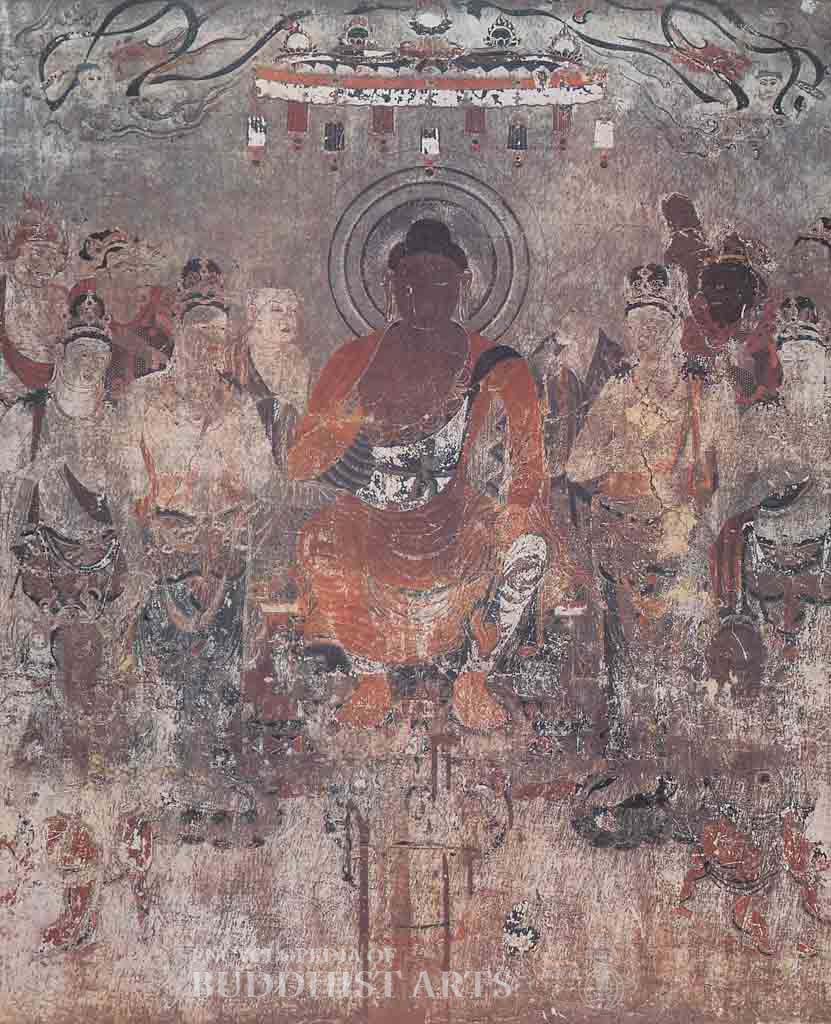
Horyuji Temple Golden Hall Murals: Mural 10 - Medicine Buddha Pure Land
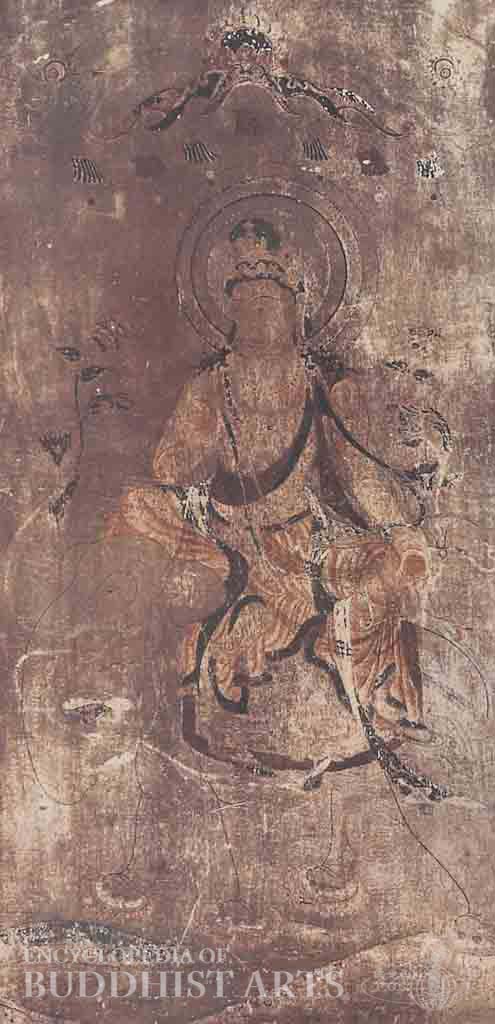
Horyuji Temple Golden Hall Murals: Mural 11 - Samantabhadra Bodhisattva
Horyuji Temple Golden Hall Murals: Mural 6 - Apsaras

Horyuji Temple Golden Hall Murals: Mural 18 - Apsaras
Horyuji Temple Golden Hall Murals
JAPAN, Nara, Ikoma; Hakuho period
The Golden Hall of Horyuji Temple used to be decorated with 12 colorful murals painted on the internal walls between the columns. The four main walls were painted with Buddha images, and Bodhisattvas were painted on each of the eight smaller walls. There were also 18 murals of Arhats and 20 murals of apsaras painted on the walls above the architraves. In 1949, a fire broke out, damaging some of the murals; as a result, most of them have been taken down for preservation. They were listed as Important Cultural Properties in 1958.
There have been various accounts concerning which four Buddhas were shown in the main murals in the hall, and where each one was positioned. One version consistent with records kept by Kofukuji Temple holds that the east, south, west, and north walls were painted with illustrations of Medicine Buddha, Sakyamuni Buddha, Amitabha Buddha, and Maitreya Buddha respectively. The Bodhisattvas on the eight smaller walls were arranged in corresponding pairs on the left and right: Avalokitesvara with Mahasthamaprapta, Samantabhadra with Manjusri, Aryavalokitesvara with Eleven-Headed Avalokitesvara, and lastly, a pair of Bodhisattvas seated cross-legged in half lotus position. The murals were produced by first drafting the picture onto the white wall using a finely-toothed comb-like tool, a process akin to line engraving. Then colors were applied to the grooves in the wall. The skin and clothes were filled in with a light gradient wash, while thicker paint was applied on the eyes, noses, and on the folds of the robes, which are decorated with colorful patterns. The iron-wire drawing technique, which results in jagged lines of consistent thickness, is used in the murals to give the figures a more realistic look. These large images display skillful craftsmanship and reflect the influence of Chinese Tang dynasty art.
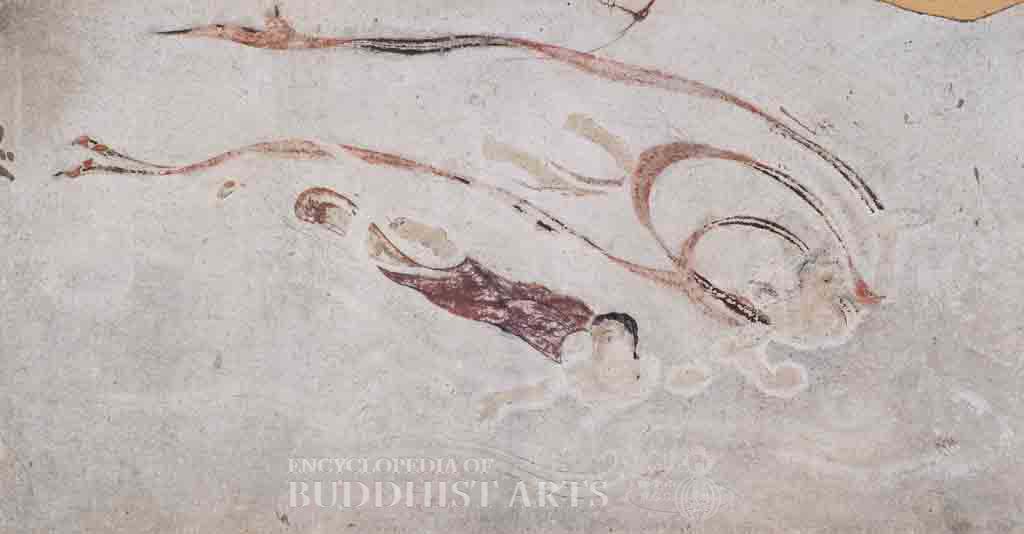
The 20 apsaras originally on the walls above the architraves were removed during a renovation prior to the fire, saving them from damage. They are in good condition despite some peeling of the paint. As all the apsaras are in the same pose, they were probably copied from the same template. They are colored with several tones of red, blue, and yellow. The outlines are traced with iron-wire lines, while the body and garments are filled in with graded tones of dark paint. In the picture, two apsaras are seen flying beside each other towards the lower right corner. Their left hands hold platters with flowers, which they scatter with their right hands. The apsaras have round faces. They wear ornaments, bracelets, anklets, and long skirts. Stoles are draped around their upper arms. Their legs are stretched out behind them, while their stoles, skirts, and the clouds around them are painted to suggest that they are flying at high speed.
For more details, go to the Encyclopedia of Buddhist Arts: Painting A-H, page 341.
Cite this article:
author = Hsingyun and Youheng and Youlu and Wilson, Graham and Manho and Mankuang and Huntington, Susan,
booktitle = {Encyclopedia of Buddhist Arts: Painting A-H},
pages = 341,
title = {{Horyuji Temple Golden Hall Murals}},
volume = 14,
year = {2016}}