
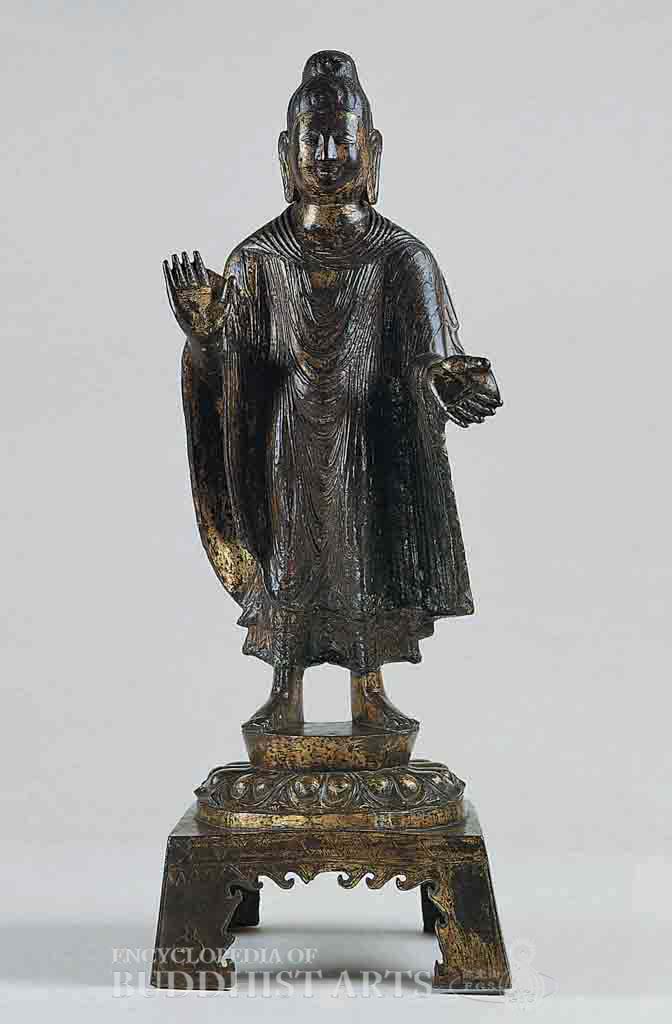
Standing Buddha
Gilt bronze
Standing Buddha
CHINA; Northern Wei dynasty
The inscription on the elaborate stand states that Wan Shen, a villager of Renqiu, commissioned the statue in 443, and dedicated it to the crown prince and Wan’s family. The survival of this piece is particularly welcome because the Emperor Taiwu (reigned 423–452) had prohibited Buddhism since 446, and most statues were destroyed during the seven years of persecution.
The Buddha stands on a lotus pedestal with his hands held out in abhaya (fearlessness) and varada (wish-granting) mudras. The tall usnisa and exaggeratedly long ears are among the physical characteristics of a Buddha. The monastic robe portrayed is probably due to Indian figures from the Gupta period (circa 320–550).
For more details, go to the Encyclopedia of Buddhist Arts: Sculpture St-Z, page 1131.
Cite this article:
author = Hsingyun and Youheng and Lovelock, Yann and Chou, Yuan and Huntington, Susan and Edson, Gary and Neather, Robert,
booktitle = {Encyclopedia of Buddhist Arts: Sculpture St-Z},
pages = 1131,
title = {{Standing Buddha}},
volume = 13,
year = {2016}}