
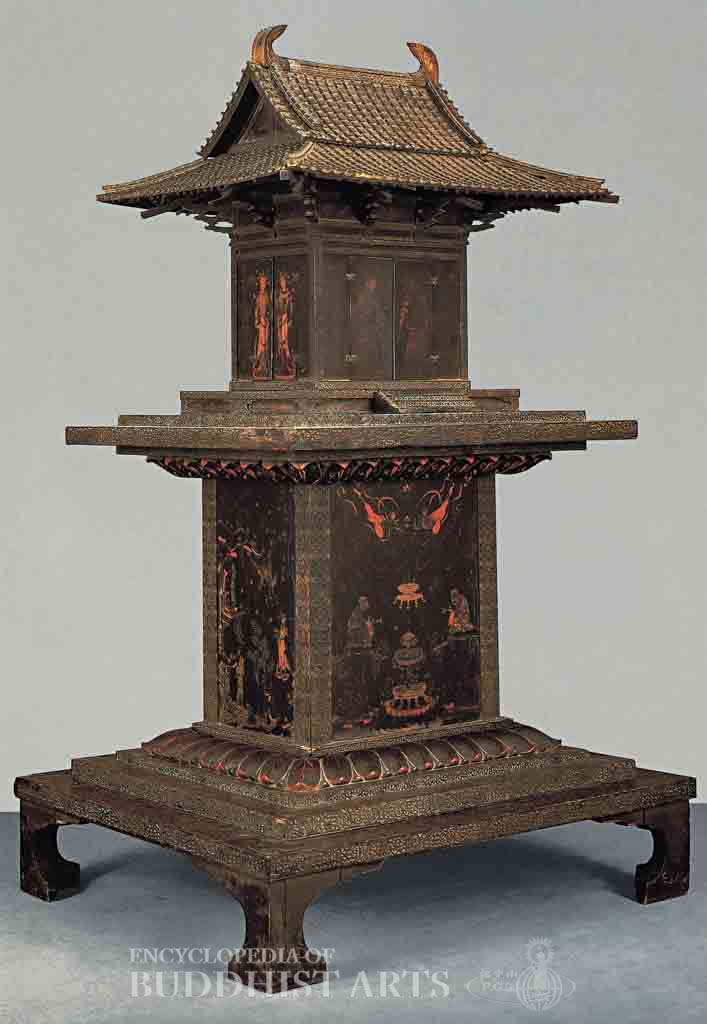
Horyuji Temple: Tamamushi Shrine
Wood
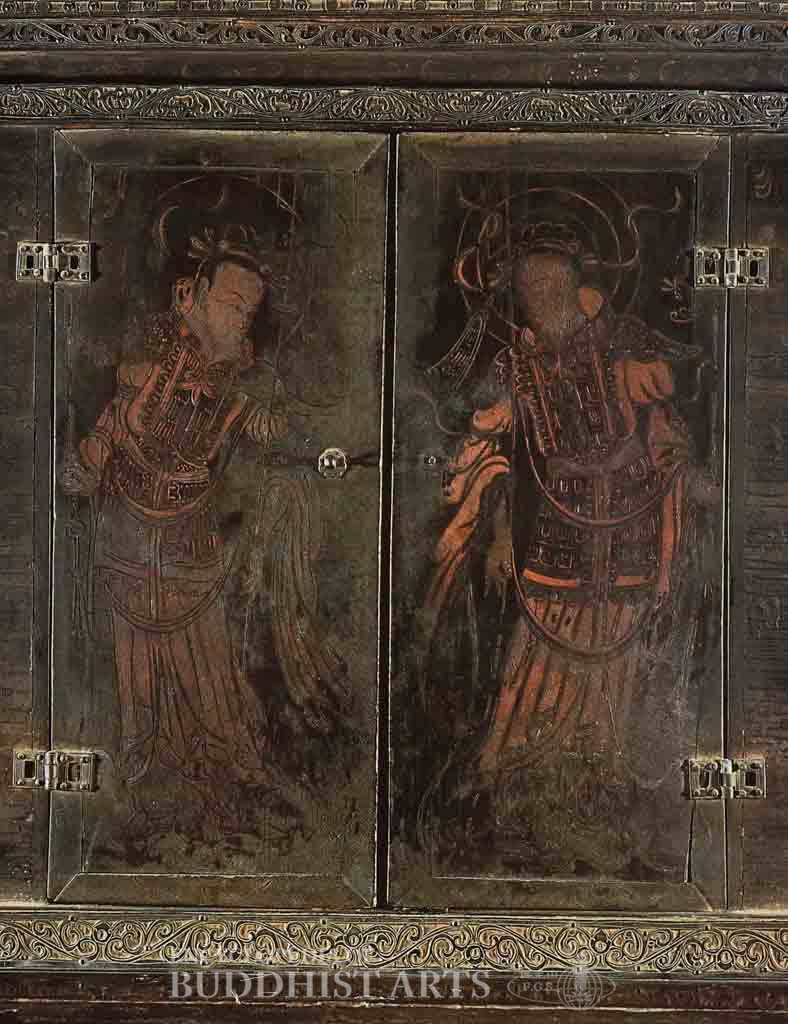
Horyuji Temple: Tamamushi Shrine - Heavenly Kings
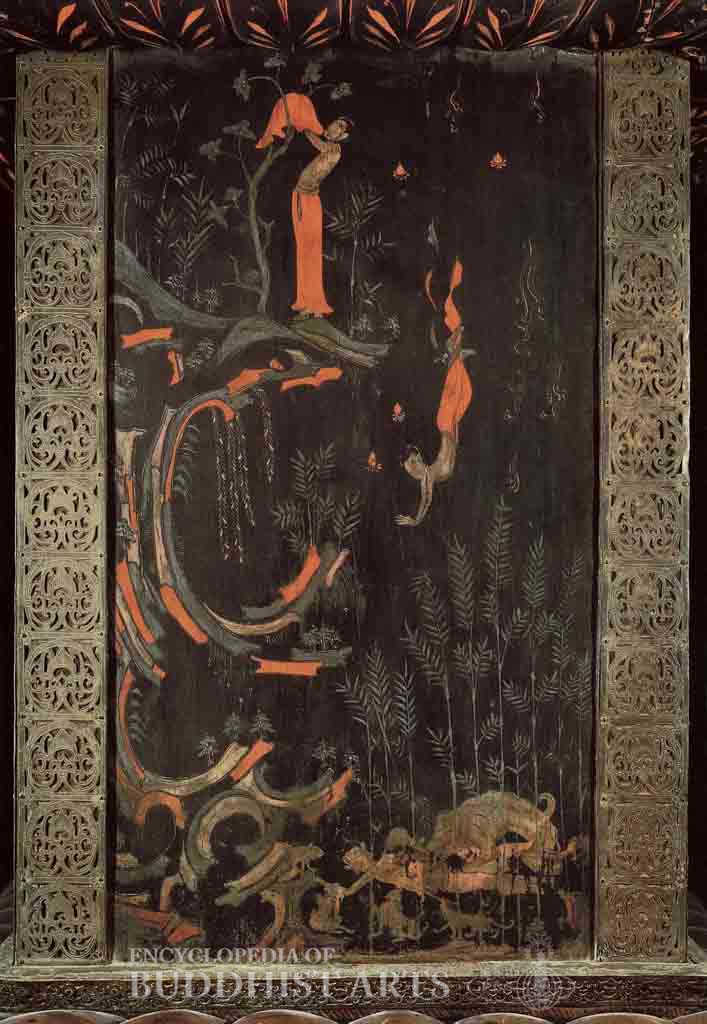
Horyuji Temple: Tamamushi Shrine - Prince Mahasattva Jataka
Horyuji Temple: Tamamushi Shrine
JAPAN, Nara, Ikoma; Asuka period
This shrine derives its name from the tamamushi (jewel) beetle, whose iridescent wings were used to decorate parts of the sides and the base. It was listed as a National Treasure in 1951.
The shrine is made from cypress and lacquered in black. Red, green, yellow, and white colors were applied using a technique involving pigments bound with oil and lead oxide. It is the earliest example of the combination of lacquer and this lead oxide coloring technique. The shrine can be divided into three sections: a base, a lower tier, and an upper tier.
The base has four layers, with the upper consisting of openwork petals. The front of the lower tier has an illustration of the offering of relics, while the rear has a depiction of the cosmology of Mount Sumeru. The sides have illustrations of the Prince Mahasattva Jataka and the Jataka of Sacrifice for a Gatha by Jumping off a Cliff. These represent the oldest known Japanese illustrations of Buddhist stories.
The front of the upper tier is painted with two deities, while the rear has an illustration of the Buddha Teaching the Dharma at Vulture Peak. On the sides, there are pairs of Bodhisattvas. The insides of the front doors and inner walls contain repoussé images of the Thousand Buddhas. The shrine has a single-eave hip-and-gable roof with ridge ornaments at the ends. The tiles are made from bronze plates, and the roof is supported by bracket sets with downward-pointing cantilevers. The shrine serves as a valuable example of Asuka period (538–645) architecture.
For more details, go to the Encyclopedia of Buddhist Arts: Artifacts, page 130.
Cite this article:
author = Hsingyun and Youheng and Youji and Pokorski, Stefanie and Mankuang and Fan, Wen,
booktitle = {Encyclopedia of Buddhist Arts: Artifacts },
pages = 130,
title = {{Horyuji Temple: Tamamushi Shrine}},
volume = 18,
year = {2016}}