
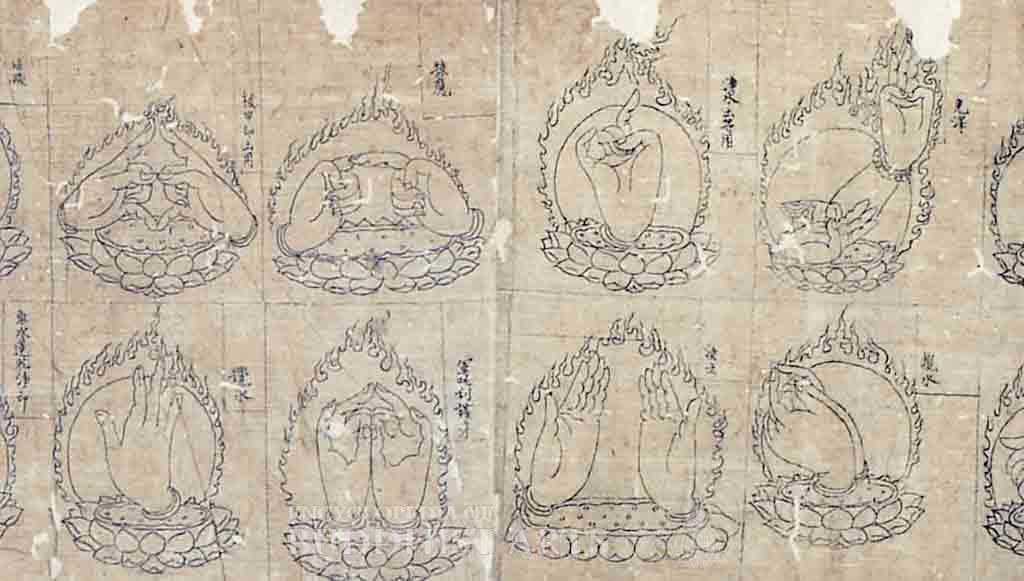
Mudras of the Susiddhi Ritual
Line drawing on paper
Mudras of the Susiddhi Ritual
CHINA; Tang dynasty
This scroll illustrating the mudras used in the Susiddhi ritual was bequeathed to Shuei, a Japanese monk who traveled to China, by Faquan, a monk at Qinglong Temple in Chang’an (present day Xi’an, Shaanxi). The Susiddhi ritual is based on the Susiddhikara Sutra, the title of which means “True Fulfillment.” This sutra is from the Vajrayana Buddhist tradition, which places emphasis on the performance of rituals as a path to enlightenment. This artwork and another scroll known as the Meditation Methods of the Five Families kept by the Onjoji Temple in Shiga, Japan, are some of the only remaining mudra illustrations from the Late Tang period (846–907). An inscription on the scroll dates it to 864. It was listed as an Important Cultural Property of Japan in 1939.
Realistically drawn hands forming mudras are positioned above lotuses and surrounded by flame patterns. An inscription is written beside each image. The scroll is painted with dark ink lines. Both the outline and details are intricately executed with the soft, elegant strokes of a fine bush, exemplifying the Tang painting style.
For more details, go to the Encyclopedia of Buddhist Arts: Painting I-O, page 699.
Cite this article:
author = Hsingyun and Youheng and Youlu and Wilson, Graham and Manho and Mankuang and Huntington, Susan,
booktitle = {Encyclopedia of Buddhist Arts: Painting I-O},
pages = 699,
title = {{Mudras of the Susiddhi Ritual}},
volume = 15,
year = {2016}}