
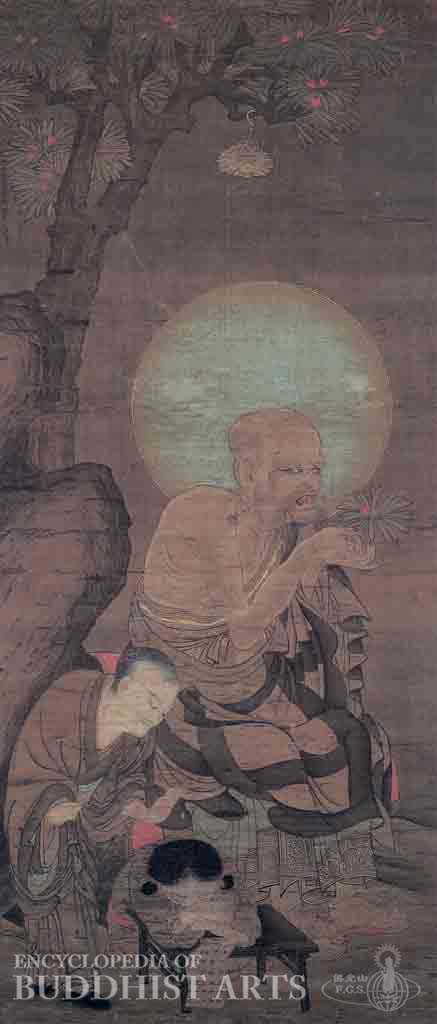
Sixteen Arhats - First Arhat
Ink and color on silk
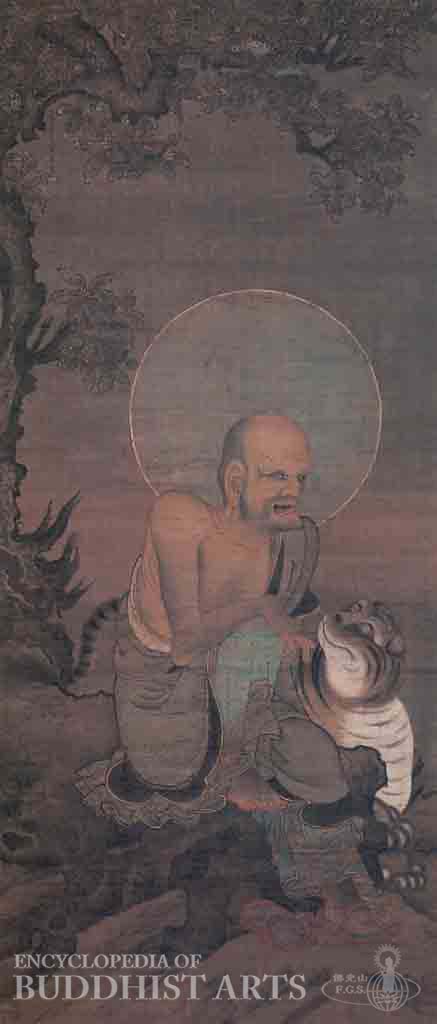
Sixteen Arhats - Sixth Arhat
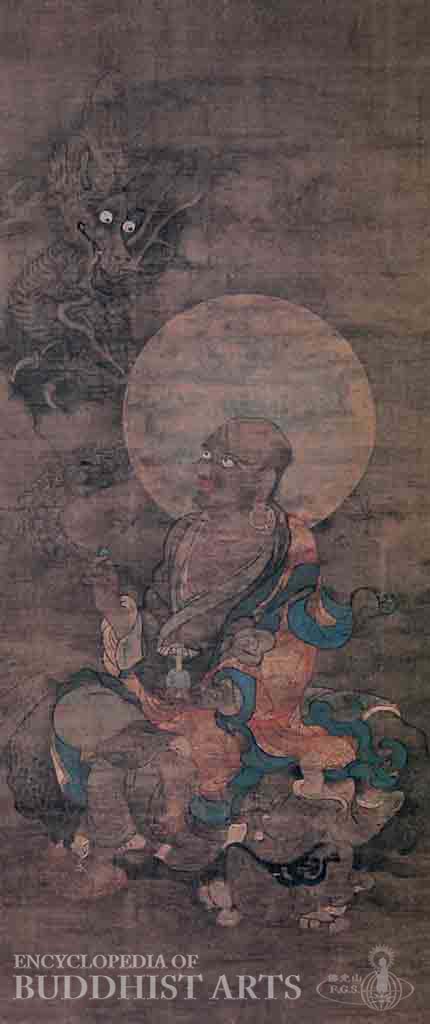
Sixteen Arhats - Fifteenth Arhat

Sixteen Arhats - First Arhat (detail)
Sixteen Arhats
CHINA; Southern Song dynasty
These illustrations of the Sixteen Arhats were painted in China during the Southern Song dynasty (1127–1279) and were later brought to Japan. According to the inscription recording the restoration of the paintings during the Edo period (1615–1868), this set was originally kept at Hokke Zanmai Tadain Temple. They have been used as master copies for many duplicate illustrations of the Arhats since the late Kamakura period (1185–1333). One painting is currently kept in the Museum of Modern Art in Gunma, Japan, ten paintings are kept in the Tokyo National Museum, and the remaining five paintings have been lost. There are inscriptions on the pictures that read “painted by Jin Dashou of Mingzhou, Song dynasty.” Mingzhou is present day Ningbo in Zhejiang, China. It was renamed “Qingyuan prefecture” in 1195 of the Southern Song dynasty. Thus, this set of pictures was painted sometime before that date. During that time, Ningbo was a busy trading harbor with many Buddhist temples. There was a large demand for Buddhist paintings, so many artists gathered there, including Lu Zhongyuan, Lu Xinzhong, Zhang Sixun, and the painter of these pictures, Jin Dashou. In 1937, this set of paintings was listed as an Important Cultural Property of Japan.
The first Arhat with a pale green nimbus gazes intently at a flower that falls towards his curved fingers. Below, a child kneels at a low table and reads a scripture while an attendant looms overhead, reaching down as if to pat the child on the head. The tree in the upper register is full of blooming flowers. An incense burner shaped like a lotus hangs from a tree branch. Most of the picture is painted in dark tones, emphasizing the bright nimbus of the central figure.
There is an interesting symmetry between the paintings of the sixth and the fifteenth Arhats; one gazes up into the upper left corner and the other looks down to the right, reminiscent of the Tiger-Taming and Dragon-Subduing Arhats. The sixth Arhat has deep-set eyes and a high bridged nose. With mouth open, he appears to be teaching the Dharma to the tiger beside him. In return, the tiger raises its head and appears to listen. The fifteenth Arhat has wide, bright eyes and red lips. Holding a vase in his left hand and a blue jewel in his right, he stares intently at a dragon in the upper left corner. The dragon has the same wide eyes as the Arhat, strangely meeting and mirroring his gaze. A terrified attendant crouches and hides his head beneath the colorful robe of the Arhat.
For more details, go to the Encyclopedia of Buddhist Arts: Painting P-Z, page 844.
Cite this article:
author = Hsingyun and Youheng and Youlu and Wilson, Graham and Manho and Mankuang and Huntington, Susan,
booktitle = {Encyclopedia of Buddhist Arts: Painting P-Z},
pages = 844,
title = {{Sixteen Arhats}},
volume = 16,
year = {2016}}