
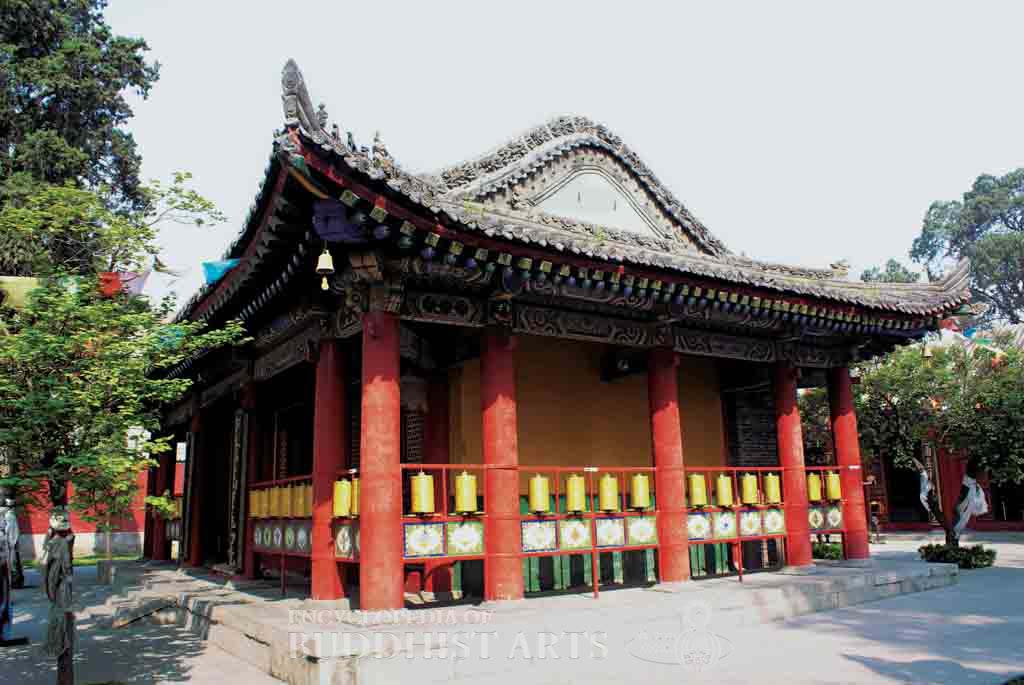
Guangren Temple: Great Hero Hall
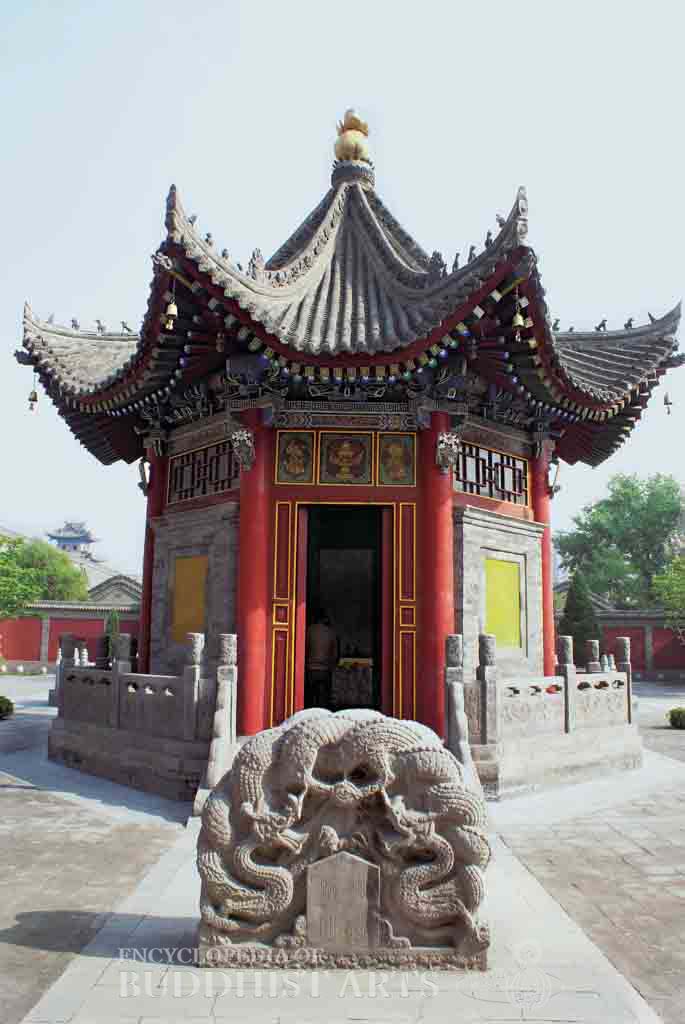
Guangren Temple: Stele Pavilion
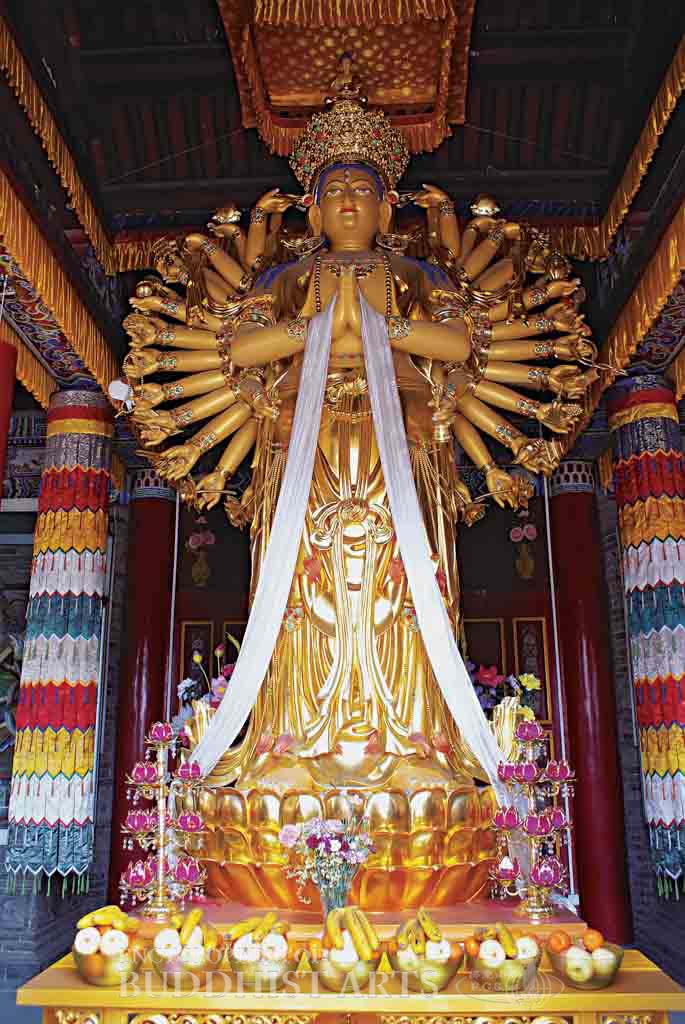
Guangren Temple: Main Temple Gate - Avalokitesvara Bodhisattva
Guangren Temple
CHINA, Shaanxi, Xi’an
Guangren means Vast Kindness. It is the only Tibetan temple in Xi’an. It was built by imperial order in 1705 during the Qing dynasty as a resting place for Mongolian and Tibetan Buddhists on their way to Beijing to see the emperor. The temple was renovated in 1920 and listed as a Key Buddhist temple in the Han region of China in 1983.
Facing south, the temple occupies 1.1 ha. The main structures include the screen wall, stele pavilion, main temple gate, Great Hero Hall, sutra repository, Dharma Hall, side halls, and subsidiary buildings. The stele pavilion has a hexagonal pyramidal roof with markedly upturned eaves. The stele erected inside was bestowed by Emperor Kangxi (reigned 1661–1722), and describes the establishment of the temple. The main temple gate houses a standing statue of Avalokitesvara Bodhisattva. The five-by-two bay Great Hero Hall has a curved roof. It is surrounded by a veranda lined with prayer wheels. The three gilded seated statues of Bodhisattvas Avalokitesvara, Manjusri and Samantabhadra enshrined within the hall are believed to be from the Tang dynasty (618–907). The sutra repository houses a statue of Tsongkhapa, founder of the Gelug school. It contains the Ming Tripitaka in 6,770 fascicles, and 108 volumes of the Tibetan Kangyur carved in 1700 during the Qing dynasty. The temple also houses artifacts such as gilt bronze statues of Buddhas and Yamantaka from the Tang dynasty, and the stone lotus throne belonging to the statue of Sakyamuni Buddha brought to Tibet by Princess Wencheng.
For more details, go to the Encyclopedia of Buddhist Arts: Architecture G-L, page 393.
Cite this article:
author = Hsingyun and Youheng and Johnson, Peter and Mankuang and Lancaster, Lewis,
booktitle = {Encyclopedia of Buddhist Arts: Architecture G-L},
pages = 393,
title = {{Guangren Temple}},
volume = 2,
year = {2016}}