
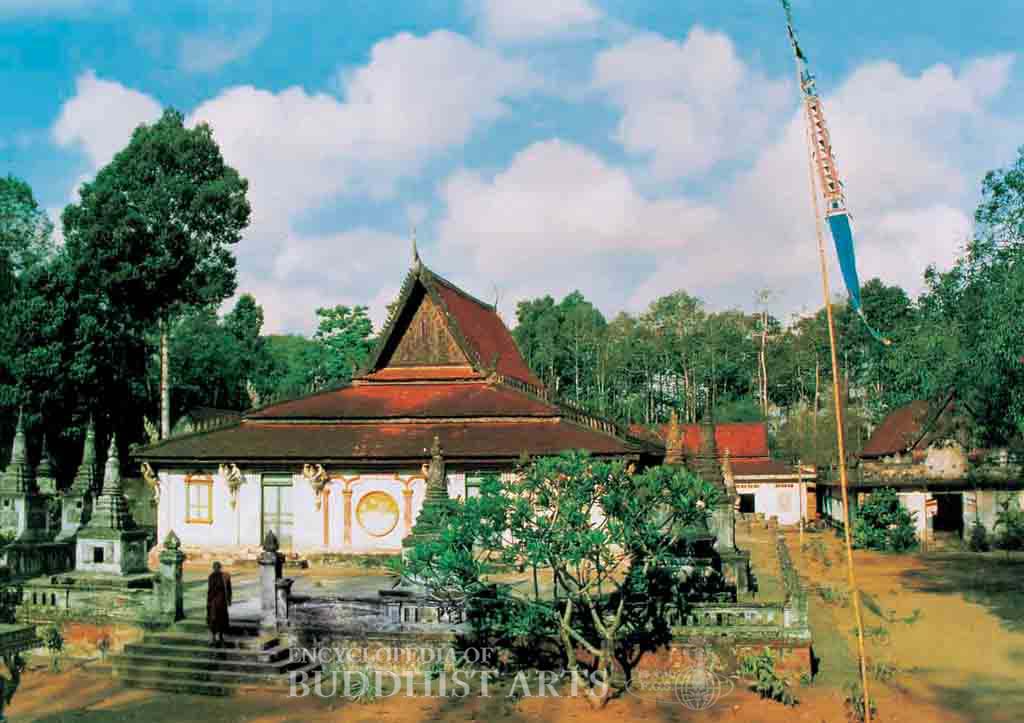
Samrong Ek Temple
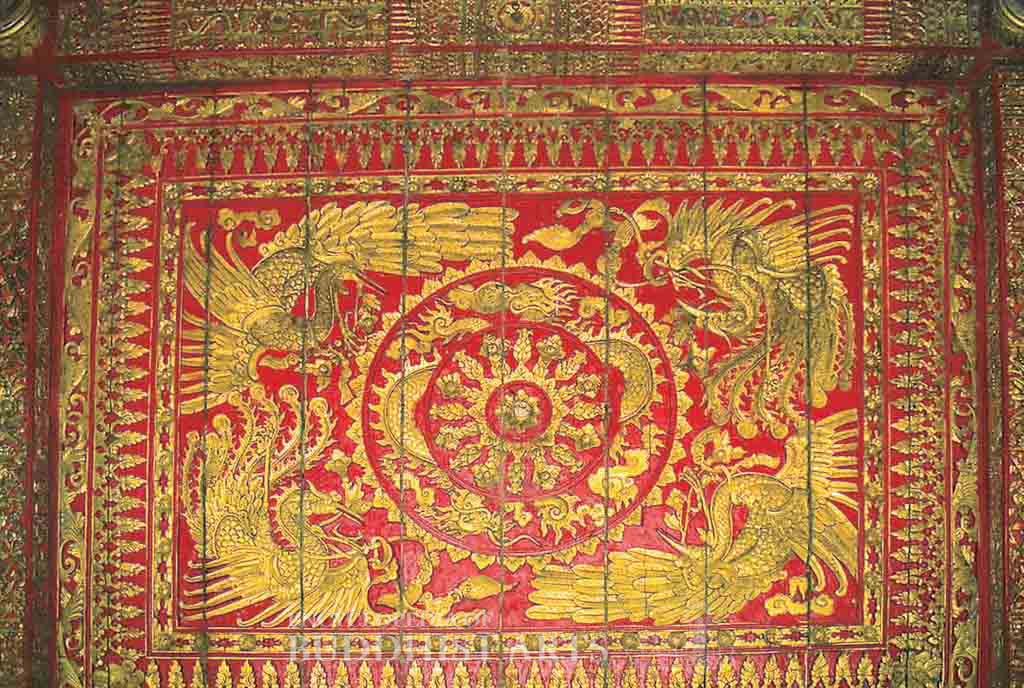
Samrong Ek Temple: Main Hall - Ceiling
Samrong Ek Temple
VIETNAM, Tra Vinh, Chau Thanh
The date of the founding of the temple is not clear: According to the temple records, it was established in 642; however, another source puts forward the later date of 1373. The present temple is a result of restoration work carried out in 1850. The main hall was repaired in 1944. This is the most prominent Khmer-style temple in the province.
The principal buildings include the main hall, a stone pagoda, and a lecture hall. The main hall has a double-eave hip-and-gable roof, with the gable facing the front. The upper roof is steeply pitched, while the lower roof has a gentle slope. There are carvings of garudas under the eaves. The Buddha niche within the hall is intricately carved and houses numerous statues of Sakyamuni Buddha in various postures and sizes. The ceiling of the hall has a detailed relief of a pair of dragons and phoenixes. Surrounding the main hall are slender, pointed Khmer-style stone stupas, which contain the ashes of monastics and devotees.
For more details, go to the Encyclopedia of Buddhist Arts: Architecture M-S, page 923.
Cite this article:
author = Hsingyun and Youheng and Johnson, Peter and Mankuang and Lancaster, Lewis,
booktitle = {Encyclopedia of Buddhist Arts: Architecture M-S},
pages = 923,
title = {{Samrong Ek Temple}},
volume = 3,
year = {2016}}