
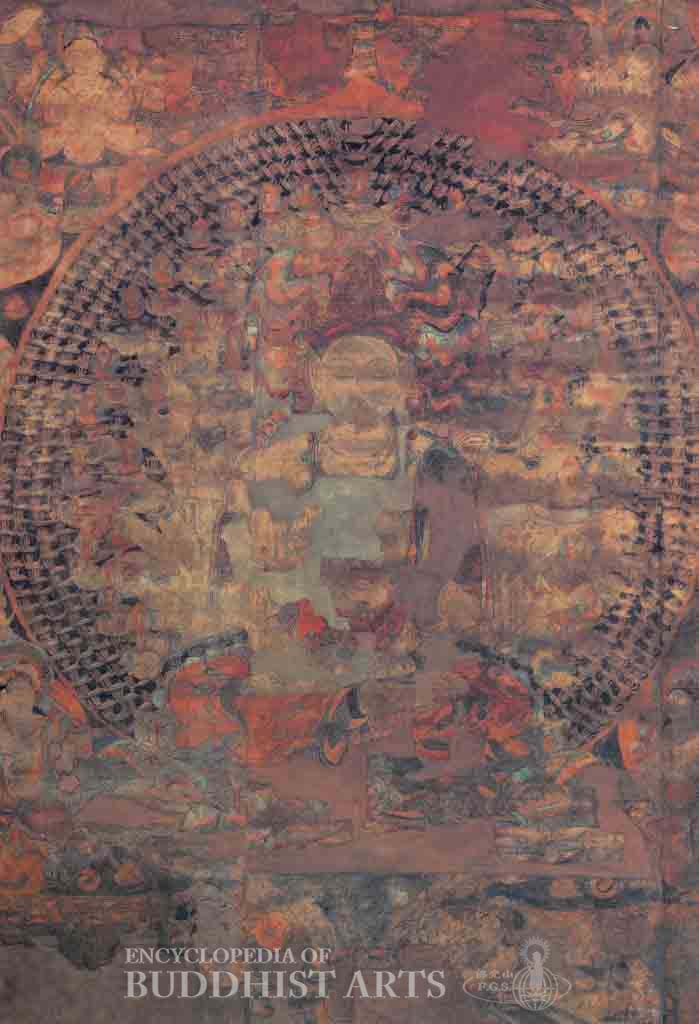
Mogao Cave 17: Manjusri with Thousand Bowls
Ink and color on silk
Mogao Cave 17: Manjusri with Thousand Bowls
CHINA, Gansu, Dunhuang; Tang dynasty
This artwork from the Mid-Tang period (756–846) is illustrated according to the descriptions of Manjusri Bodhisattva found in the Sutra on Manjusri with Thousand Arms and Thousand Bowls and the Manjusri Yoga Method from the Vajrasekhara Sutra. The Bodhisattva sits in full lotus position on a lotus throne. The smooth, round face is surrounded by a nimbus decorated with undulating colored lines. Manjusri has yellow skin, wears a crown and a necklace, and has chrysanthemums behind the ears. The numerous arms, arranged in a large circle, form mudras or hold bowls.
Manjusri is accompanied by other Bodhisattvas, Heavenly Kings including Vaisravana, Heavenly King of the North, and heavenly beings such as Mahesvara. Though illustrations of Manjusri with a thousand arms and a thousand bowls are rare, another similar work was also found in Mogao Cave 361.
For more details, go to the Encyclopedia of Buddhist Arts: Painting I-O, page 638.
Cite this article:
author = Hsingyun and Youheng and Youlu and Wilson, Graham and Manho and Mankuang and Huntington, Susan,
booktitle = {Encyclopedia of Buddhist Arts: Painting I-O},
pages = 638,
title = {{Mogao Cave 17: Manjusri with Thousand Bowls}},
volume = 15,
year = {2016}}