
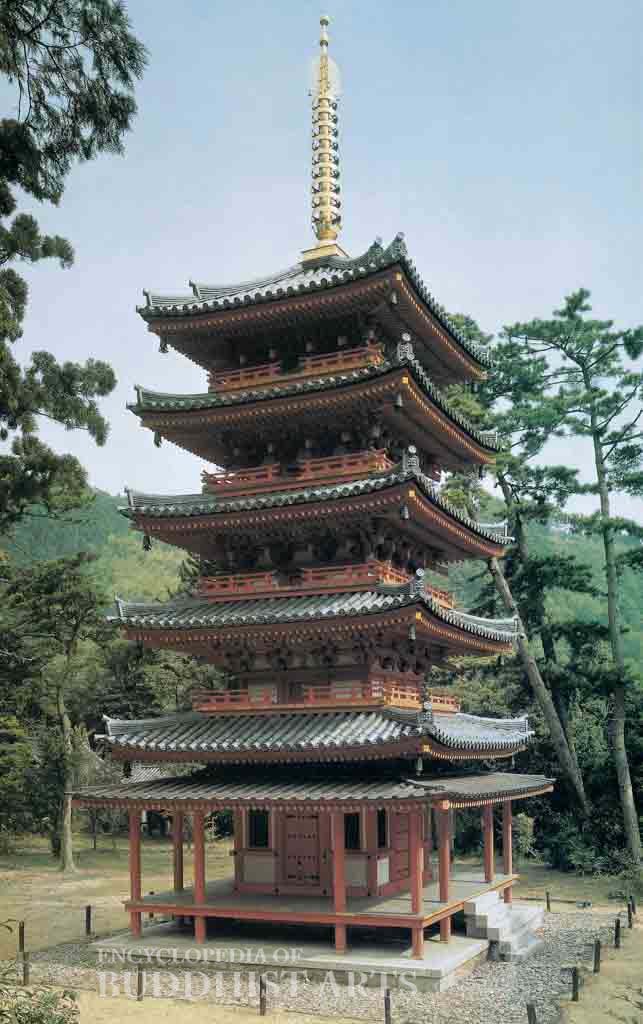
Kaijusenji Temple Five-Story Pagoda
Kaijusenji Temple Five-Story Pagoda
JAPAN, Kyoto
This pagoda was built to enshrine a relic of the Buddha and was completed in 1214 as the only wooden five-story pagoda of the Kamakura period (1185–1333). Kaijusenji Temple, which belongs to the Chisan branch of the Shingon school of Buddhism, was constructed during the Nara period (710–794). It flourished in 1207 during the Kamakura period under the monk Jokei. It was listed as a National Treasure in 1952.
The three-by-three bay square pagoda is 17.7 m high. The roof is covered with cylindrical tiles and the eaves are supported by two-tier bracket sets. The first story has double eaves supported by pillars and there is a veranda around the central chamber. The central pillar starts from the ceiling on the first story and is the oldest part of the pagoda. The spire consists of the harmika, inverted bowl, upturned lotus, stacked rings, flame, and jewels.
Inside the first story, the Sumeru throne is decorated with paintings and Buddha images, displaying various characteristics common during the Nara period.
For more details, go to the Encyclopedia of Buddhist Arts: Architecture G-L, page 574.
Cite this article:
author = Hsingyun and Youheng and Johnson, Peter and Mankuang and Lancaster, Lewis,
booktitle = {Encyclopedia of Buddhist Arts: Architecture G-L},
pages = 574,
title = {{Kaijusenji Temple Five-Story Pagoda}},
volume = 2,
year = {2016}}