
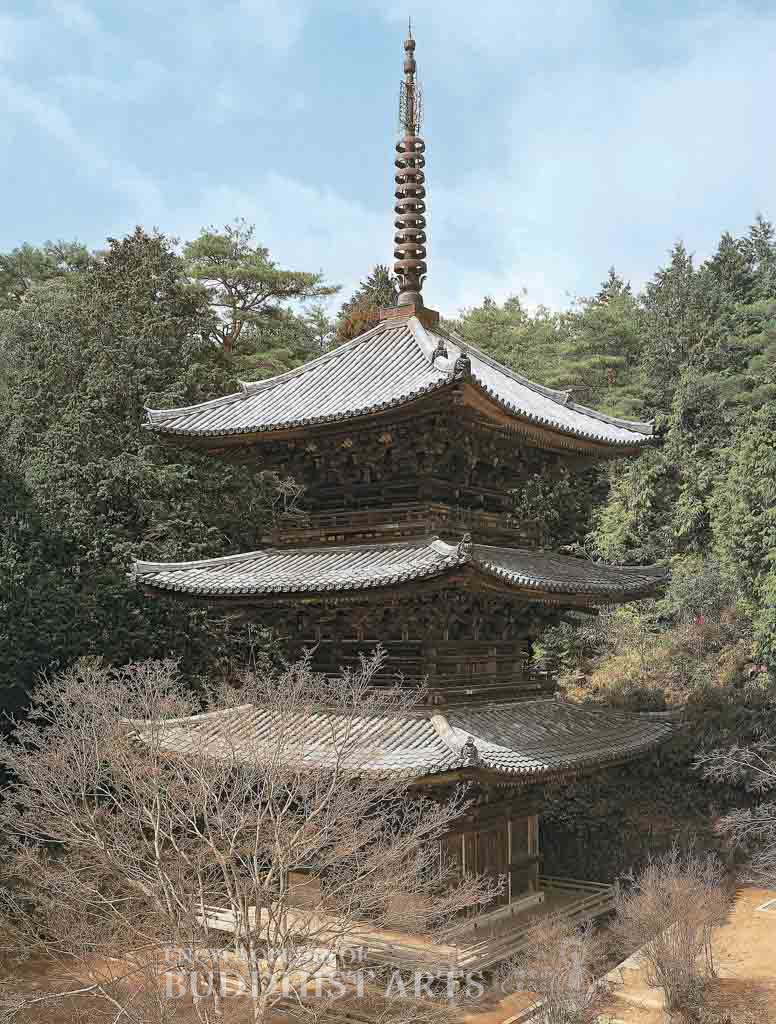
Jyorakuji Temple Three-Tier Pagoda

Jyorakuji Temple Three-Tier Pagoda
JAPAN, Shiga, Koka
The temple was founded by monk Ryokei during the Nara period (710–794) and it belongs to the Tendai school of Buddhism. According to inscriptions on the tiles, the pagoda was built between 1398 and 1400 during the early Muromachi period. It was listed as a National Treasure in 1953.
The three-by-three bay wooden pagoda is 22.8 m high and each side on the first story measures 4.6 m. There is a veranda surrounding the first story, while the second and third stories have low balustrades. The eaves are supported by three-tier bracket sets and the roofs are covered with cylindrical tiles. The spire consists of a harmika, inverted bowl, upturned lotus, stacked rings, a flame, and jewels. A statue of Sakyamuni Buddha on a Sumeru throne is enshrined within the first story. There are colored murals of the Eight Patriarchs of the Shingon school and the Judgments by the Ten Kings, which are characteristic of the esoteric Shingon school of Buddhism.
For more details, go to the Encyclopedia of Buddhist Arts: Architecture G-L, page 563.
Cite this article:
author = Hsingyun and Youheng and Johnson, Peter and Mankuang and Lancaster, Lewis,
booktitle = {Encyclopedia of Buddhist Arts: Architecture G-L},
pages = 563,
title = {{Jyorakuji Temple Three-Tier Pagoda}},
volume = 2,
year = {2016}}