
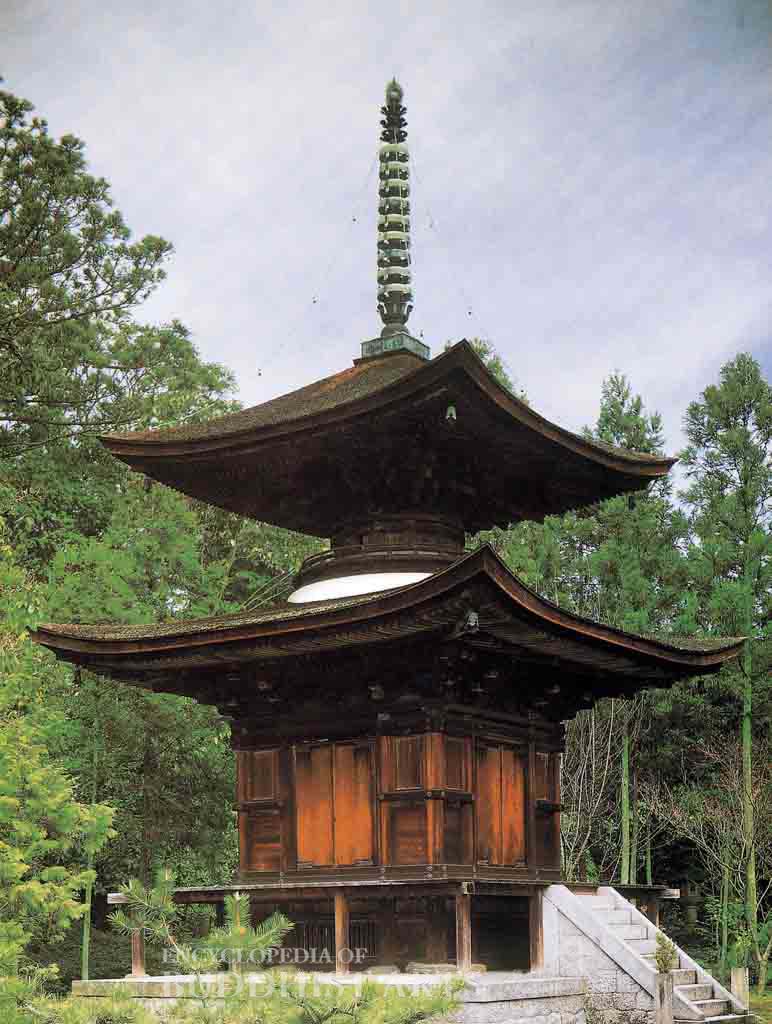
Jigenin Temple Prabhutaratna Pagoda
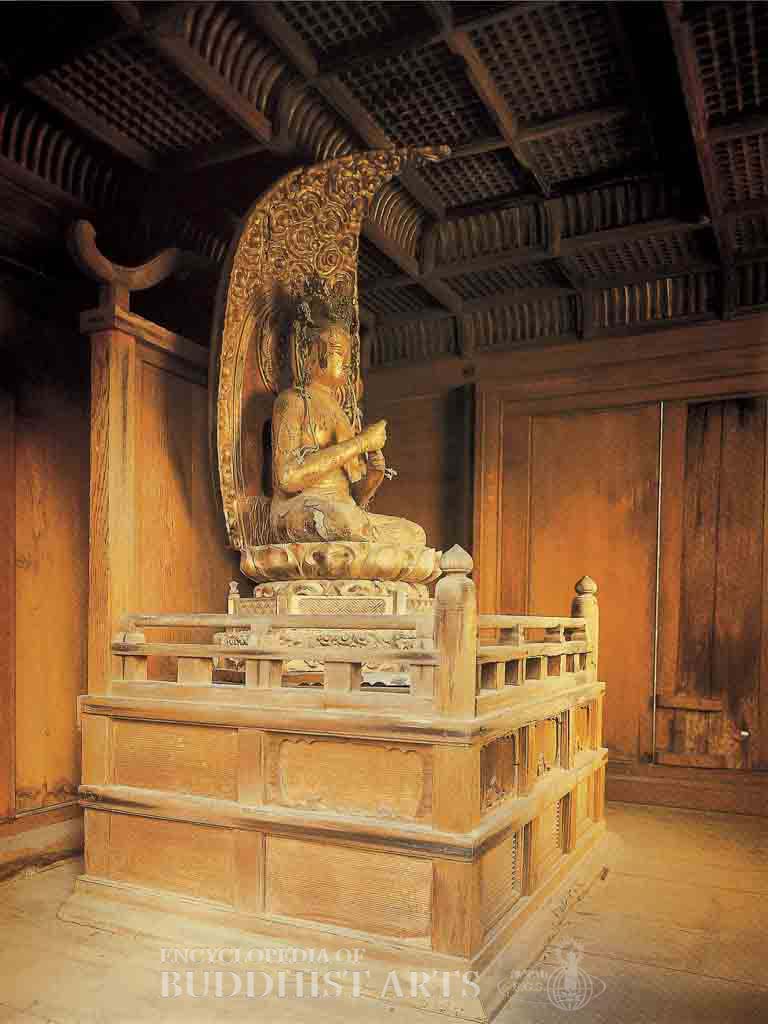
Jigenin Temple Prabhutaratna Pagoda (interior)
Jigenin Temple Prabhutaratna Pagoda
JAPAN, Osaka, Izumisano
The temple belongs to the Omuro branch of the Shingon school of Buddhism. It was constructed in 674 and restored between 729 and 749 during Nara period by monk Kakugo. The Prabhutaratna Pagoda was built in 1271 during the Kamakura period, and is one of the oldest in Japan. It was listed as a National Treasure in 1953.
The three-by-three bay pagoda stands on a stone base and is 10.8 m high. The first level is square with doors on all four sides. The eaves are supported by two-tier bracket sets. The second level is spherical and is surmounted by low balustrades. The upper eaves are supported by four-tier bracket sets. Both roofs are covered with cypress bark. The simple spire consists of a harmika, inverted bowl, upturned lotus, stacked rings, a flame, and a jewel. There is no central pillar on the first level, thus creating an open space in which there is a statue of Vairocana Buddha sitting on a Sumeru throne. Behind the statue there is an intricately carved flaming mandorla.
For more details, go to the Encyclopedia of Buddhist Arts: Architecture G-L, page 514.
Cite this article:
author = Hsingyun and Youheng and Johnson, Peter and Mankuang and Lancaster, Lewis,
booktitle = {Encyclopedia of Buddhist Arts: Architecture G-L},
pages = 514,
title = {{Jigenin Temple Prabhutaratna Pagoda}},
volume = 2,
year = {2016}}