
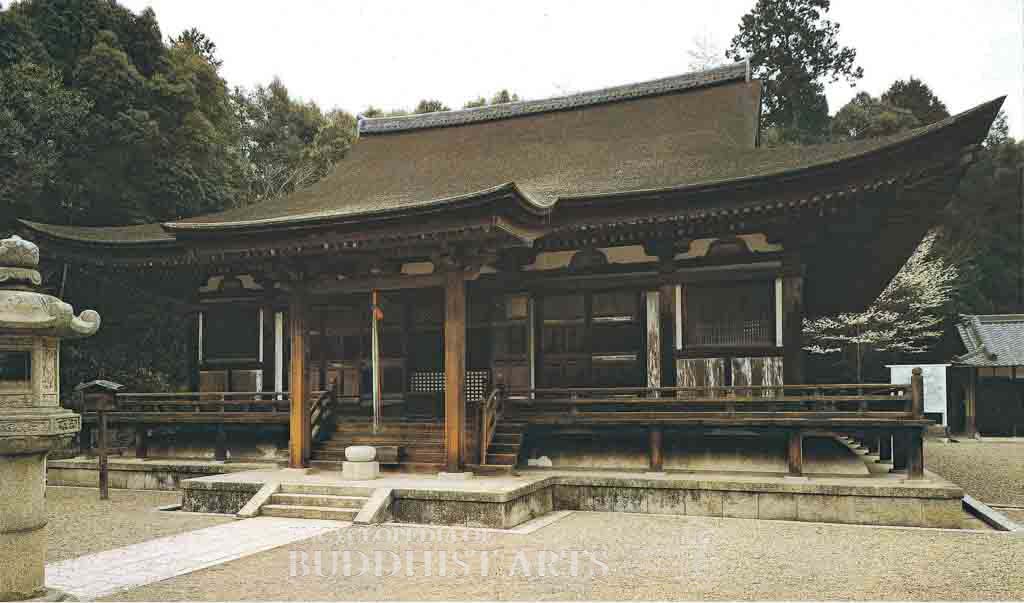
Chokyuji Temple Main Hall
Chokyuji Temple Main Hall
JAPAN, Nara, Ikoma
The temple, which belongs to the Shingon school, was built by monk Gyoki during the Nara period (710–794). The records and inscriptions on the beams state that the main hall was built in 1279. It is an example of a Buddhist hall from the mid-Kamakura period (1185–1333). It was listed as a National Treasure in 1953.
The five-by-six bay hall has a single-eave hip-and-gable roof covered in cypress bark. The hall is surrounded by a veranda, and the front eaves are extended in the center to form a portico. There are lattice doors and mullioned windows on the front and sides of the hall. The interior is divided by lattice doors into the worship area and the inner shrine, which are both three bays deep. There are square and diamond patterns on the lattice doors. The ceiling is also decorated in lattice work. The inner shrine has an altar on which there is a wooden sculpture of the Eleven-Headed Avalokitesvara Bodhisattva. This sculpture is listed as an Important Cultural Property.
For more details, go to the Encyclopedia of Buddhist Arts: Architecture A-F, page 155.
Cite this article:
author = Hsingyun and Youheng and Johnson, Peter and Mankuang and Lancaster, Lewis,
booktitle = {Encyclopedia of Buddhist Arts: Architecture A-F},
pages = 155,
title = {{Chokyuji Temple Main Hall}},
volume = 1,
year = {2016}}