
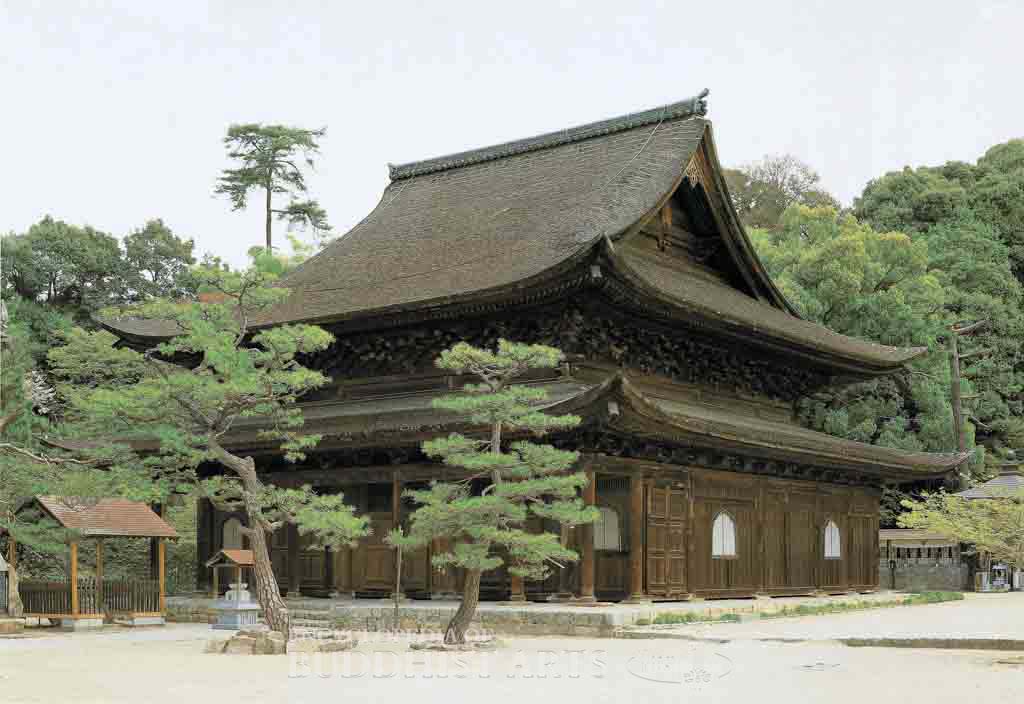
Fudoin Temple Golden Hall
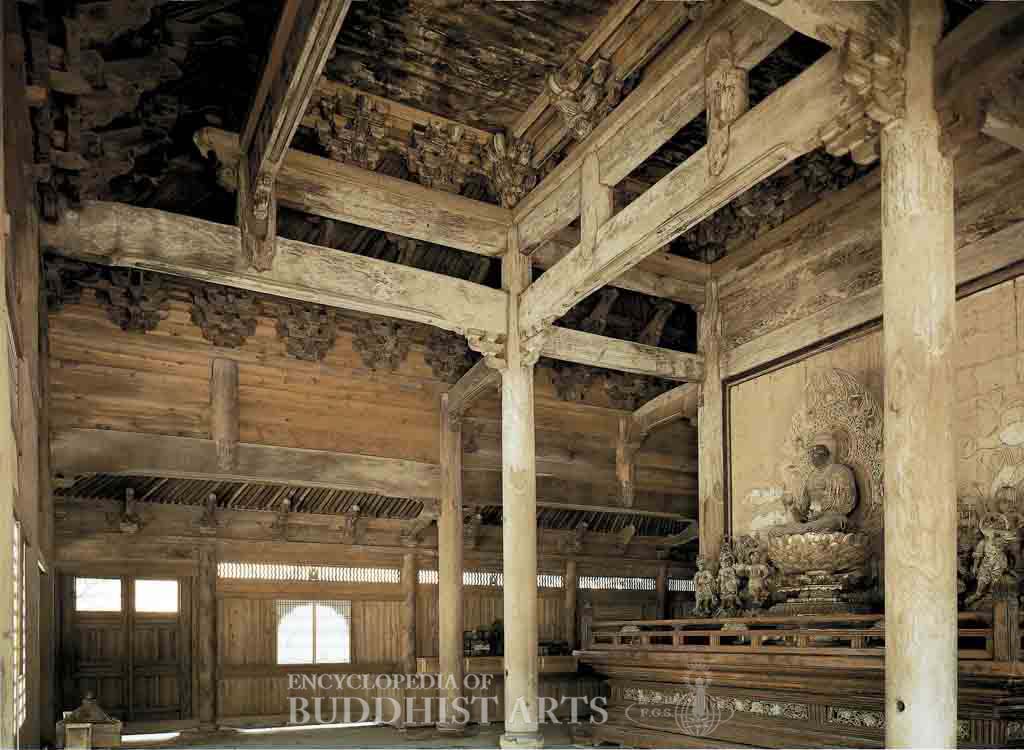
Fudoin Temple Golden Hall (interior)
Fudoin Temple Golden Hall
JAPAN, Hiroshima, Higashi
The hall was constructed in 1540 during the Muromachi period, and moved from Yamaguchi to its current location between 1573 and 1592 during the Azuchi-Momoyama period. It is the largest Zen hall built during the Japanese Medieval period (1185–1573) and it was listed as a National Treasure in 1958.
The three-by-four bay hall has a double-eave hip-and-gable roof covered with cypress shingles. There is a portico at the front of the hall. Inside there is a worshipping area and a shrine with a Buddha statue sitting on a Sumeru throne. The roof structure is supported by columns and tie beams with camel humps and bracket sets. The high plafond, measuring 8.6 m in height, produces a sense of spaciousness. The hall is a fine example of a Zen-style structure.
For more details, go to the Encyclopedia of Buddhist Arts: Architecture A-F, page 344.
Cite this article:
author = Hsingyun and Youheng and Johnson, Peter and Mankuang and Lancaster, Lewis,
booktitle = {Encyclopedia of Buddhist Arts: Architecture A-F},
pages = 344,
title = {{Fudoin Temple Golden Hall}},
volume = 1,
year = {2016}}