
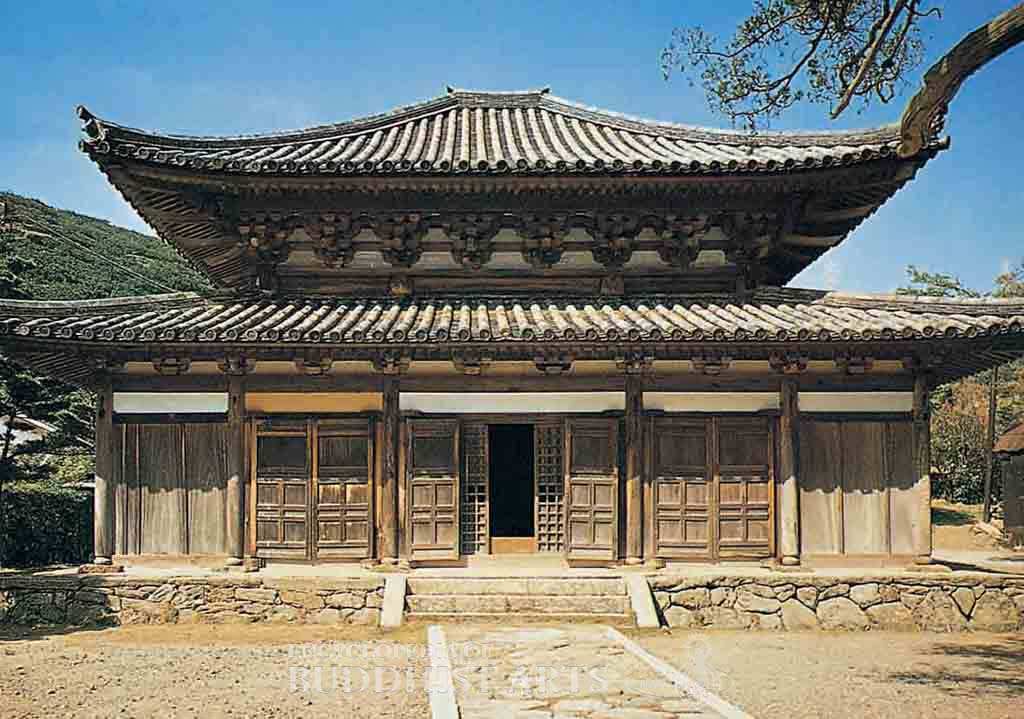
Zenpukuin Temple Sakyamuni Hall
Zenpukuin Temple Sakyamuni Hall
JAPAN, Wakayama, Kainan
The temple originally belonged to the Zen school but later changed to the Tendai school of Japanese Buddhism. It was built by Master Eisai in 1214 during the Kamakura period. According to the inscription found on the seated Sakyamuni Buddha statue, the hall was rebuilt in 1327 during the Kamakura period. It was listed as a National Treasure in 1953.
The five-bay wide hall is built on a stone base. It has a double-eave hip roof covered in cylindrical tiles. The lower roof is supported by single-tier bracket sets, while the upper roof is supported by three-tier bracket sets. The rafters are laid parallel to each other. There are doors in the three central bays and plain wooden walls in the outer bays. The building is a fine example of the simple Zen architectural style of the Kamakura period (1185–1333).
For more details, go to the Encyclopedia of Buddhist Arts: Architecture T-Z, page 1389.
Cite this article:
author = Hsingyun and Youheng and Johnson, Peter and Mankuang and Lancaster, Lewis,
booktitle = {Encyclopedia of Buddhist Arts: Architecture T-Z},
pages = 1389,
title = {{Zenpukuin Temple Sakyamuni Hall}},
volume = 4,
year = {2016}}