
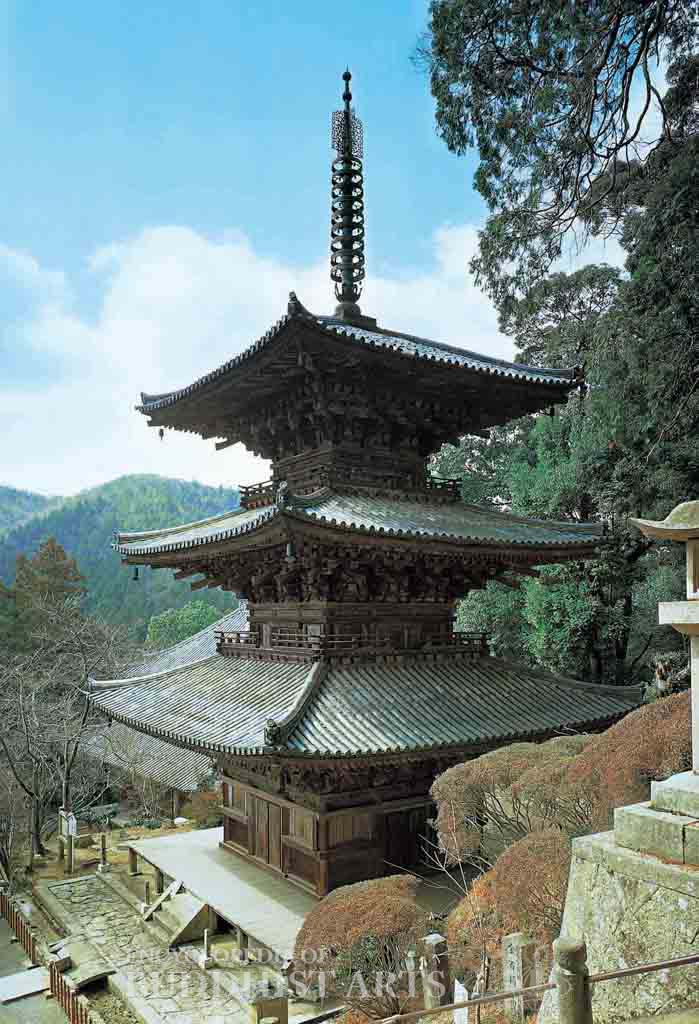
Ichijoji Temple Three-Tier Pagoda
Ichijoji Temple Three-Tier Pagoda
JAPAN, Hyogo, Kasai
According to the inscription found at the top of the pagoda, it was built in 1171 during the late Heian period. It was listed as a National Treasure in 1952.
The three-by-three bay pagoda measures 21.8 m in height and has a roof made of cylindrical tiles. The first story measures 4.8 m on each side and it is surrounded by a veranda. Three-tier bracket sets are used to support the extended eaves, resulting in a sense of strength and stability. The floor has wooden floorboards. The central pillar starts in the ceiling of the first story. An altar is set up in the center. The spire consists of a harmika, inverted bowl, upturned lotus, nine stacked rings, a flame and jewels.
For more details, go to the Encyclopedia of Buddhist Arts: Architecture G-L, page 489.
Cite this article:
author = Hsingyun and Youheng and Johnson, Peter and Mankuang and Lancaster, Lewis,
booktitle = {Encyclopedia of Buddhist Arts: Architecture G-L},
pages = 489,
title = {{Ichijoji Temple Three-Tier Pagoda}},
volume = 2,
year = {2016}}