
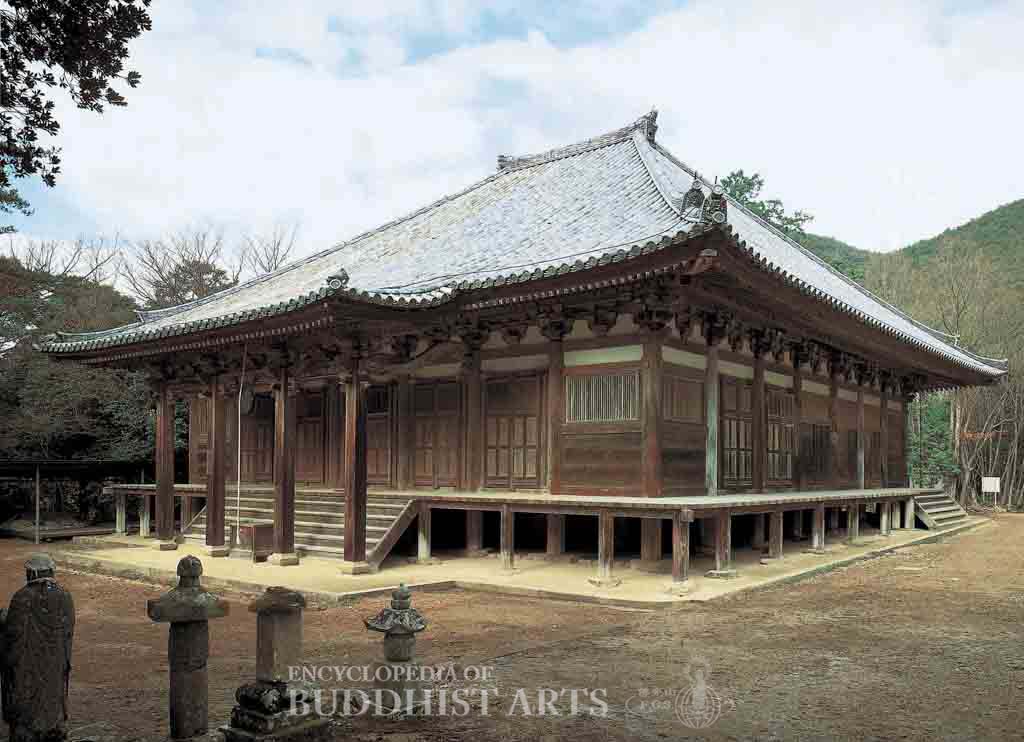
Chokoji Temple Main Hall
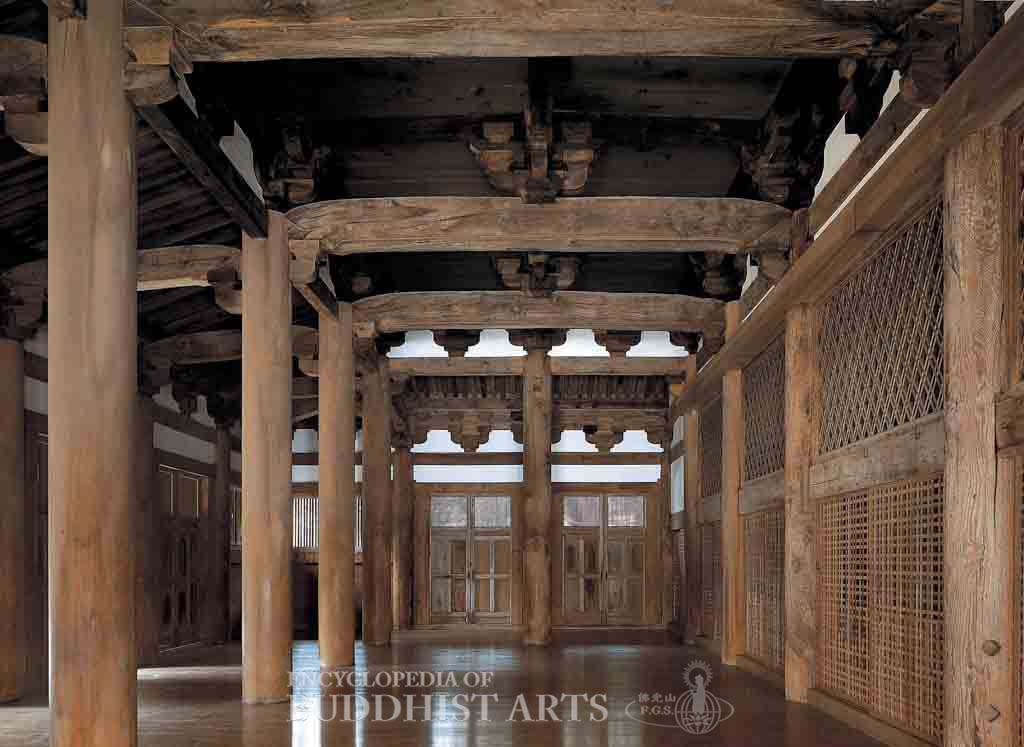
Chokoji Temple Main Hall (interior)
Chokoji Temple Main Hall
JAPAN, Hyogo, Kato
The temple belongs to the Shingon school and was built in 650 during the Hakuho period. According to inscriptions found in the altar, the main hall was built in 1413 during the Muromachi period. The building is a fusion of traditional Japanese and Buddhist Zen styles. The hall was listed as a National Treasure in 1954.
The seven-by-seven bay hall has a single-eave hip roof covered with cylindrical tiles. There is a three-bay wide portico at the front. The three central bays have lattice doors, while the outer bays have mullioned windows. Inside the roof a frame of columns and beams is exposed. Bracket sets at the capitals of the columns support the eaves. The interior is laid with floorboards. It is divided into an inner shrine and a worship area by a partition door decorated with flowery square and diamond patterns. On top of a Sumeru platform there is a cabinet containing a standing statue of a Thousand-Armed Avalokitesvara Bodhisattva.
For more details, go to the Encyclopedia of Buddhist Arts: Architecture A-F, page 154.
Cite this article:
author = Hsingyun and Youheng and Johnson, Peter and Mankuang and Lancaster, Lewis,
booktitle = {Encyclopedia of Buddhist Arts: Architecture A-F},
pages = 154,
title = {{Chokoji Temple Main Hall}},
volume = 1,
year = {2016}}