
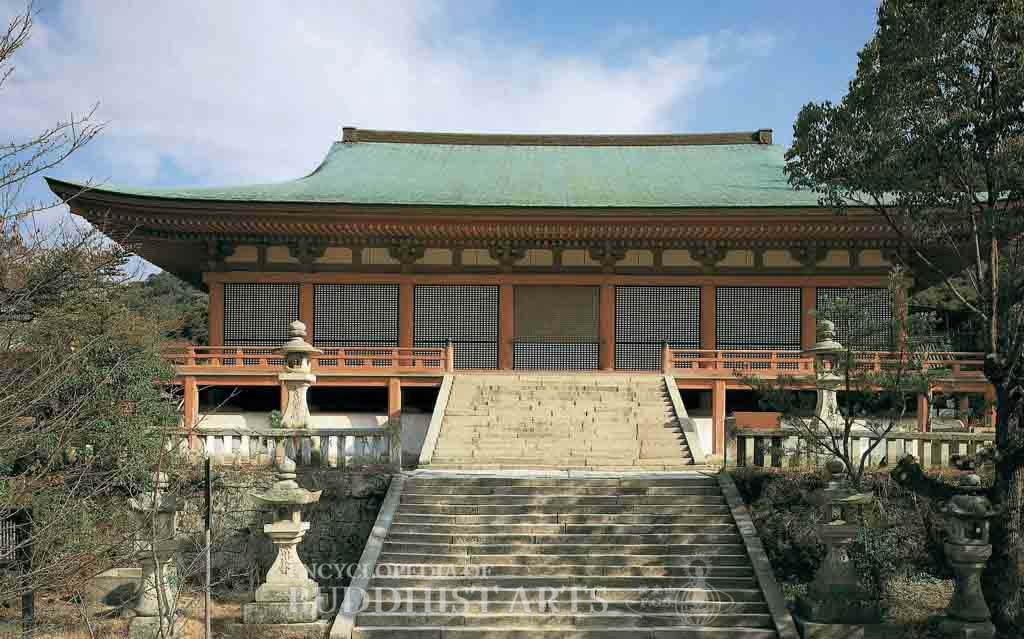
Taisanji Temple Main Hall
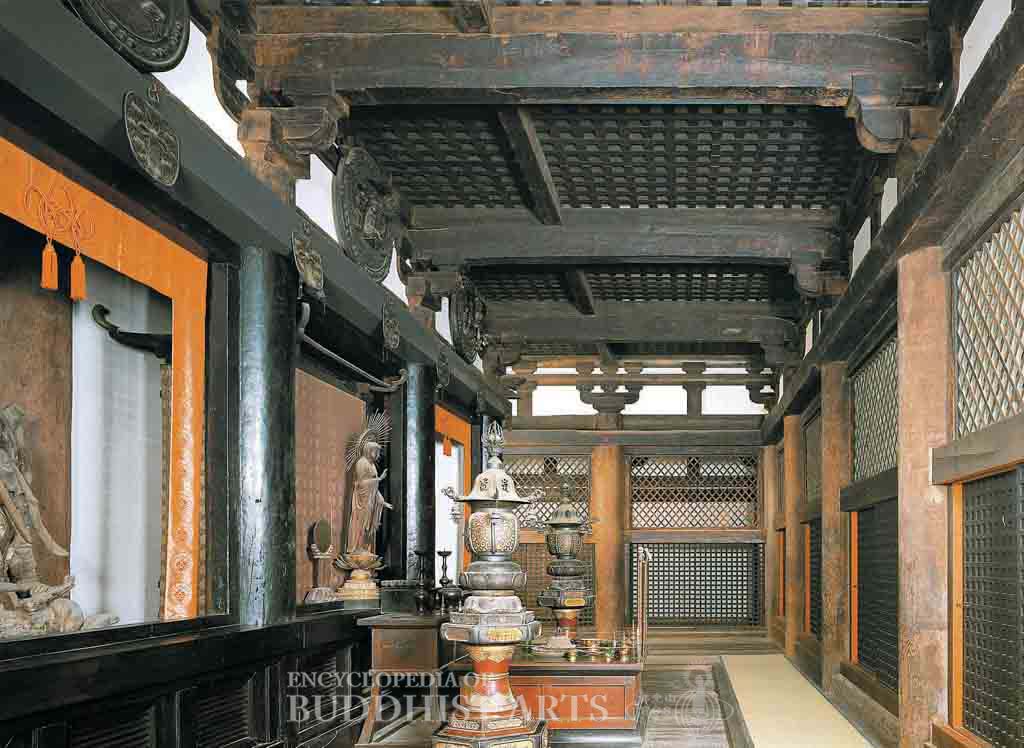
Taisanji Temple Main Hall (interior)
Taisanji Temple Main Hall
JAPAN, Hyogo, Kobe
The temple belongs to the Tendai school of Japanese Buddhism and was founded during the Nara period (710–794). The main hall was rebuilt during the Kamakura period (1185–1333) after a disastrous fire. It was listed as a National Treasure in 1955.
The seven-by-six bay hall has a single-eave hip-and-gable roof covered in cylindrical tiles. There are simple three-tier bracket sets supporting the eaves. It is an open-style Buddha hall with seven sash windows and a wooden door at the side. The interior is divided by a diamond-shaped lattice window and a square lattice door into a worship space at the front and a three-bay inner shrine at the rear. In front of the images depicting Amitabha and the Western Pure Land there are four thick columns connected by horizontal beams. The ceiling is coffered. Buddha statues are enshrined within the main hall. With minimal decoration, this main hall is an example of the classical architectural style of the Japanese Medieval period (1185–1573). The temple also houses Important Cultural Properties, such as paintings of the Sakyamuni Buddha Triad and the Lotus Sutra Mandala.
For more details, go to the Encyclopedia of Buddhist Arts: Architecture T-Z, page 1082.
Cite this article:
author = Hsingyun and Youheng and Johnson, Peter and Mankuang and Lancaster, Lewis,
booktitle = {Encyclopedia of Buddhist Arts: Architecture T-Z},
pages = 1082,
title = {{Taisanji Temple Main Hall}},
volume = 4,
year = {2016}}