
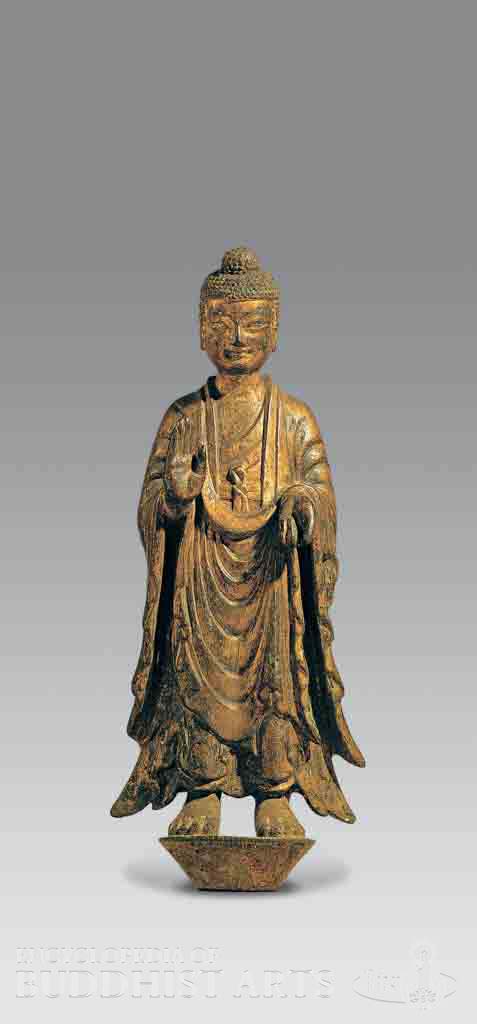
Standing Buddha
Gilt bronze
Standing Buddha
CHINA; Northern Wei dynasty
The treatment of the head of this statue, with its simplified curls and mounded usnisa, is conventional. The Buddha’s right hand is in abhaya (fearlessness) mudra while the left hand is in a mudra where the third and fourth fingers are closed into the palm. The Buddha wears a monastic robe that opens at the front to reveal a knotted inner robe. The folds cascade downward in rippled waves where the material falls over the wrists to flare out around the ankles. The figure stands on a simple pedestal on which lotus petals are engraved.
For more details, go to the Encyclopedia of Buddhist Arts: Sculpture St-Z, page 1130.
Cite this article:
Hsingyun, et al. "Standing Buddha." Encyclopedia of Buddhist Arts: Sculpture St-Z, vol. 13, 2016, pp. 1130.
Hsingyun, Youheng, Yann Lovelock, Yuan Chou, Susan Huntington, Gary Edson, and Robert Neather. 2016. "Standing Buddha" In Encyclopedia of Buddhist Arts: Sculpture St-Z, 13:1130.
Hsingyun, Youheng, Lovelock, Y., Chou, Y., Huntington, S., Edson, G., & Neather, R.. (2016). Standing Buddha. In Encyclopedia of Buddhist Arts: Sculpture St-Z (Vol. 13, pp. 1130).
@misc{Hsingyun2016,
author = Hsingyun and Youheng and Lovelock, Yann and Chou, Yuan and Huntington, Susan and Edson, Gary and Neather, Robert,
booktitle = {Encyclopedia of Buddhist Arts: Sculpture St-Z},
pages = 1130,
title = {{Standing Buddha}},
volume = 13,
year = {2016}}
author = Hsingyun and Youheng and Lovelock, Yann and Chou, Yuan and Huntington, Susan and Edson, Gary and Neather, Robert,
booktitle = {Encyclopedia of Buddhist Arts: Sculpture St-Z},
pages = 1130,
title = {{Standing Buddha}},
volume = 13,
year = {2016}}