
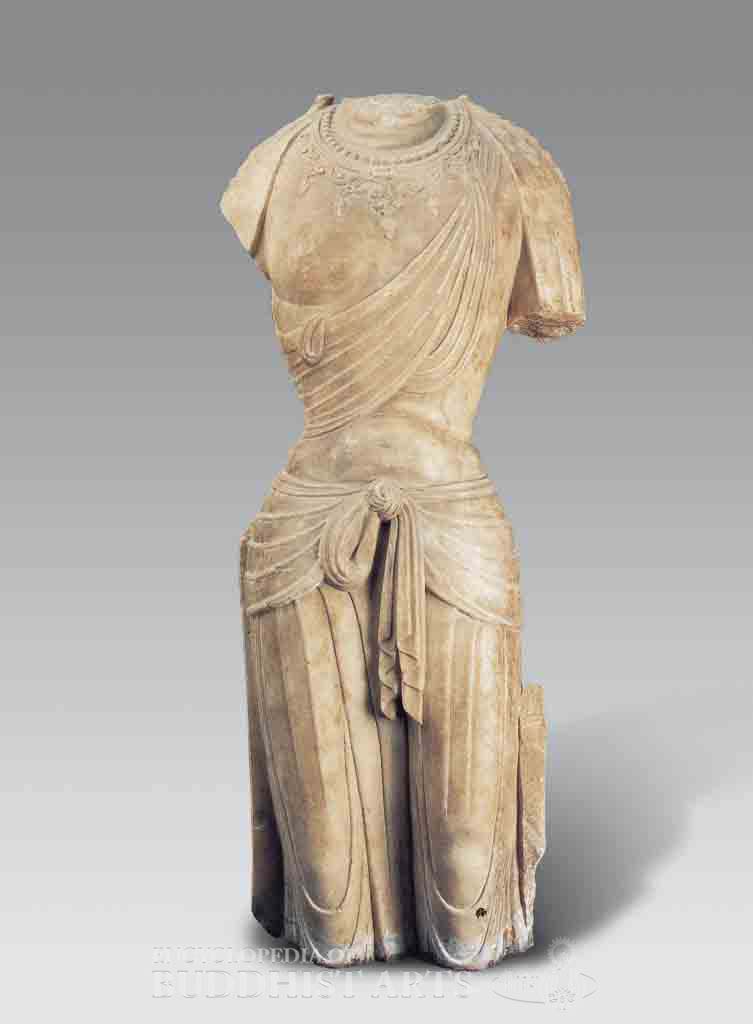
Xi’an Daming Palace: Standing Bodhisattva
Marble
Xi’an Daming Palace: Standing Bodhisattva
CHINA, Shaanxi, Xi’an; Tang dynasty
The statue was discovered from the ruins of Daming Palace in Xi’an. The amount of careful detail on this statue makes it a cause of regret it has only survived in a damaged state. The necklace is carved on the body in bas-relief, while the knot at the waist is brought forward in mid-relief. The folds of the garment and the stole are realistically delineated. The left leg is advanced and slightly bent, so the hips sway to one side in a slight tribhanga posture. Although the waist is unnaturally slim, the roll of fat about the stomach gives it lifelike touch, adding to the realistic treatment that is often seen in High Tang period (712–756) artwork. The statue has often been touted as the Asian Venus de Milo.
For more details, go to the Encyclopedia of Buddhist Arts: Sculpture St-Z, page 1368.
Cite this article:
author = Hsingyun and Youheng and Lovelock, Yann and Chou, Yuan and Huntington, Susan and Edson, Gary and Neather, Robert,
booktitle = {Encyclopedia of Buddhist Arts: Sculpture St-Z},
pages = 1368,
title = {{Xi’an Daming Palace: Standing Bodhisattva}},
volume = 13,
year = {2016}}