
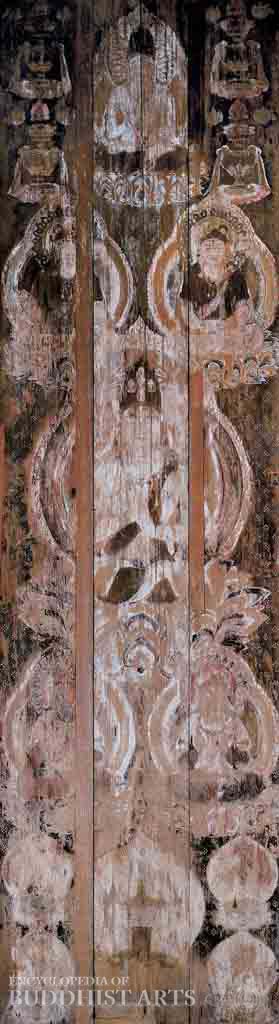
Daigoji Temple Five-Story Pagoda Murals: Diamond Realm Mandala (central pillar, east side)
Mural on wood
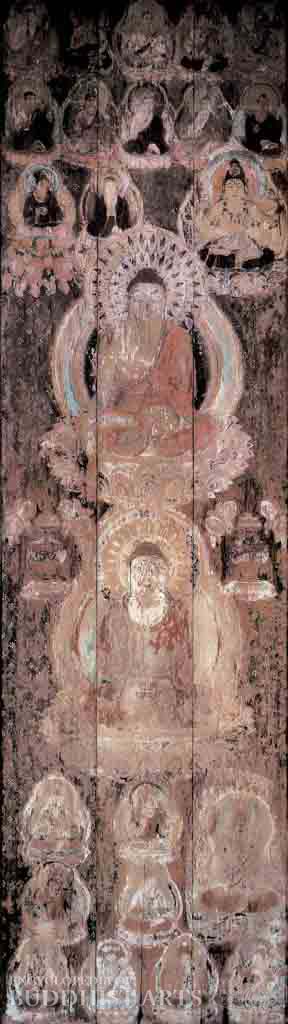
Daigoji Temple Five-Story Pagoda Murals: Womb Realm Mandala (central pillar, north side)
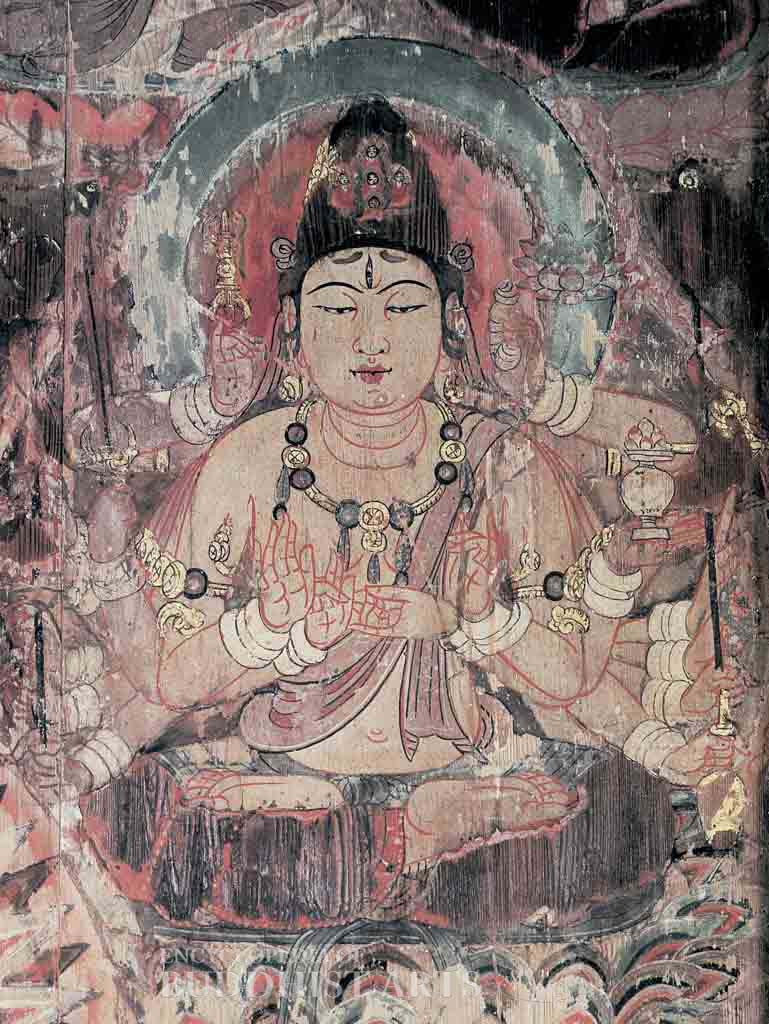
Daigoji Temple Five-Story Pagoda Murals: Womb Realm Mandala - Cundi (central pillar, north side)
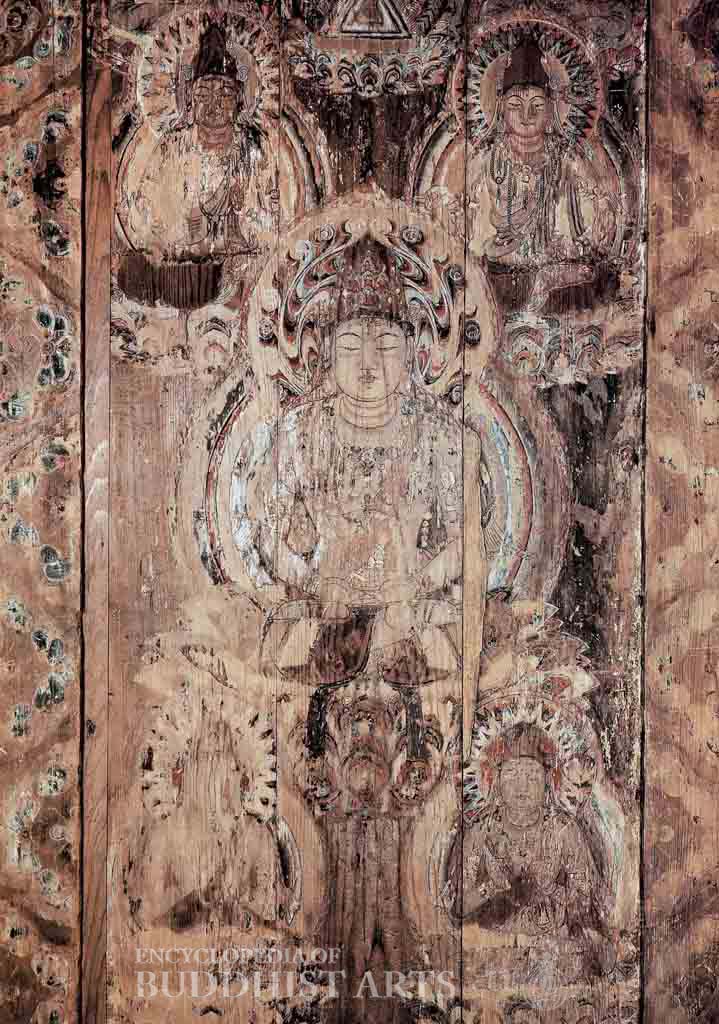
Daigoji Temple Five-Story Pagoda Murals: Womb Realm Mandala - Eight Petal Hall (central pillar, south side)
Daigoji Temple Five-Story Pagoda Murals
JAPAN, Kyoto; Heian period
These murals, painted on wood on the first story of the five-story pagoda of Daigoji Temple, were completed in 951 of the Heian period, around the same time as the completion of the pagoda. The 18 murals on the central pillar and walls include representations of the Womb Realm Mandala and Diamond Realm Mandala, the eight patriarchs of the Shingon school, and the kings of the eight directions. Listed as a National Treasure in 1976, these are some of the most significant of the few surviving Heian period (794–1185) murals.
Among the four murals on the central pillar, the east mural focuses on the assembly of the perfected body and includes images of the single mudra assembly and the samaya assembly. The west mural depicts Vairocana Buddha and the Bodhisattvas Samantabhadra, Maitreya, Manjusri, and Avalokitesvara. The north and south wall murals portray the halls to the left and right of the eight petal hall in Womb Realm Mandala. There are also images of the eight patriarchs of the Shingon school, where were based on the portraits of the patriarchs painted by Li Zhen. These paintings were brought back from China by the monk Kukai during the Tang dynasty (618–907).
The figures in the murals are neatly arranged. They were outlined in red strokes before thick colors were applied, a style influenced by Tang dynasty art. The mandorlas and thrones are shaded in gentle hues. These murals are an example of the shift toward the Wayo painting style that began in the mid-Heian period.
For more details, go to the Encyclopedia of Buddhist Arts: Painting A-H, page 179.
Cite this article:
author = Hsingyun and Youheng and Youlu and Wilson, Graham and Manho and Mankuang and Huntington, Susan,
booktitle = {Encyclopedia of Buddhist Arts: Painting A-H},
pages = 179,
title = {{Daigoji Temple Five-Story Pagoda Murals}},
volume = 14,
year = {2016}}