
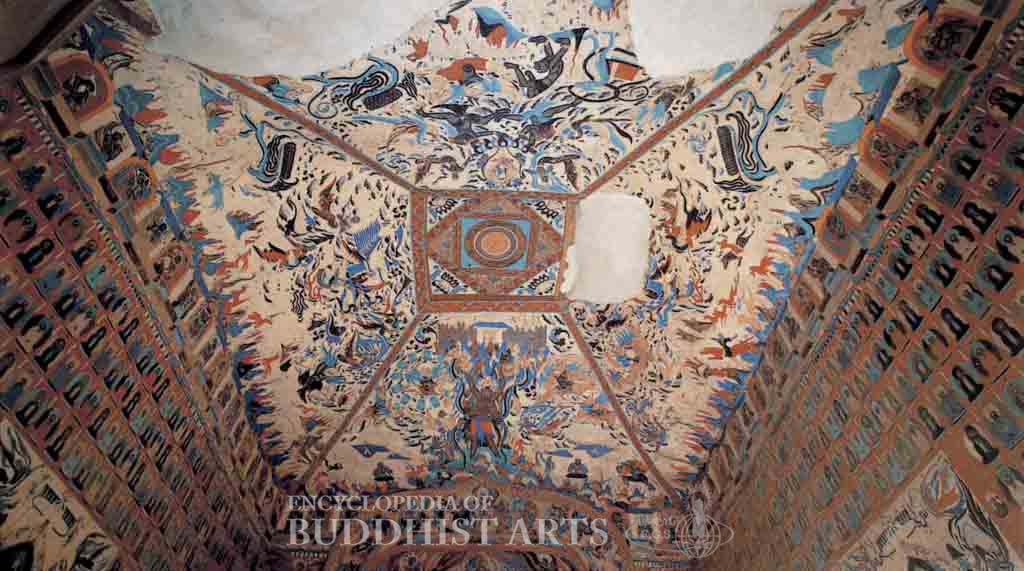
Mogao Cave 249: Ceiling
Mogao Cave 249: Ceiling
CHINA, Gansu, Dunhuang; Western Wei dynasty
A circle and diamond-in-square motifs are painted in the center of the truncated pyramidal ceiling, with a lotus flower, the petals now barely discernible, in the middle, and honeysuckle motifs in each corner of the largest square. On the surrounding four slopes of the ceiling are depictions of the heavens. On the west slope is an asura, alongside of which are the Wind Deity, Thunder Deity, a garuda, and others. On the east slope is a wish-fulfilling jewel surrounded by apsaras. On the north slope is a portrayal of a male deity riding a dragon carriage, surrounded by male heavenly beings riding dragons, beneath which is a hunting scene, and on the south slope is a portrayal of a female deity riding a phoenix carriage, accompanied by female heavenly beings riding phoenixes. At the bottom of the four slopes are mountains and forests. The overall theme is that of the convergence of heaven and earth.
The truncated pyramidal ceiling as an architectural element in caves became the standard since the Western Wei dynasty.
For more details, go to the Encyclopedia of Buddhist Arts: Caves M-Mo, page 1059.
Cite this article:
author = Hsingyun and Youheng and Johnson, Peter and Mankuang and Huntington, Susan and Edson, Gary and Neather, Robert,
booktitle = {Encyclopedia of Buddhist Arts: Caves M-Mo},
pages = 1059,
title = {{Mogao Cave 249: Ceiling}},
volume = 7,
year = {2016}}