
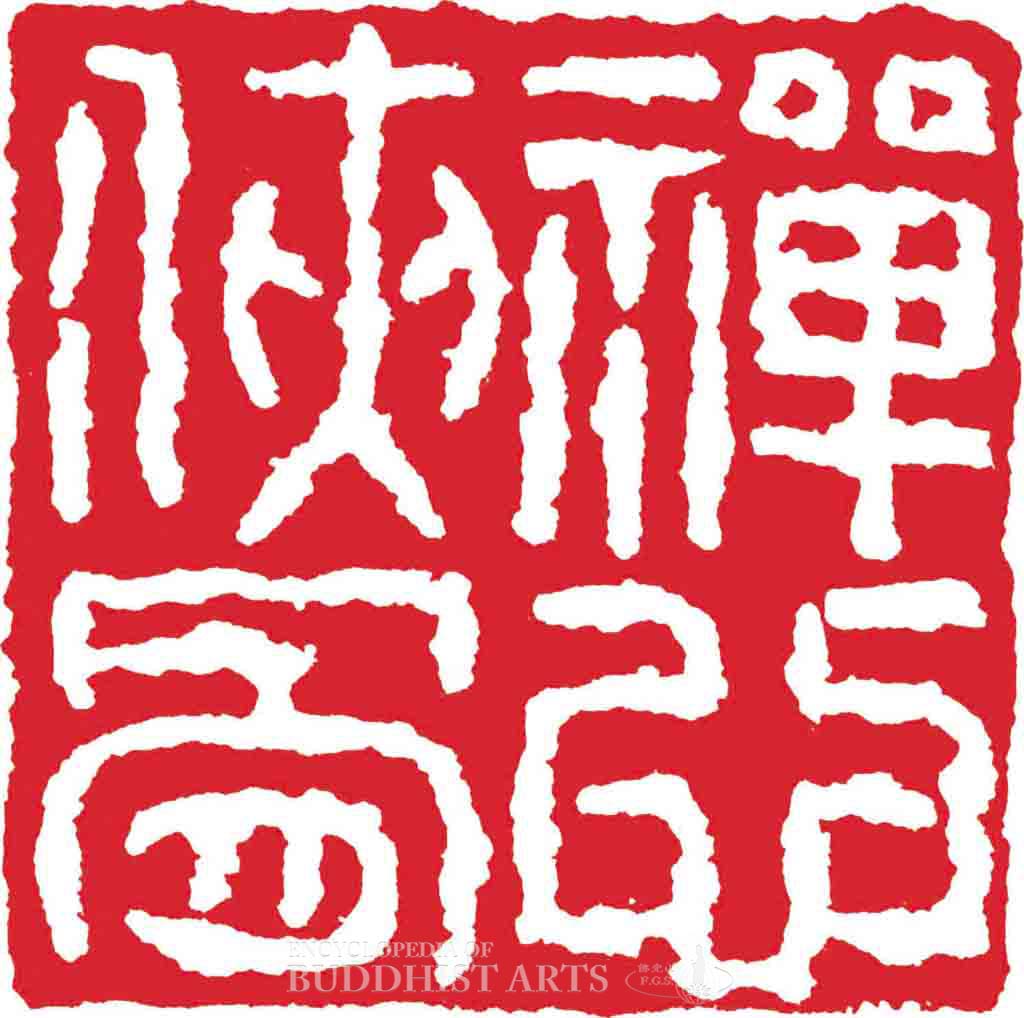
Chan Mind With a Righteous Nature
White-character square seal
Chan Mind With a Righteous Nature
CHINA; Qing dynasty
The cutting of this seal followed the guidelines set forth by the Qin (221–207 BCE) and Han (206 BCE–220 CE) dynasties. Each of its four characters was placed in one of the four corners, bringing order and balance to the piece. Zhejiang school engraving techniques can be seen in the unique cutting of this seal, which features broken carved lines, although the style was inherited from the Wuxian school. Overall, it exudes a serene, elegant, and scholarly appeal. This particular work was highly valued by the Xiling Seal Art Society, and Yinxian Pavilion Stele was erected in its honor.
Yang Xie was also known as Longshi. A native of Wujiang, Jiangsu, he was a seal engraver and was also competent in prose and poetry. He also specialized in the archaeological study of epigraphy. He initially learned the techniques of the Zhejiang school, but later adopted the strengths of Wuxian school artists such as Wen Peng, Gu Ling, and Xu Jian.
For more details, go to the Encyclopedia of Buddhist Arts: Calligraphy, page 293.
Cite this article:
author = Hsingyun and Youheng and Youlu and Pokorski, Stefanie and Mankuang and Edson, Gary,
booktitle = {Encyclopedia of Buddhist Arts: Calligraphy },
pages = 293,
title = {{Chan Mind With a Righteous Nature}},
volume = 17,
year = {2016}}