
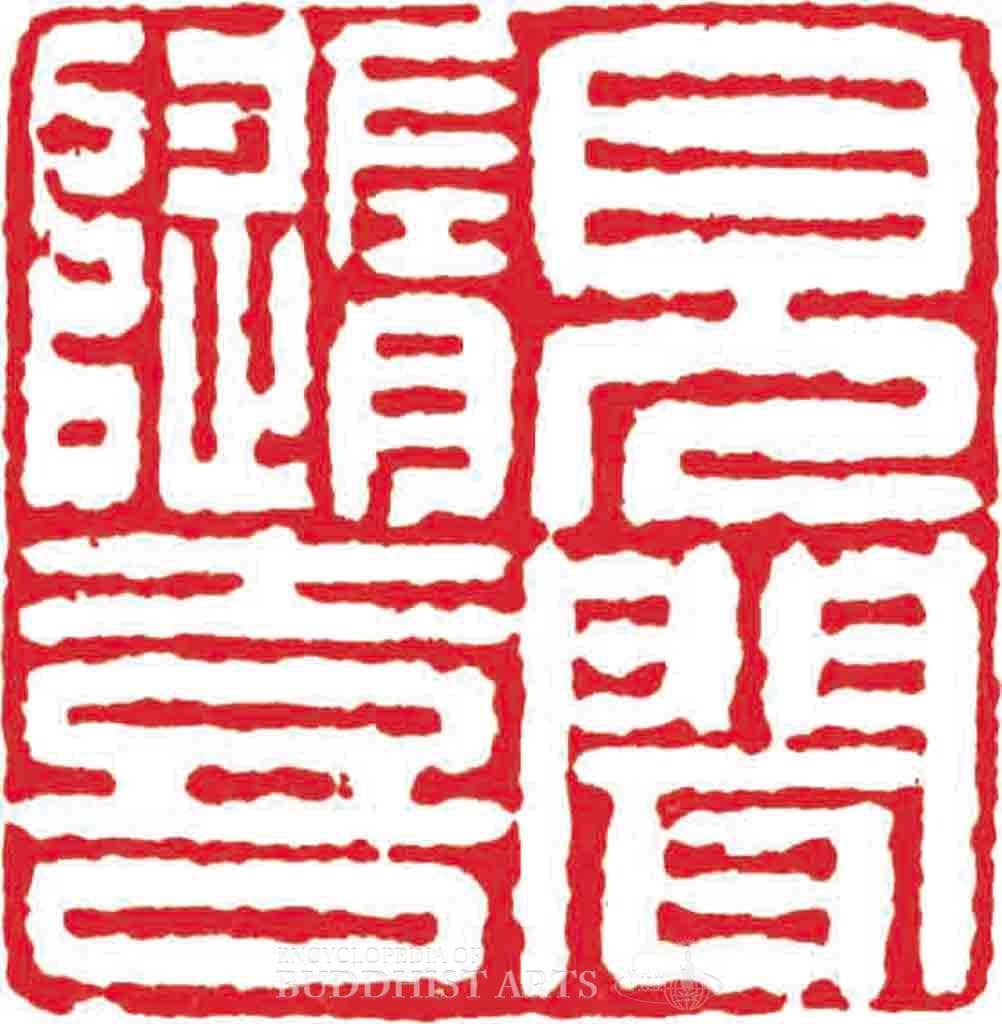
Rejoice upon Witnessing Good
White-character square seal
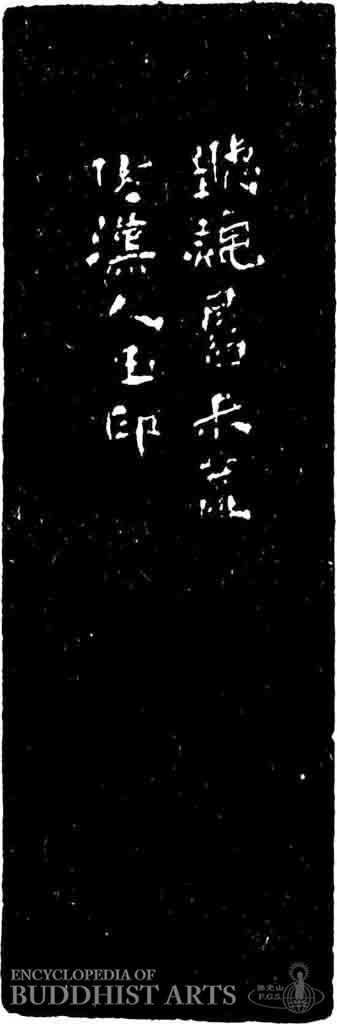
Rejoice upon Witnessing Good (side colophon)
Rejoice upon Witnessing Good
CHINA; Qing dynasty
Derived from the Golden Light Sutra, “rejoice upon witnessing good” is a thought impling that when one encounters others doing good deeds, chanting or practicing sutras, a sense of happiness will arise in one’s heart. A colophon on the side of the seal reads, “Property of Ting Qiu; copy of a Han jade seal by Shu Gai.”
This seal is carved in a rigorous, well-proportioned style with the four characters evenly spread out across the surface. Unlike Zhejiang school works, the incisions are smooth and leave no rough edges. At each turn in carving the characters, the script appears rounded within an inherent square form. Indicative of traditional Han jade seal cutting, the design of this seal is simultaneously firm and flexible.
Qian Song was originally named Songru and was also known as Shu Gai, among several other aliases. A seal engraver, calligrapher, and painter from Qiantang (present day Hangzhou, Zhejiang), he was reputed as one of the Eight Masters of Xiling.
For more details, go to the Encyclopedia of Buddhist Arts: Calligraphy, page 322.
Cite this article:
author = Hsingyun and Youheng and Youlu and Pokorski, Stefanie and Mankuang and Edson, Gary,
booktitle = {Encyclopedia of Buddhist Arts: Calligraphy },
pages = 322,
title = {{Rejoice upon Witnessing Good}},
volume = 17,
year = {2016}}