
Self-Abandonment to Dunhuang
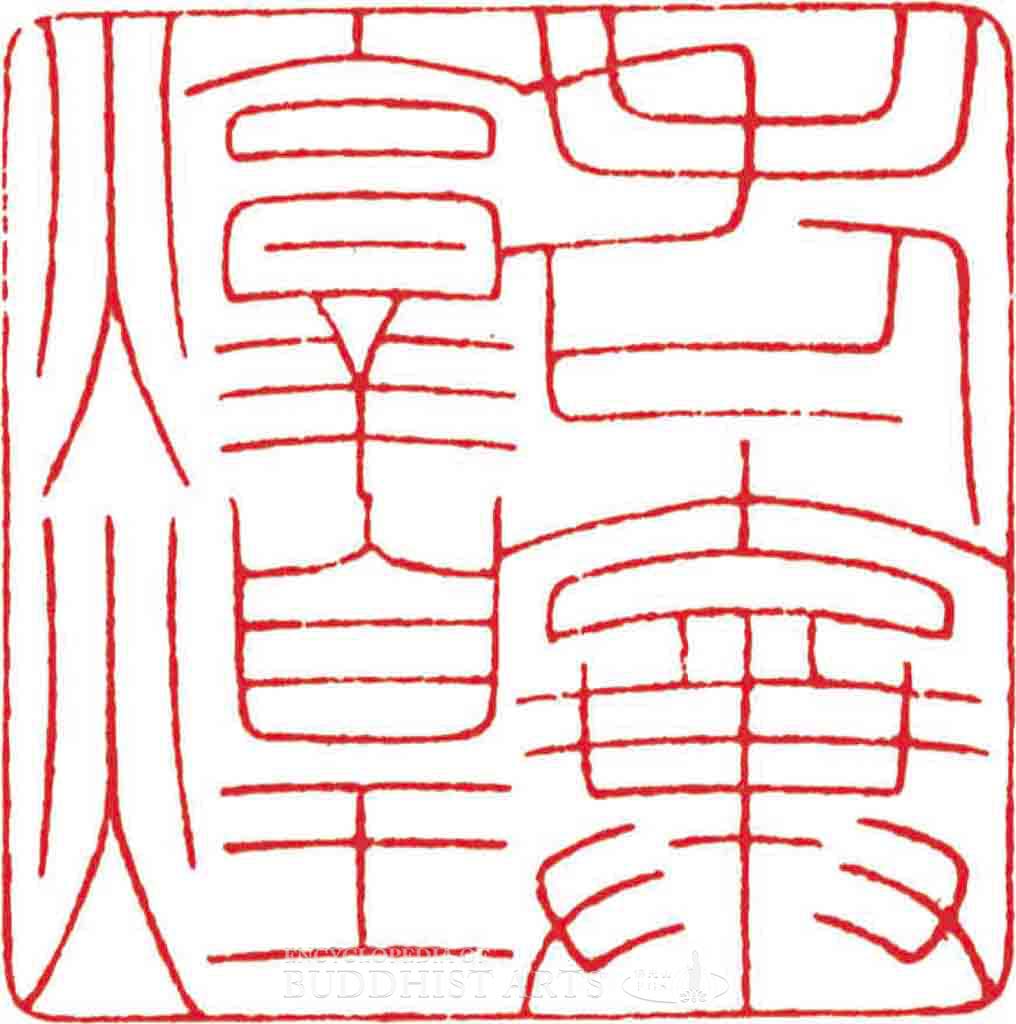
Red-character square seal
Self-Abandonment to Dunhuang
TAIWAN
The official seal of “Self-Abandonment to Dunhuang” was often seen on Chang Dai-Chien’s copies of Dunhuang murals. Chang requested a copy of this seal to be carved and it was used by him as a sort of self-praise for his ability to copy the ancient Dunhuang murals with new techniques and style.
Carved from ivory with a smooth layout and scripts as thin and strong as iron strings, the piece takes on a novel aspect. Delicate and ingenious in style, the influence of Wang Ti is evident in the powerful cutting technique seen in this seal.
Dun Lifu was a native of Baoding, Hebei from the 20th century and later lived in Beijing. While working for the renowned seal engraver, Wang Ti, he collected Wang’s discarded drafts and imitated them. Later, he learned seal engraving from Wang himself and was also influenced by Chen Julai.
For more details, go to the Encyclopedia of Buddhist Arts: Calligraphy, page 328.
Cite this article:
author = Hsingyun and Youheng and Youlu and Pokorski, Stefanie and Mankuang and Edson, Gary,
booktitle = {Encyclopedia of Buddhist Arts: Calligraphy },
pages = 328,
title = {{Self-Abandonment to Dunhuang}},
volume = 17,
year = {2016}}