
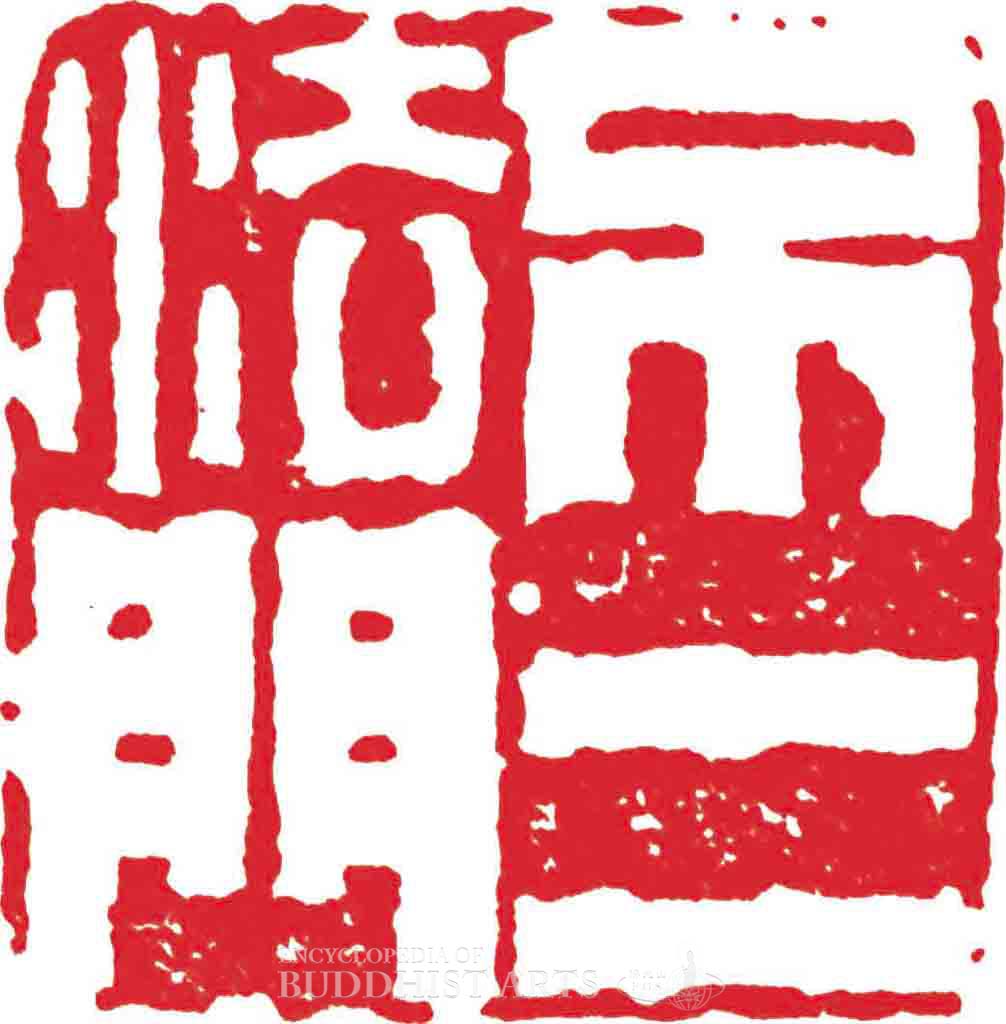
Dharma Gate of Non-Duality
White-character square seal
Dharma Gate of Non-Duality
CHINA; Qing dynasty
Borrowed from the Vimalakirti Sutra, “Bu’er Famen” is a term that refers to entering through the Dharma gate of non-duality; in other words, it represents the act of leaving all things, particularly thoughts, questions, and knowledge behind in order to attain true realization, or non-duality. In Buddhist doctrine, this phrase and its attached ideology has come to be thought of as the “one and only way.”
The four characters of this seal are evenly spaced across its square confines. Three out of the four characters are carved in bold, straight contours, while the last is comprised of thin lines. The peculiarity of this contrast is striking yet harmonious, thereby presenting not only a strong expression of the words, but a sense of subtly as well. Cut in a stable and steady manner, the carving embraces the Zhejiang school method of uneven entry.
A native of Huating (present day Shanghai), Yang Ruxie was a seal engraver and painter. His calligraphy was modeled after that of Mi Fu and Dong Qichang, and his seal cutting style strayed from the popular Qin (221–207 BCE) and Han (206 BCE–220 CE) dynasties influenced examples that were popular at the time.
For more details, go to the Encyclopedia of Buddhist Arts: Calligraphy, page 295.
Cite this article:
author = Hsingyun and Youheng and Youlu and Pokorski, Stefanie and Mankuang and Edson, Gary,
booktitle = {Encyclopedia of Buddhist Arts: Calligraphy },
pages = 295,
title = {{Dharma Gate of Non-Duality}},
volume = 17,
year = {2016}}