
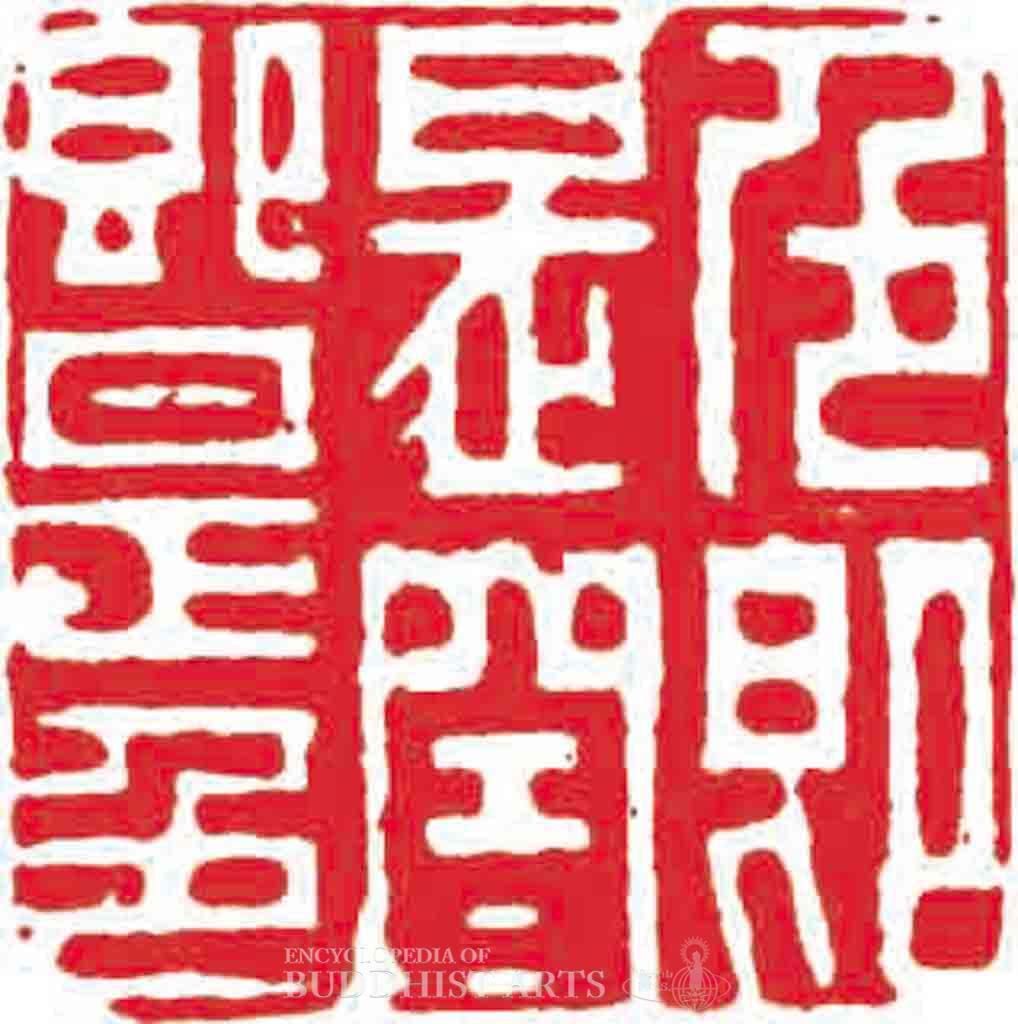
Form is Emptiness and Emptiness is Form
White-character square seal
Form is Emptiness and Emptiness is Form
CHINA; Qing dynasty
Borrowed from the Heart Sutra, the concept, “form is emptiness,” refers to all physical phenomena that arises from causes and conditions which are themselves void and without entity.
The eight characters of this seal are composed in sinuous seal script, resulting in a square, upright, and elegant style. The message is strengthened by the white characters on a red background, which only appear upon stamping, thus further conveying a void and empty ambiance.
Pan Xifeng, also known as Tong Gang or Lao Tong, was from Xinchang, Zhejiang. He later lived in Yangzhou and learned seal engraving under Wang Xuzhou. He was known to be a knowledgeable man who chose to lead a simplistic lifestyle.
For more details, go to the Encyclopedia of Buddhist Arts: Calligraphy, page 299.
Cite this article:
author = Hsingyun and Youheng and Youlu and Pokorski, Stefanie and Mankuang and Edson, Gary,
booktitle = {Encyclopedia of Buddhist Arts: Calligraphy },
pages = 299,
title = {{Form is Emptiness and Emptiness is Form}},
volume = 17,
year = {2016}}