
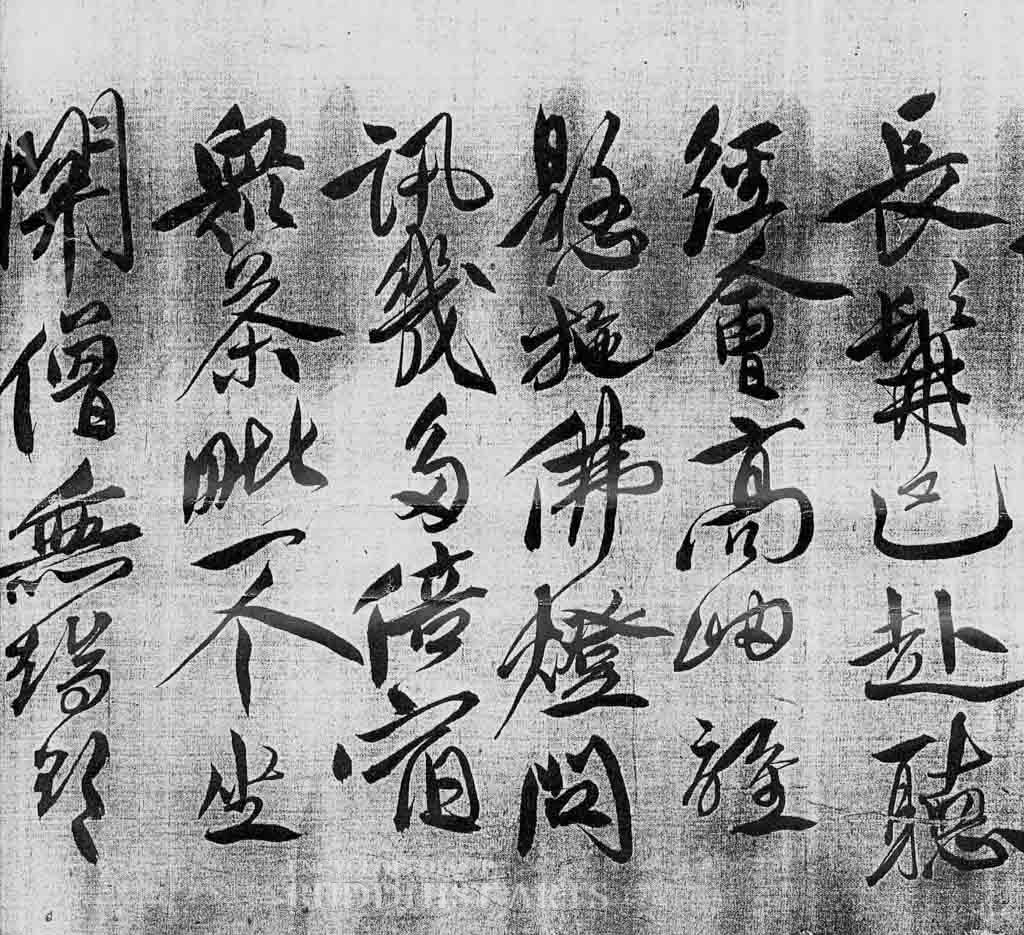
Poem on Tianwa Temple
Ink on silk
Poem on Tianwa Temple
CHINA; Ming dynasty
According to the inscription on the back of the scroll, this poem was written by Xu Wei at the request of a monk from Tianwa Temple. The poem commences with a description of the temple and its scenery, and finishes in lament of the poet’s life experiences and a yearning for a peaceful lifestyle akin to one found in the temple.
Xu Wei, also known as Wenqing or Wenchang, was a Ming dynasty (1368–1944) painter, calligrapher, and scholar. His calligraphy is exuberant and vigorous, and his style of thin, long strokes appears similar to that of Song dynasty (960–1279) calligrapher Huang Tingjian. Ming dynasty poet Yuan Hongdao held Xu Wei in high esteem and remarked that Xu can only be referred to in terms of the “essence and spirit of his calligraphy, rather than its technicalities.” The swift and powerful style of this scroll exudes a dynamic feel almost as if one is facing a stormy gale. Certain decorative strokes appear somewhat superfluous, but nevertheless, this work is regarded as one of Xu’s masterpieces.
For more details, go to the Encyclopedia of Buddhist Arts: Calligraphy, page 177.
Cite this article:
author = Hsingyun and Youheng and Youlu and Pokorski, Stefanie and Mankuang and Edson, Gary,
booktitle = {Encyclopedia of Buddhist Arts: Calligraphy },
pages = 177,
title = {{Poem on Tianwa Temple}},
volume = 17,
year = {2016}}