
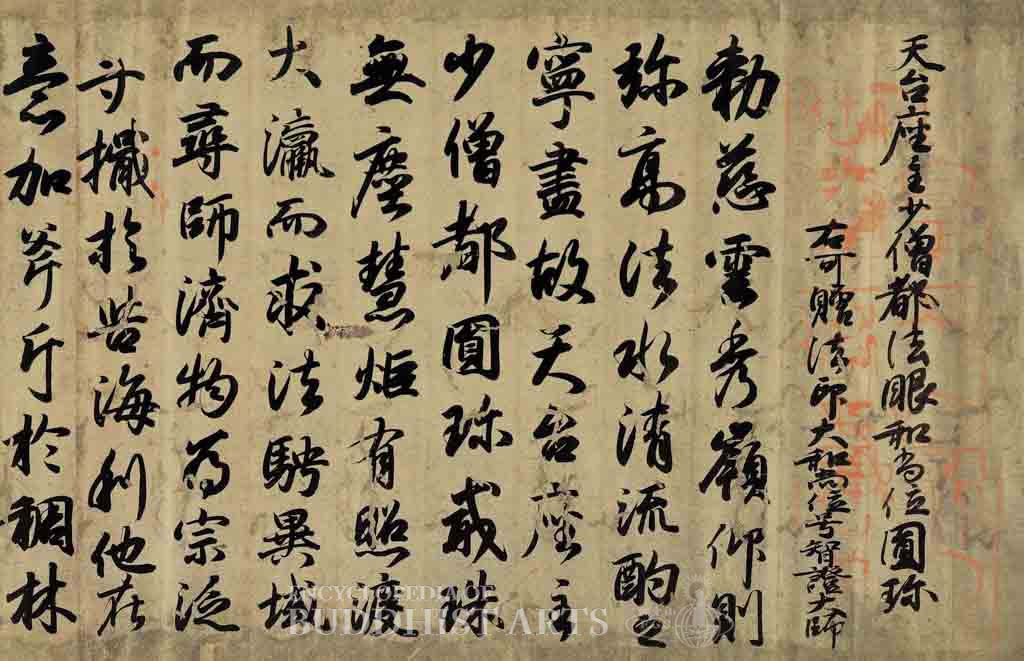
Posthumous Conferment on Master Enchin (right end section)
Ink on paper
Posthumous Conferment on Master Enchin
JAPAN; Heian period
This scroll, originally a work composed by Fujiwara Hirofumi, was transcribed by Ono no Michikaze at the age of 34. The text describes that in the year 927, 36 years after the passing of Master Enchin, Emperor Daigo (reigned 897–930) of the Heian period conferred on the master a posthumous title of Master Chisho (Realization of Wisdom). The scroll was listed as a National Treasure in 1952.
Master Enchin was the founding Patriarch of the Jimon branch of the Tendai school of Buddhism, in addition to being the fifth abbot of Enryakuji Temple. He went to China in 853 and studied Tiantai school teachings, Vajrayana Buddhism, and Siddham. Upon his return to Japan, Enchin brought back with him around 1,000 scrolls of sutras and other translations of Buddhist texts. He established the Tendai school of Vajrayana Buddhism in 868, the teachings of which later formed the Jimon branch.
Ono no Michikaze was a calligrapher of the mid-Heian period (794–1185). Along with Fujiwara no Sukemasa and Fujiwara no Yukinari, he was known as one of the Three Brush Traces, denoting a group of outstanding calligraphers. Ono no Michikaze was the creator of the Wayo style, which was known as the first distinctly Japanese style of calligraphy. The generous use of ink in this piece exhibit the aesthetics of wayoshodo. His writing style, in addition to the wide formation of characters, display influences of Master Kukai.
For more details, go to the Encyclopedia of Buddhist Arts: Calligraphy, page 186.
Cite this article:
author = Hsingyun and Youheng and Youlu and Pokorski, Stefanie and Mankuang and Edson, Gary,
booktitle = {Encyclopedia of Buddhist Arts: Calligraphy },
pages = 186,
title = {{Posthumous Conferment on Master Enchin}},
volume = 17,
year = {2016}}