
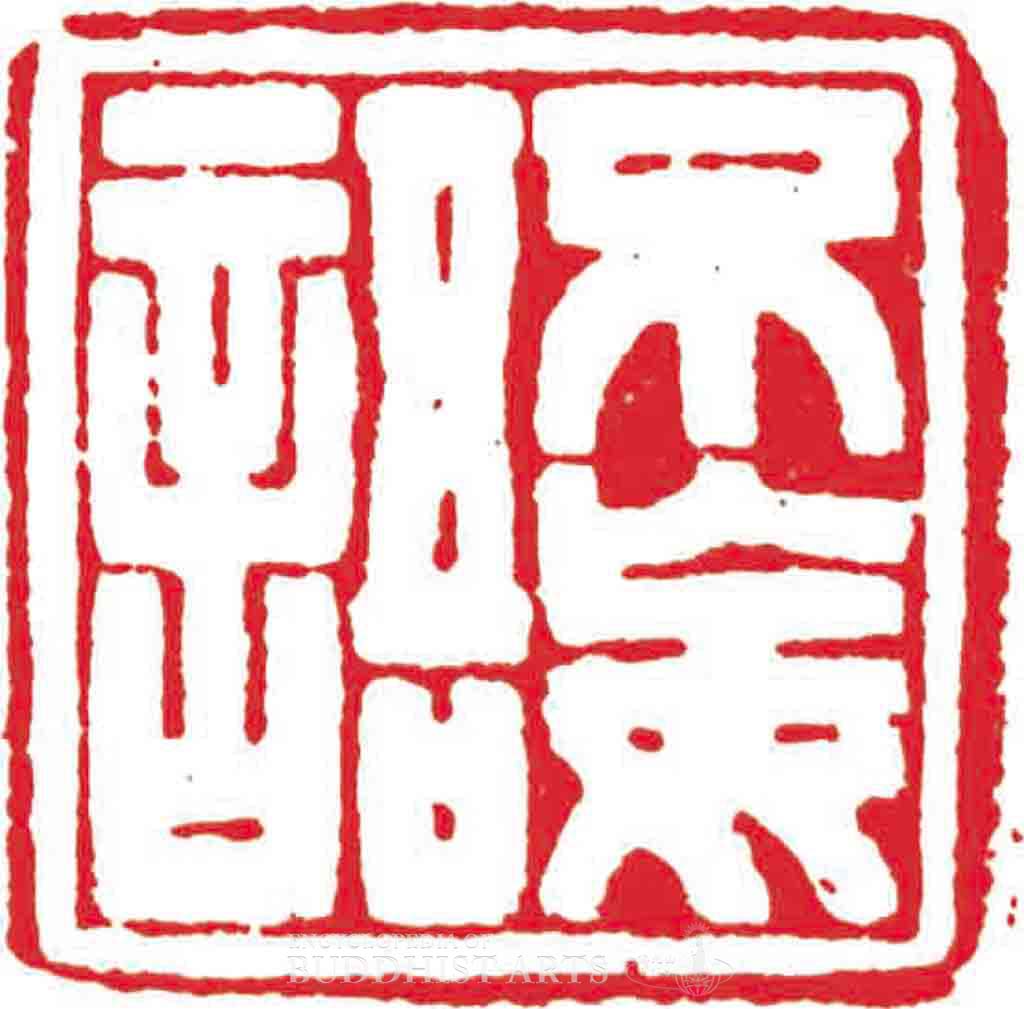
No Lying
White-character square seal
No Lying
CHINA
One of the Five Precepts is “no lying.” Simple in meaning, it refers to abstention from false speech or making any untrue statements. The three characters of this message are arranged into two columns, dividing the seal in half. Reading from right to left, the first two characters are stacked vertically on the right side, and the third character appears alone on the left. The layout is based on a traditional Qin seal style, and the seal script is regular and proportionate. As a whole, the cutting of the seal is firm and conventional, and the work has a simple and quaint appeal.
Song Qi, whose original name was Shouyao, was also known as Zhishan. Learning poetry, calligraphy, and seal engraving from his father, he was most accomplished in seal art. He was a civil official in Guangzhou during the late Qing dynasty (1644–1911), but retired during his middle age to concentrate wholly on his seal engraving work.
For more details, go to the Encyclopedia of Buddhist Arts: Calligraphy, page 313.
Cite this article:
author = Hsingyun and Youheng and Youlu and Pokorski, Stefanie and Mankuang and Edson, Gary,
booktitle = {Encyclopedia of Buddhist Arts: Calligraphy },
pages = 313,
title = {{No Lying}},
volume = 17,
year = {2016}}