
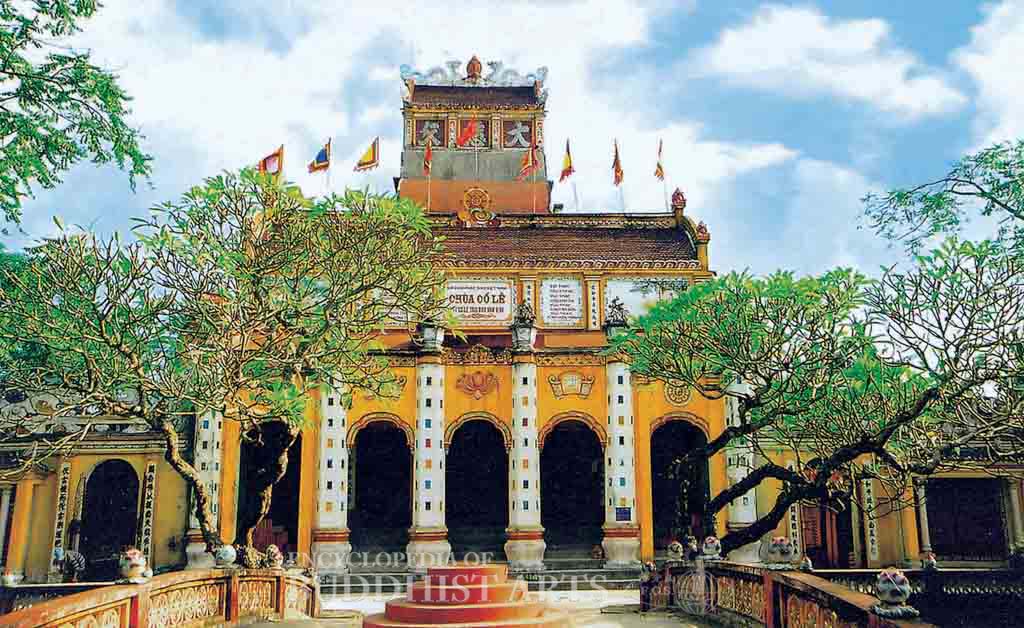
Co Le Temple
Co Le Temple
VIETNAM, Nam Dinh, Truc Ninh
The temple was founded by monk Minh Khong in 1061 during the Ly dynasty. It was damaged during wartime and was rebuilt in 1920 by the monk Pham Quang Tuyen. He expanded the area of the temple by building over the sites of three smaller temples. The temple was listed as a National Cultural Heritage Site in 1962.
The principal buildings include the main hall, bell tower, Nine-Staged Lotus Pagoda, and Buddhist House. The architectural style of these buildings is a blend of Vietnamese and European features. Built using bricks made of a mixture of limestone, sand, and paper pulp instead of steel and cement, these sturdy structures have a unique style.
Within the main hall there is a three-tier Buddha niche with a 4 m high statue of Sakyamuni Buddha cast in gold installed on the uppermost tier. At the back of the niche, there are images of the founder and National Master Minh Khong, as well as various other patriarchs.
The Nine-Staged Lotus Pagoda was built in 1926. It is a 12-story octagonal pagoda with a height of 32 m. At the base of the pagoda there is a large stone tortoise that faces the main hall. There are niches containing statues of Buddhas and Bodhisattvas on each side of the pagoda body. Inside there is a spiral staircase with 62 steps.
A bridge to the rear of the pagoda leads to the Buddhist House. Further back there is an open square with a 4.2 m high bronze bell cast in 1936 and weighing 9 t.
For more details, go to the Encyclopedia of Buddhist Arts: Architecture A-F, page 179.
Cite this article:
author = Hsingyun and Youheng and Johnson, Peter and Mankuang and Lancaster, Lewis,
booktitle = {Encyclopedia of Buddhist Arts: Architecture A-F},
pages = 179,
title = {{Co Le Temple}},
volume = 1,
year = {2016}}