
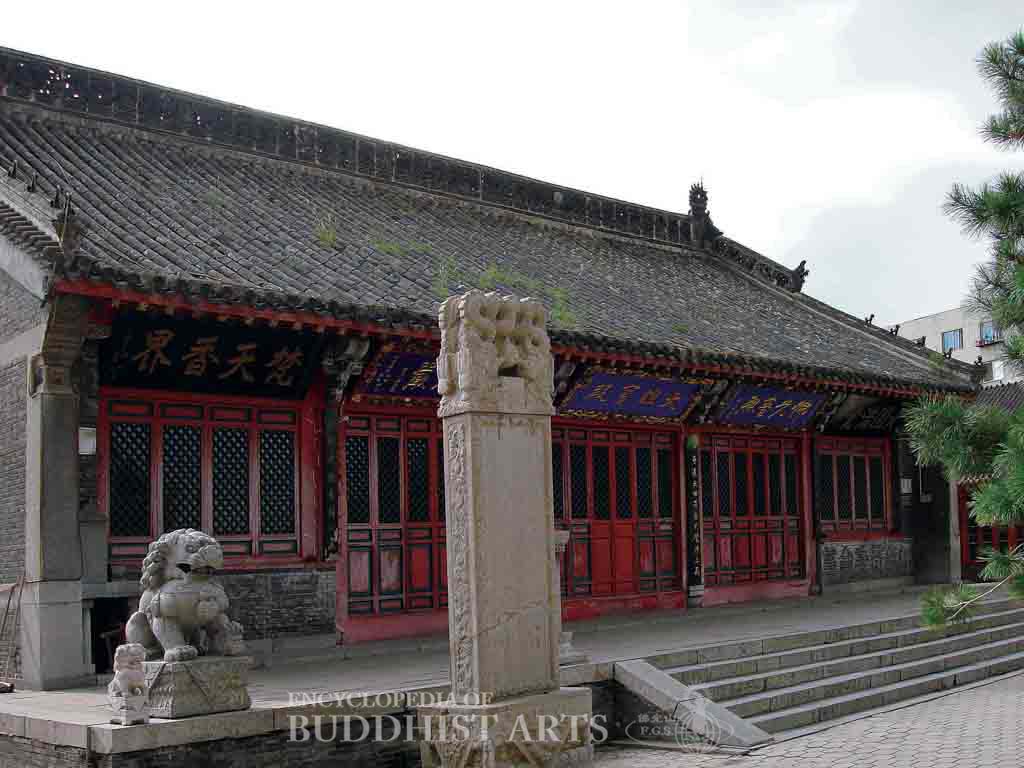
Ci’en Temple: Great Hero Hall
Ci’en Temple
CHINA, Liaoning, Shenyang
Ci’en means Kindness and Gratitude. It is the largest Buddhist temple in Shenyang and is one of the Four Major Temples in northeast China. It was built in 1628 during the Later Jin dynasty, and was renovated and expanded in 1644 and 1823 during the Qing dynasty, as well as in 1923. It was listed as a key Buddhist temple in the Han region of China in 1983.
The temple faces east and covers an area of 1.3 ha. The principal buildings include the main temple gate, Heavenly King Hall, Great Hero Hall, Bhiksu Platform, sutra repository, chanting hall, and the abbot’s quarters. The five-by-three bay Great Hero Hall has a hip roof. The Buddhas of the Past, Present, and Future are enshrined within the hall. The three-by-three bay Bhiksu Altar has a single-eave hip-and-gable roof. The building houses a wooden statue of Sakyamuni Buddha. The seven-bay wide sutra repository is two stories high: while the lower story level acts as the meditation hall, the upper floor is a treasure trove, storing 724 cases of the Ming Tripitaka and the Qing Tripitaka.
The temple houses the largest number of artifacts in Shenyang, including sutras, Buddha statues, and Dharma instruments, which are all in good condition. The Ci’en Buddhist College is located here, along with a research center dedicated to the study of the Buddhist canon.
For more details, go to the Encyclopedia of Buddhist Arts: Architecture A-F, page 172.
Cite this article:
author = Hsingyun and Youheng and Johnson, Peter and Mankuang and Lancaster, Lewis,
booktitle = {Encyclopedia of Buddhist Arts: Architecture A-F},
pages = 172,
title = {{Ci’en Temple}},
volume = 1,
year = {2016}}